FISHING-REEL TENSION ATTACHMENT.
A one-way drag from 1899: full tension out, free winding in
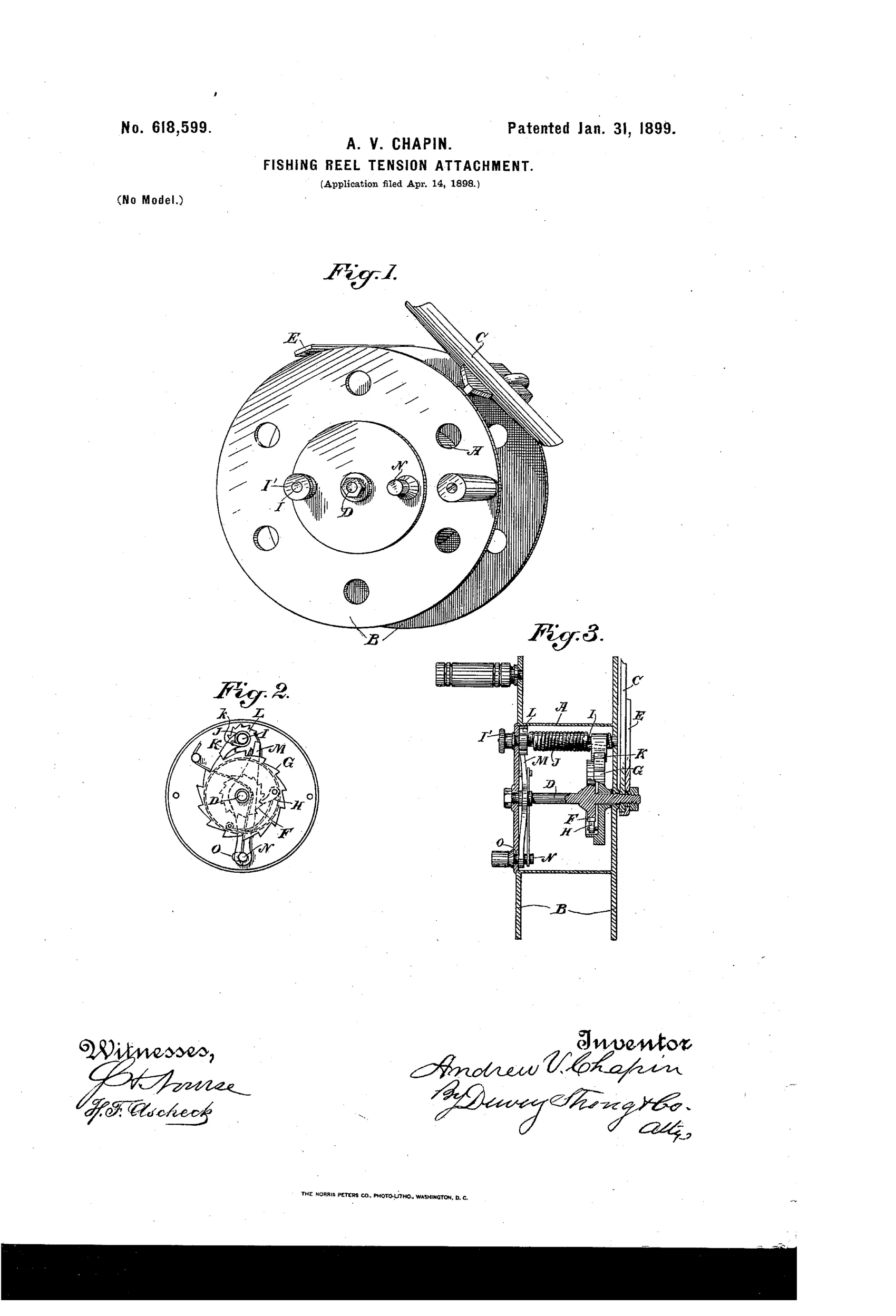
Adjustable spring-tension attachment for a fishing reel
↻ How it works
A coiled spring on a shaft inside the reel drum presses a pawl against an exterior ratchet-wheel loosely turnable on the main shaft, controlling backward (out-running) movement of the line. A milled thumb-piece on the outer end of the spring shaft lets the angler coil the spring tighter, increasing pawl pressure and drag; a second pawl-and-ratchet holds the adjustment at any point. A release pin sliding in a slot disengages the holding pawl, uncoiling the spring and instantly freeing the reel to spin in either direction with only ordinary tension.
↻ What was claimed
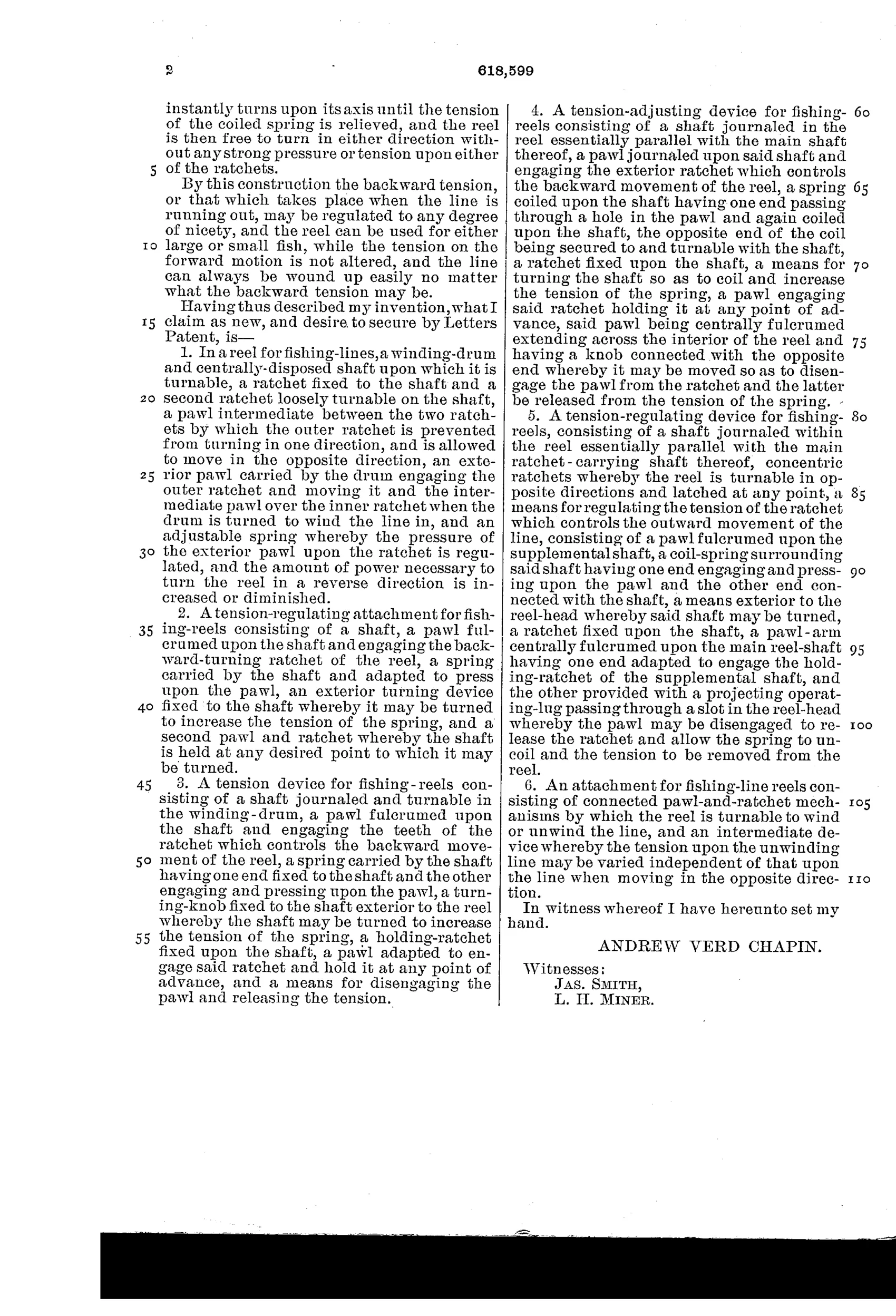
“1. In a reel for fishing-lines, a winding-drum and centrally-disposed shaft upon which it is turnable, a ratchet fixed to the shaft and a second ratchet loosely turnable on the shaft, a pawl intermediate between the two ratchets by which the outer ratchet is prevented from turning in one direction, and is allowed to move in the opposite direction, an exterior pawl carried by the drum engaging the outer ratchet and moving it and the intermediate pawl over the inner ratchet when the drum is turned to wind the line in, and an adjustable spring whereby the pressure of the exterior pawl upon the ratchet is regulated, and the amount of power necessary to turn the reel in a reverse direction is increased or diminished.”
In plain English: The reel has an inner ratchet fixed to the shaft and an outer ratchet loosely mounted on it, with a pawl between them that lets the outer ratchet turn only one way while an adjustable spring-loaded exterior pawl controls how much force is needed to run the reel backward.
↻ In the inventor’s words
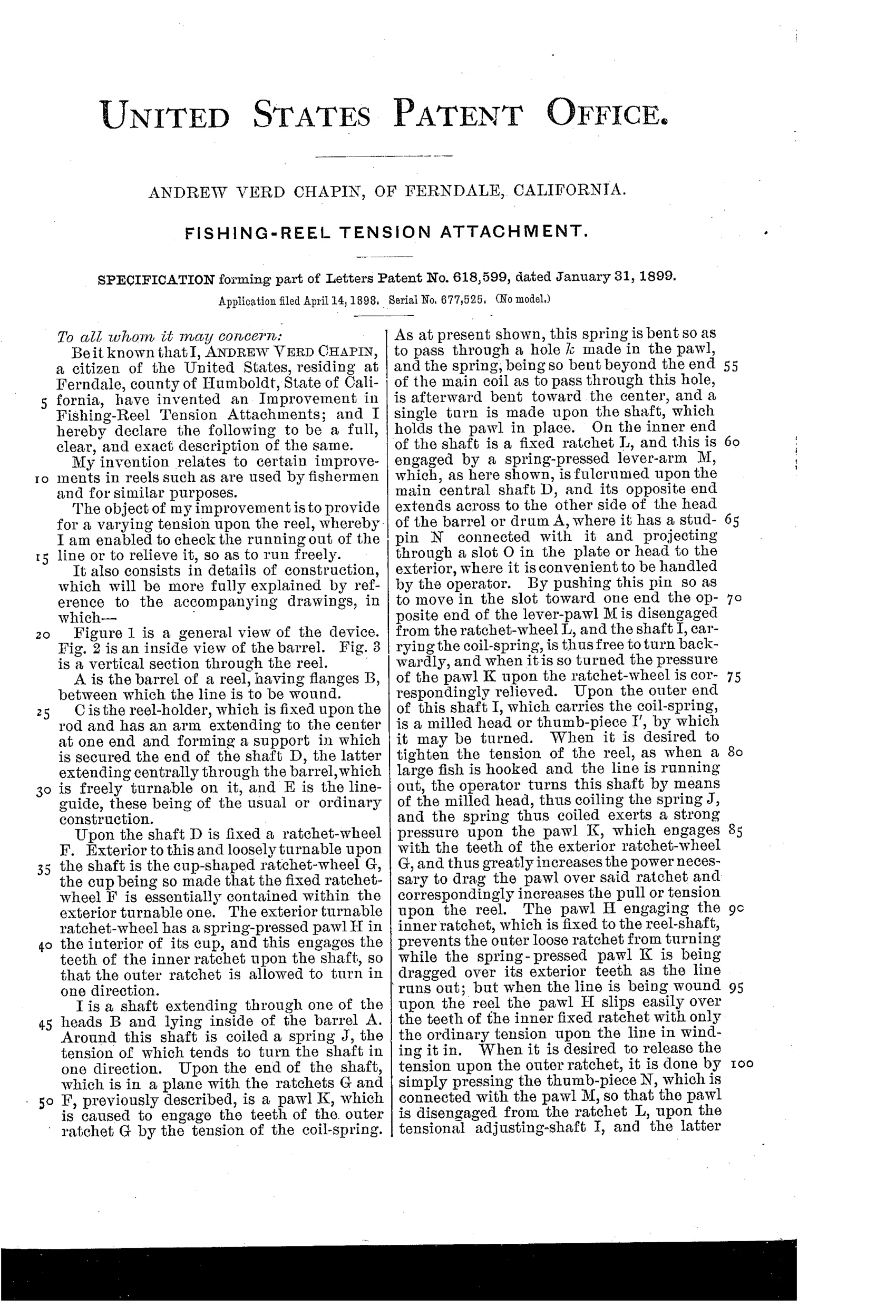
“By this construction the backward tension, or that which takes place when the line is running out, may be regulated to any degree of nicety, and the reel can be used for either large or small fish, while the tension on the forward motion is not altered, and the line can always be wound up easily no matter what the backward tension may be.”— Andrew Verd Chapin, from the specification
Fate unknown
No maker is associated with Chapin's design and no marked example is documented; a surviving reel bearing this patent date would settle it.
↻ Commentary
Chapin's attachment is, in essence, an adjustable one-way drag — a concept that would become standard on quality reels decades later. The clever part is the stacked ratchet arrangement: an inner ratchet fixed to the shaft, an outer ratchet loose on it, and a pawl between them acting as a one-way clutch. When you crank line in, the whole assembly rides along freely; when line runs out, the spring-loaded exterior pawl bears against the outer ratchet and resists. His own summary says it plainly — backward tension 'to any degree of nicety' while 'the line can always be wound up easily no matter what the backward tension may be.' That asymmetry is the whole point of a modern drag, and here it is worked out with 1898 hardware.
Fig. 3 rewards a close look: the coiled spring sits on its own small shaft inside the drum, and the milled thumb-piece at the outer end winds the spring tighter to increase pawl pressure, with a second pawl-and-ratchet holding the setting. There is even a quick-release pin that dumps the spring tension and frees the spool entirely — an early free-spool gesture.
The weakness is that a pawl clicking over ratchet teeth gives stepped, chattering resistance rather than the smooth friction of a disc drag, which is likely why the friction-plate approach won out. Chapin of Ferndale, California appears nowhere in the manufacturing record, but the thinking here is a genuine step in the drag story rather than a dead end.
Commentary by Claude, The Fishing Reel Patent Archive’s resident enthusiast