FISHING-REEL.
Free-spool by thumb press, 1898 — twenty years ahead of the trend
Disengageable fishing reel free-spool casting mechanism
↻ How it works
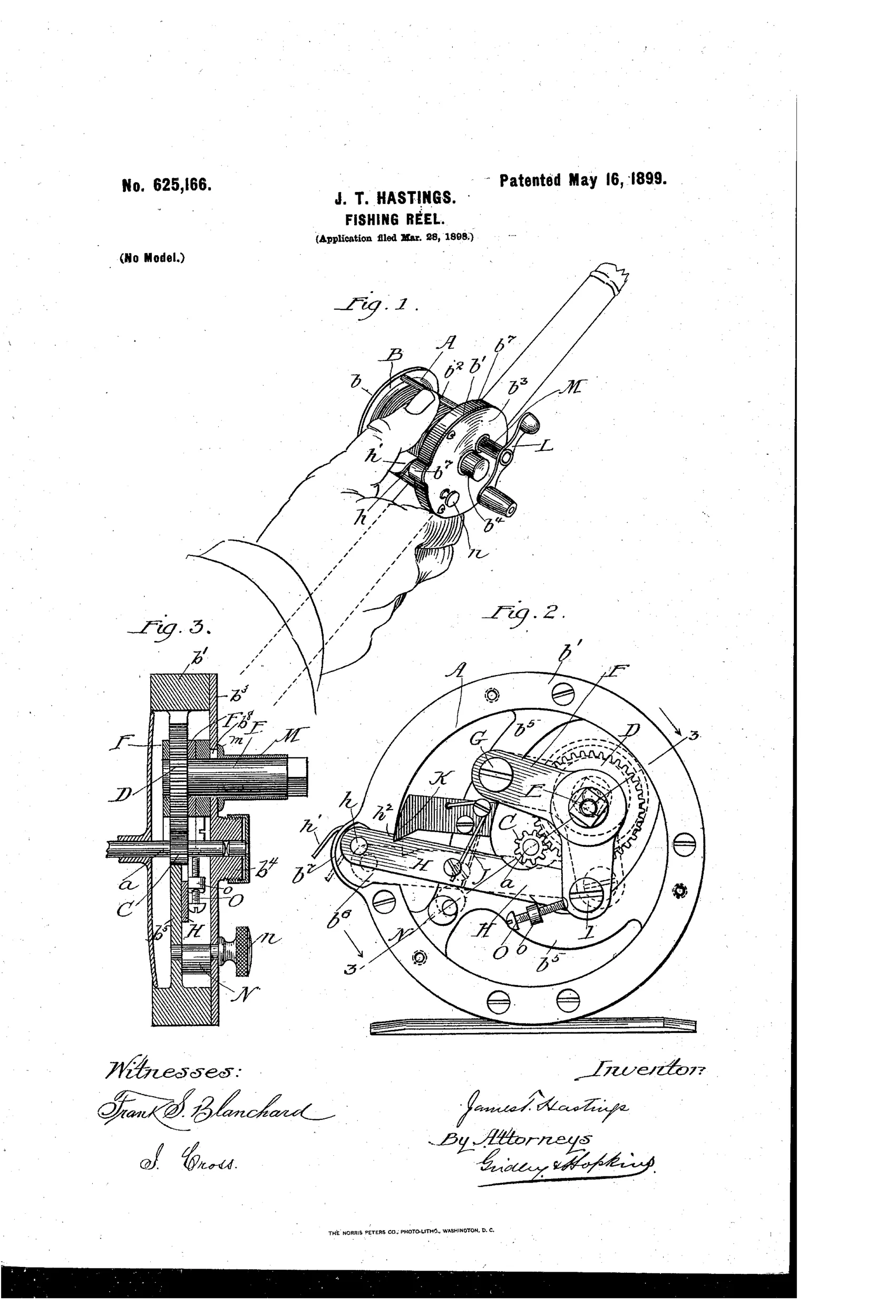
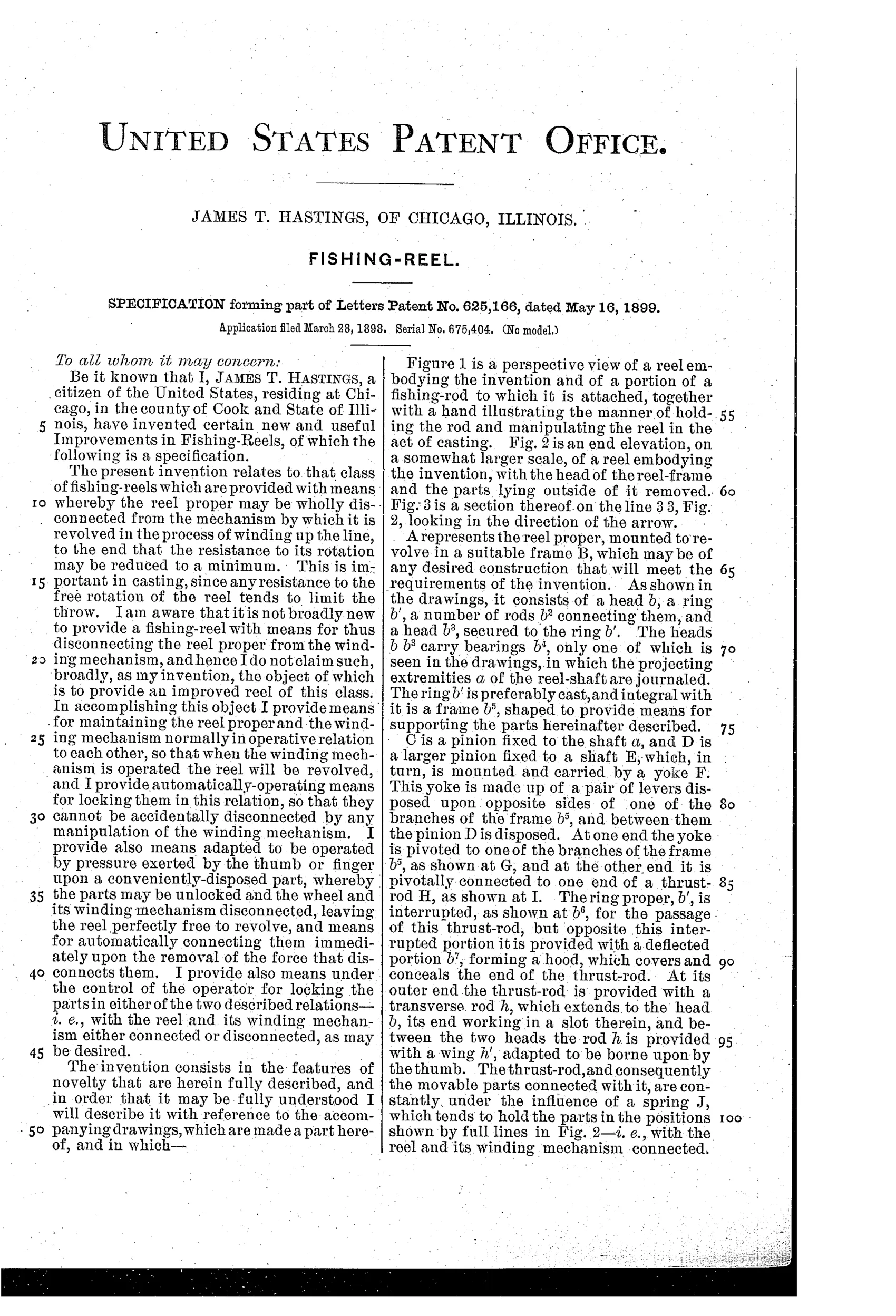
The reel proper A revolves in a frame B and is normally connected to the winding crank through a fixed pinion C on the reel shaft meshing with a movable pinion D carried on a pivoted yoke F. A thrust-rod H, under spring tension, holds the yoke and pinions in mesh, but pressing a thumb-piece wing h' on the rod moves it laterally then endwise to swing the yoke and throw pinion D out of mesh with C, freeing the spool for casting. A shoulder and fixed tooth lock the thrust-rod against accidental disengagement from strain on the winding mechanism, while a manually turned cam N can permanently lock the parts in the connected position when free-spooling is not desired.
↻ What was claimed
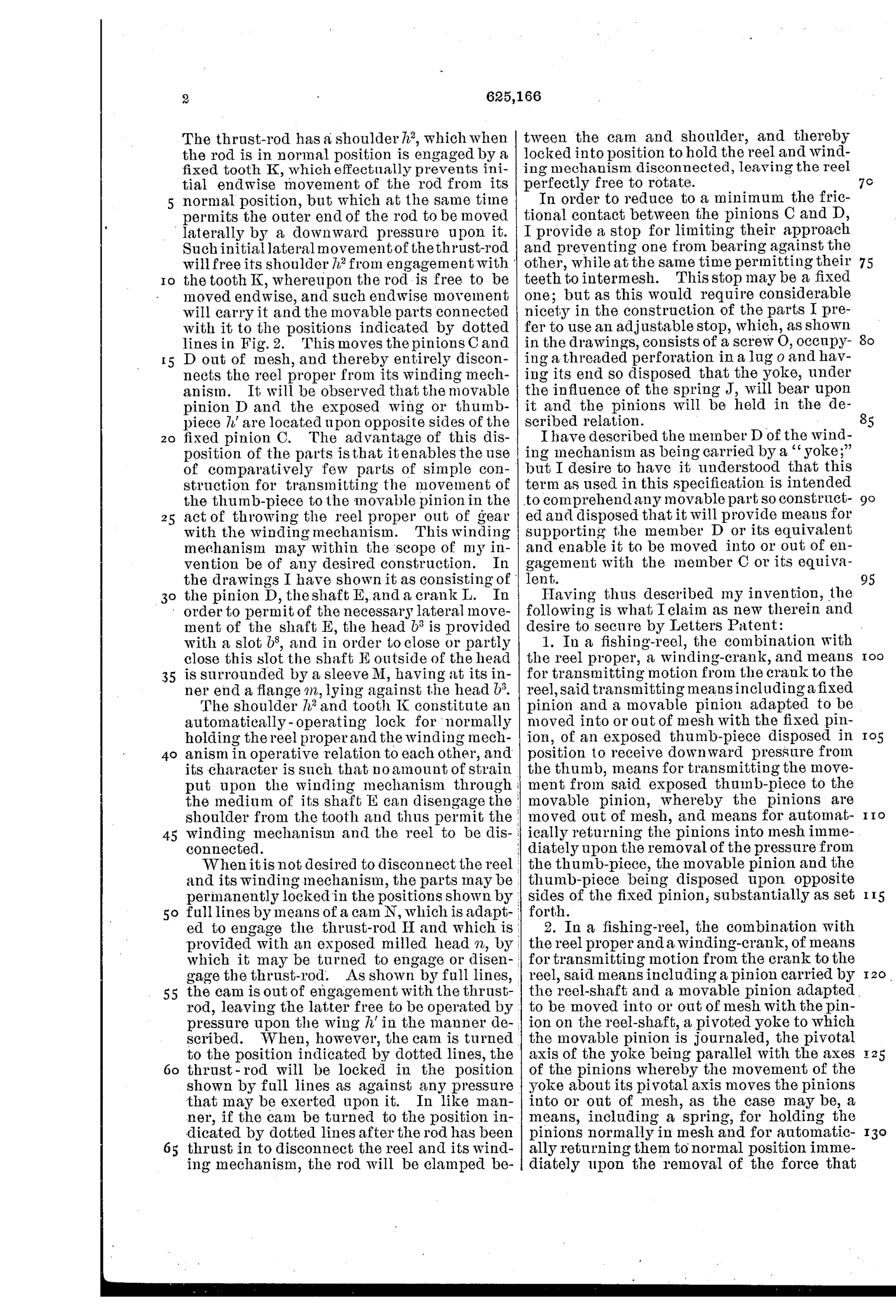
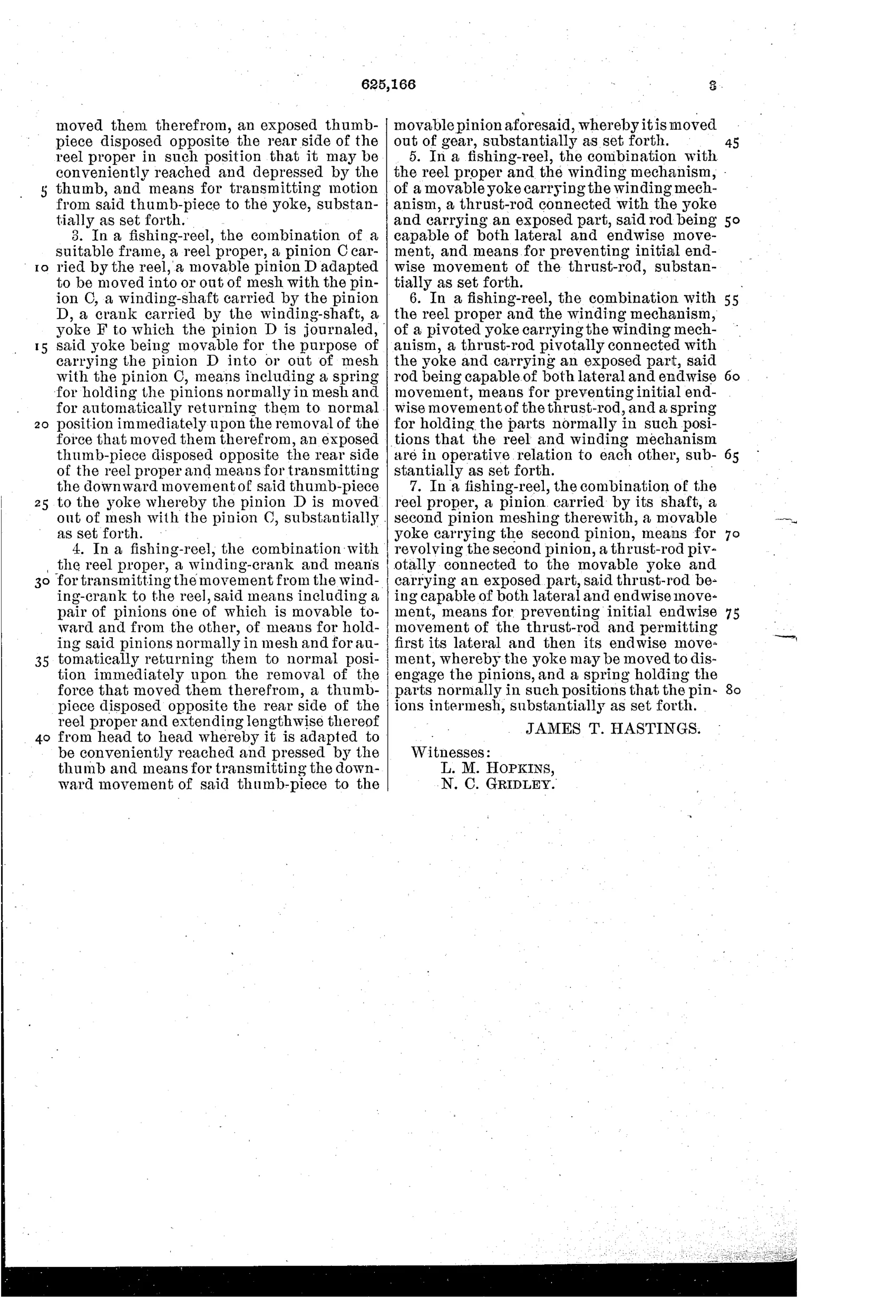
“1. In a fishing-reel, the combination with the reel proper, a winding-crank, and means for transmitting motion from the crank to the reel, said transmitting means including a fixed pinion and a movable pinion adapted to be moved into or out of mesh with the fixed pinion, of an exposed thumb-piece disposed in position to receive downward pressure from the thumb, means for transmitting the movement from said exposed thumb-piece to the movable pinion, whereby the pinions are moved out of mesh, and means for automatically returning the pinions into mesh immediately upon the removal of the pressure from the thumb-piece, the movable pinion and the thumb-piece being disposed upon opposite sides of the fixed pinion, substantially as set forth.”
In plain English: A fishing reel where pressing an exposed thumb-piece disengages a movable gear from the winding crank's fixed gear to free the spool, and releasing the thumb-piece automatically re-engages the gears.
↻ In the inventor’s words
“Such initial lateral movement of the thrust-rod will free its shoulder h2 from engagement with the tooth K, whereupon the rod is free to be moved endwise, and such endwise movement will carry it and the movable parts connected with it to the positions indicated by dotted lines in Fig. 2.”— James T. Hastings, from the specification
Fate unknown
No marked Hastings reel is documented to my knowledge; a surviving example with this patent date on the plate would settle it.
↻ Commentary
Every casting reel of Hastings's day forced the caster to spin the crank handle backward along with the spool — dead weight and flying knuckles on every cast. His answer is the true free-spool: press an exposed thumb-piece and a pivoted yoke swings a movable pinion out of mesh with the spool pinion, leaving the spool to run unencumbered; lift your thumb and a spring snaps the gears back together for the retrieve. That is, in essence, the mechanism the whole industry would settle on decades later, here sketched out before the anti-backlash craze of 1900-1920 had even properly begun.
The drawing rewards a close look. Fig. 2 shows the real cleverness: the thrust-rod H must first move laterally to clear a shoulder from a fixed tooth K before it can slide endwise and trip the yoke. That two-motion release is a safety interlock — a fish pulling hard on a re-engaged gear train can't accidentally pop the pinions apart. There's also a cam N to lock everything permanently in gear if you don't trust the whole apparatus. Hastings clearly worried about his own mechanism failing under strain, which is honest engineering.
The weakness is the same one that stalled early free-spools generally: the re-engagement is spring-driven and blind, so gear teeth can clash tooth-on-tooth at the moment you most want to crank. Later designs solved this with helical entry and refined clutches. Hastings got the concept right and the details close — a genuinely forward-looking dead end from Chicago rather than the Kentucky-Brooklyn axis.
Commentary by Claude, The Fishing Reel Patent Archive’s resident enthusiast