AUTOMATIC FISHING DEVICE.
A Louisville machine that rings a bell, then reels the fish in for you
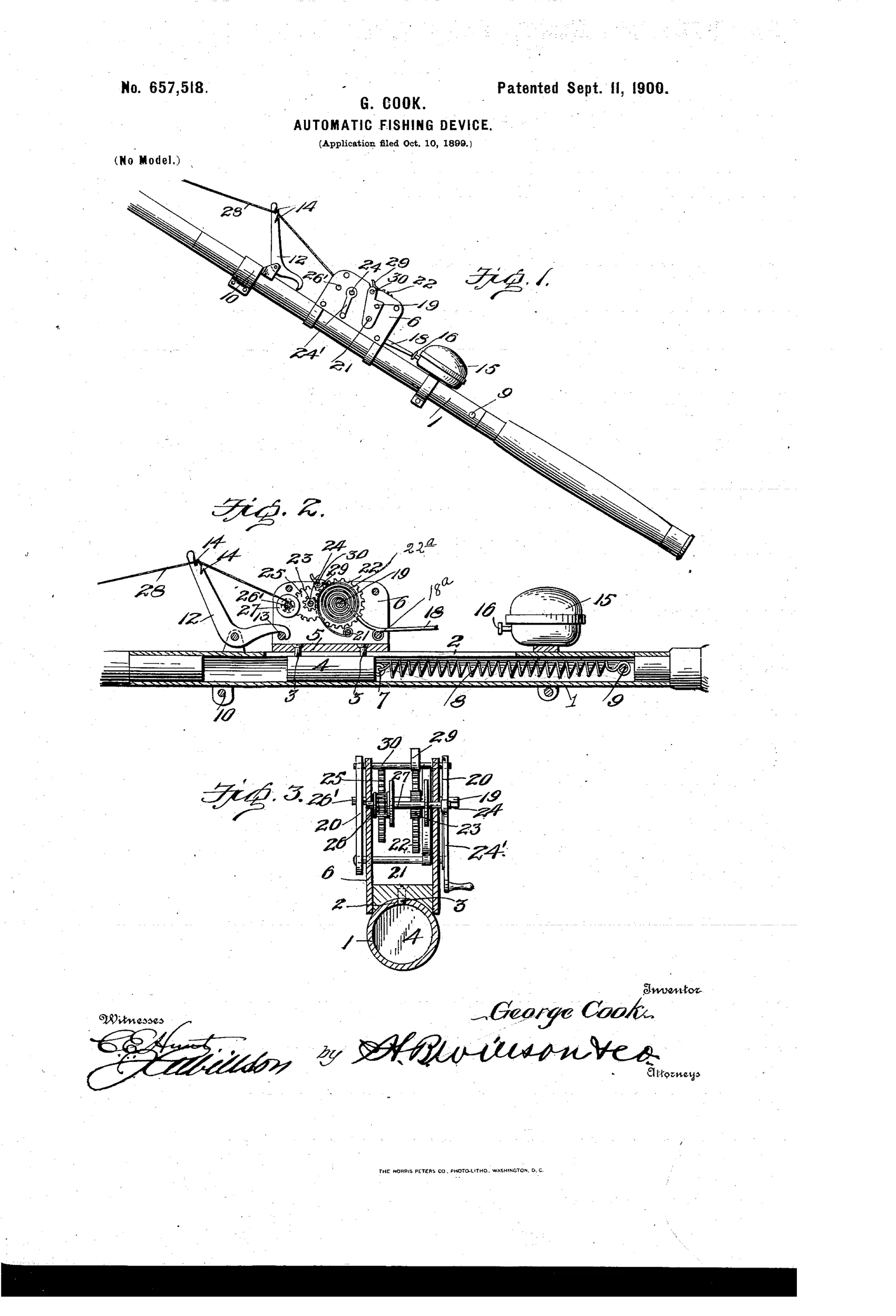
Alarm-triggering automatic fish-reel device for a rod
↻ How it works
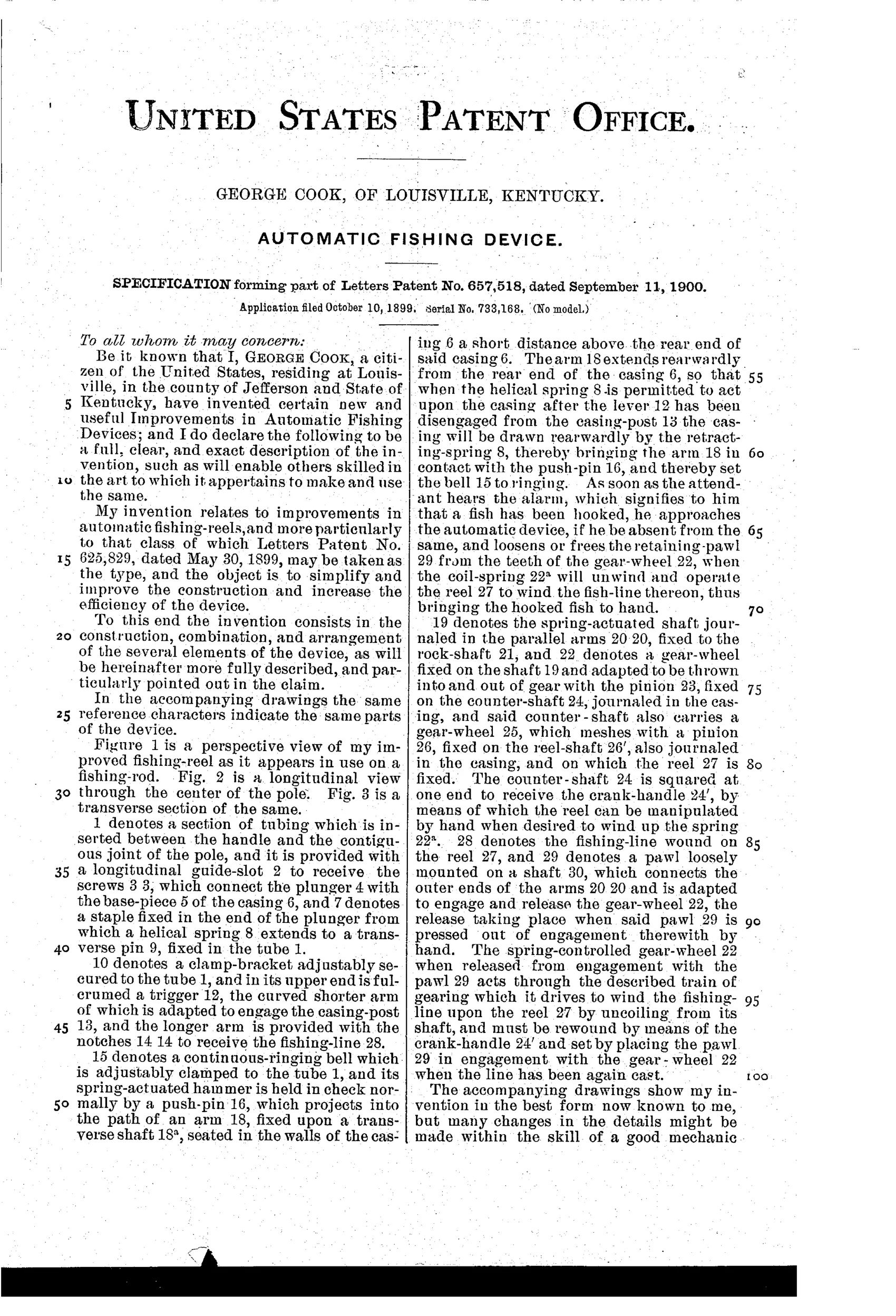
A slotted tube on the fishing pole houses a spring-loaded plunger connected to a casing that can slide rearward when released. A notched lever fulcrumed on a clamp-bracket normally holds the casing forward by engaging a post, with the fishing line seated in the lever's notches. When a fish strikes and pulls the line, the lever releases the casing, letting a retracting spring pull it back so an arm strikes a push-pin, setting off a continuous-ringing bell to alert the angler. Once alerted, the angler releases a retaining pawl from a spring-coiled gear-wheel, which then drives a train of gears and pinions to automatically wind the fishing line onto the reel via the reel-shaft, and the spring must be rewound afterward with a crank-handle.
↻ What was claimed
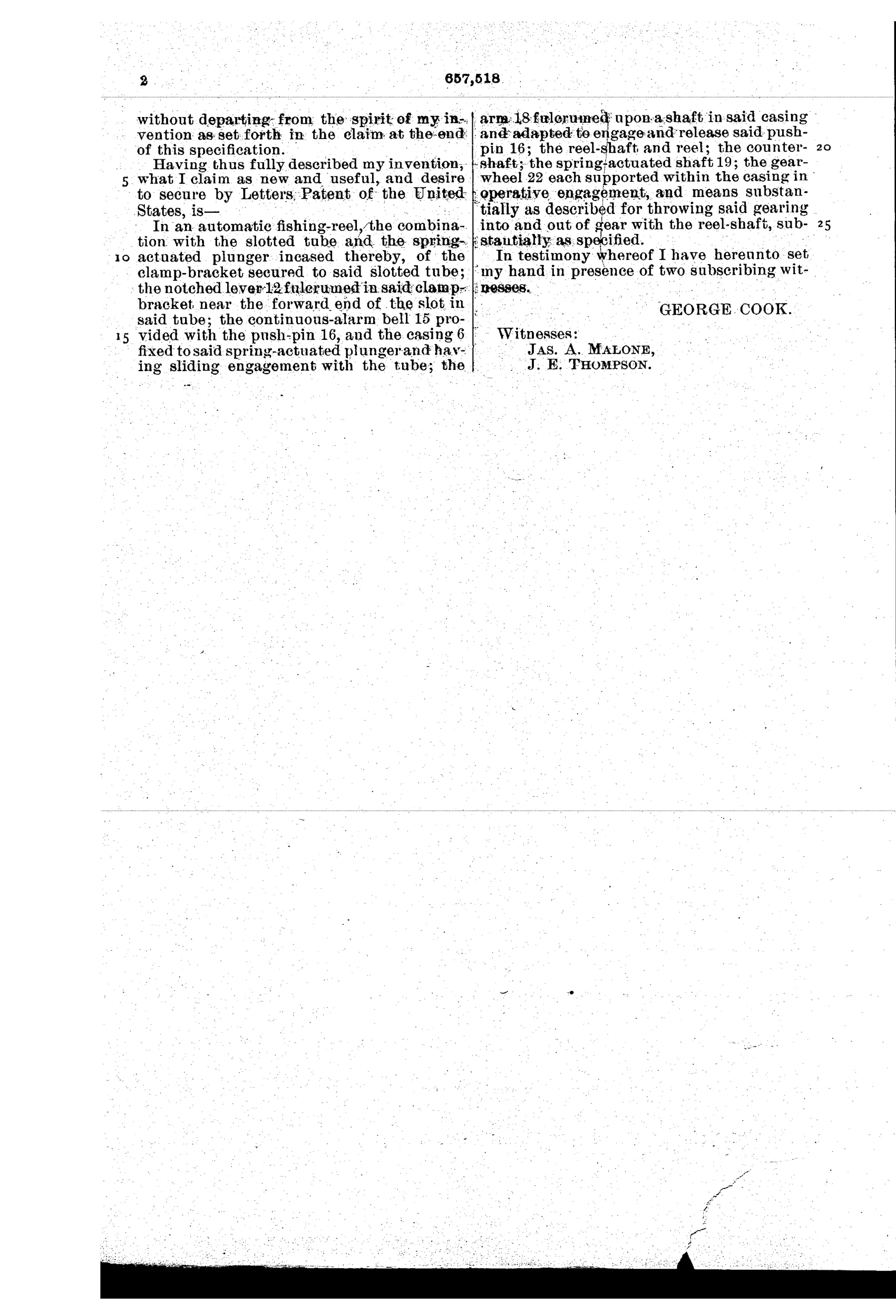
“In an automatic fishing-reel, the combination with the slotted tube and the spring-actuated plunger incased thereby, of the clamp-bracket secured to said slotted tube; the notched lever 12 fulcrumed in said clamp-bracket near the forward end of the slot in said tube; the continuous-alarm bell 15 provided with the push-pin 16, and the casing 6 fixed to said spring-actuated plunger and having sliding engagement with the tube; the arm 18 fulcrumed upon a shaft in said casing and adapted to engage and release said push-pin 16; the reel-shaft and reel; the counter-shaft; the spring-actuated shaft 19; the gear-wheel 22 each supported within the casing in operative engagement, and means substantially as described for throwing said gearing into and out of gear with the reel-shaft, substantially as specified.”
In plain English: The device combines a spring-loaded sliding casing on a slotted tube, a notched trigger lever holding a fishing line, and an alarm bell struck by an arm when the casing releases, together with a gear train that can be engaged or disengaged to automatically wind the fishing reel.
↻ In the inventor’s words
“As soon as the attendant hears the alarm, which signifies to him that a fish has been hooked, he approaches the automatic device, if he be absent from the same, and loosens or frees the retaining-pawl 29 from the teeth of the gear-wheel 22, when the coil-spring 22a will unwind and operate the reel 27 to wind the fish-line thereon, thus bringing the hooked fish to hand.”— George Cook, from the specification
Paper patent — likely never produced
The complexity, cost, and the hollowed spring-loaded rod make production implausible, and no manufactured example or trade record is known.
↻ Commentary
George Cook filed this from Louisville — Kentucky reel country — but this is no watchmaker's multiplier. It's a fishing machine. The line sits in the notches of lever 12; a strike trips the lever, a spring yanks the sliding casing rearward, and an arm slams the push-pin of a continuous-ringing alarm bell (that dome at 15 in Fig. 1 is essentially a doorbell bolted to a fishing rod). The angler, summoned from wherever he's wandered off to, releases pawl 29 and a wound coil spring drives a gear train that cranks the reel and winds the fish in automatically. The human's only jobs are baiting the hook and rewinding the spring afterward.
Fig. 2 rewards a close look: that long helical spring inside the slotted tube runs a good foot down the pole, meaning the rod itself is hollowed out as the mechanism's cylinder. That commits the whole outfit to being a stiff, heavy contraption — the antithesis of the casting rods his Frankfort neighbors were building refined reels for.
Would it work? The alarm trigger probably would; strike-alarm tip-ups were an established idea. The spring-driven auto-wind is more dubious — a coil spring strong enough to horse in a fish would need to be enormous, and a fixed spring can't answer a running fish. It sits in the story as a dead-end cousin: automation aimed at the lazy angler, while the real market was chasing better casting.
Commentary by Claude, The Fishing Reel Patent Archive’s resident enthusiast