FISHING-REEL
Pump the rod handle like a bicycle tire and the spool winds itself
Fishing rod with built-in reciprocating hand-crank reel mechanism
↻ How it works
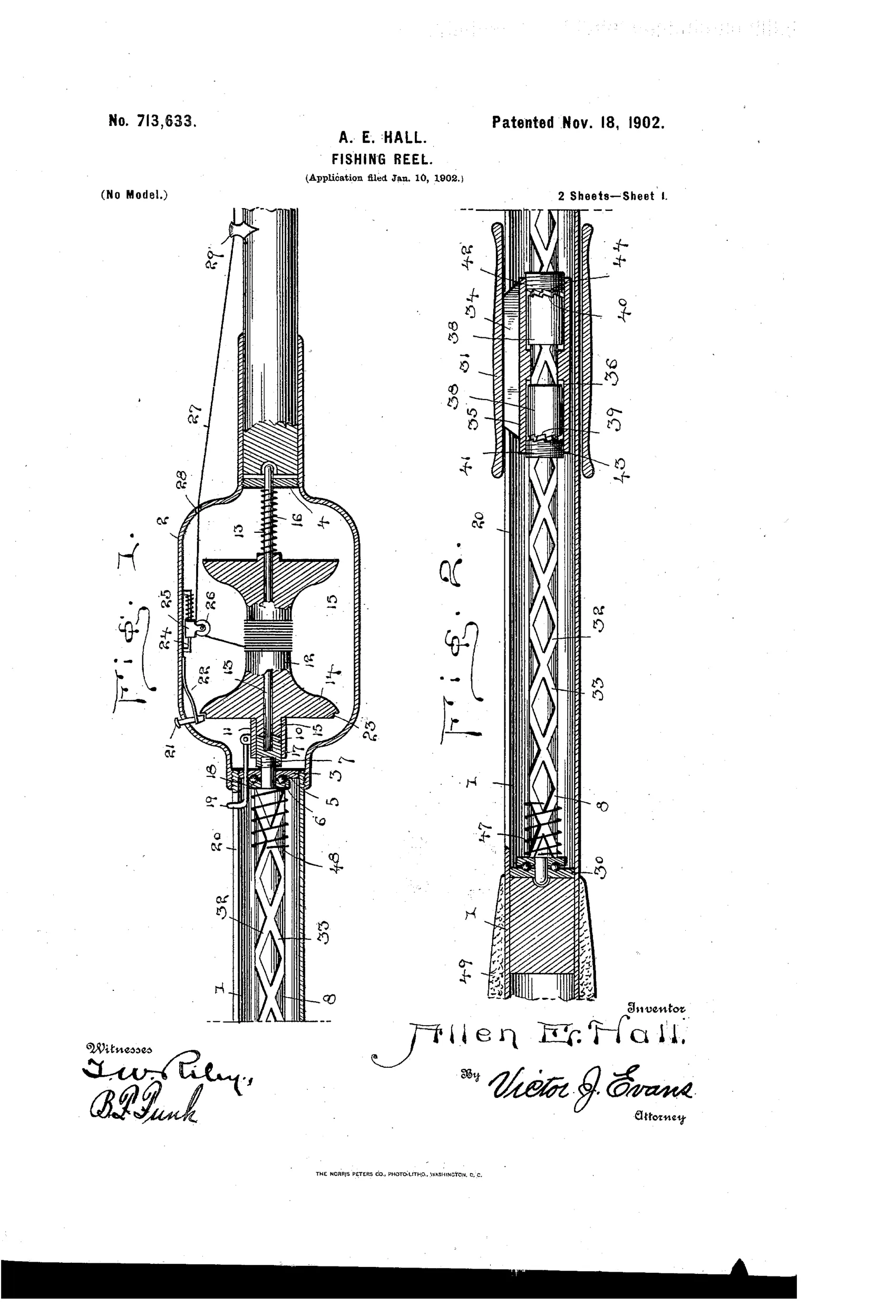
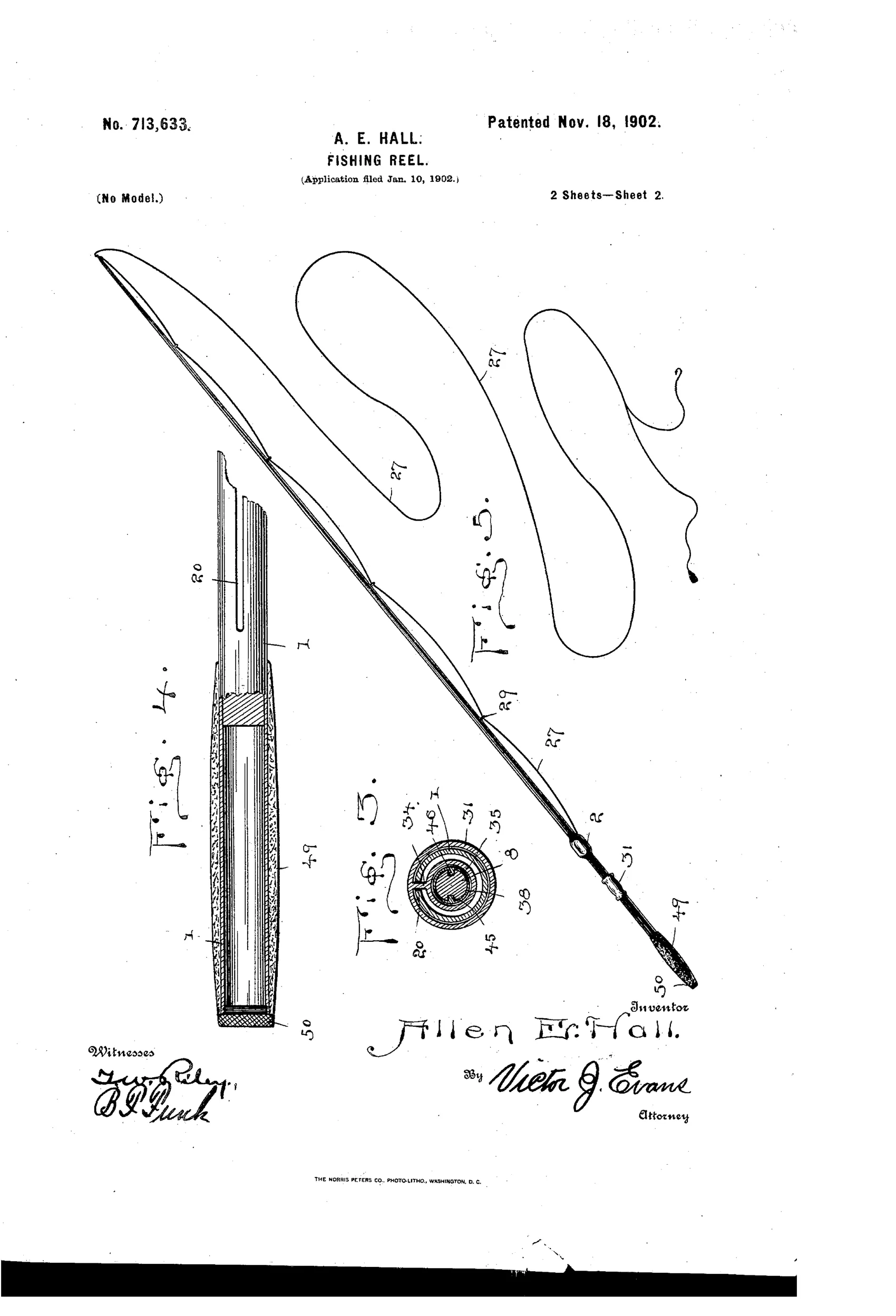
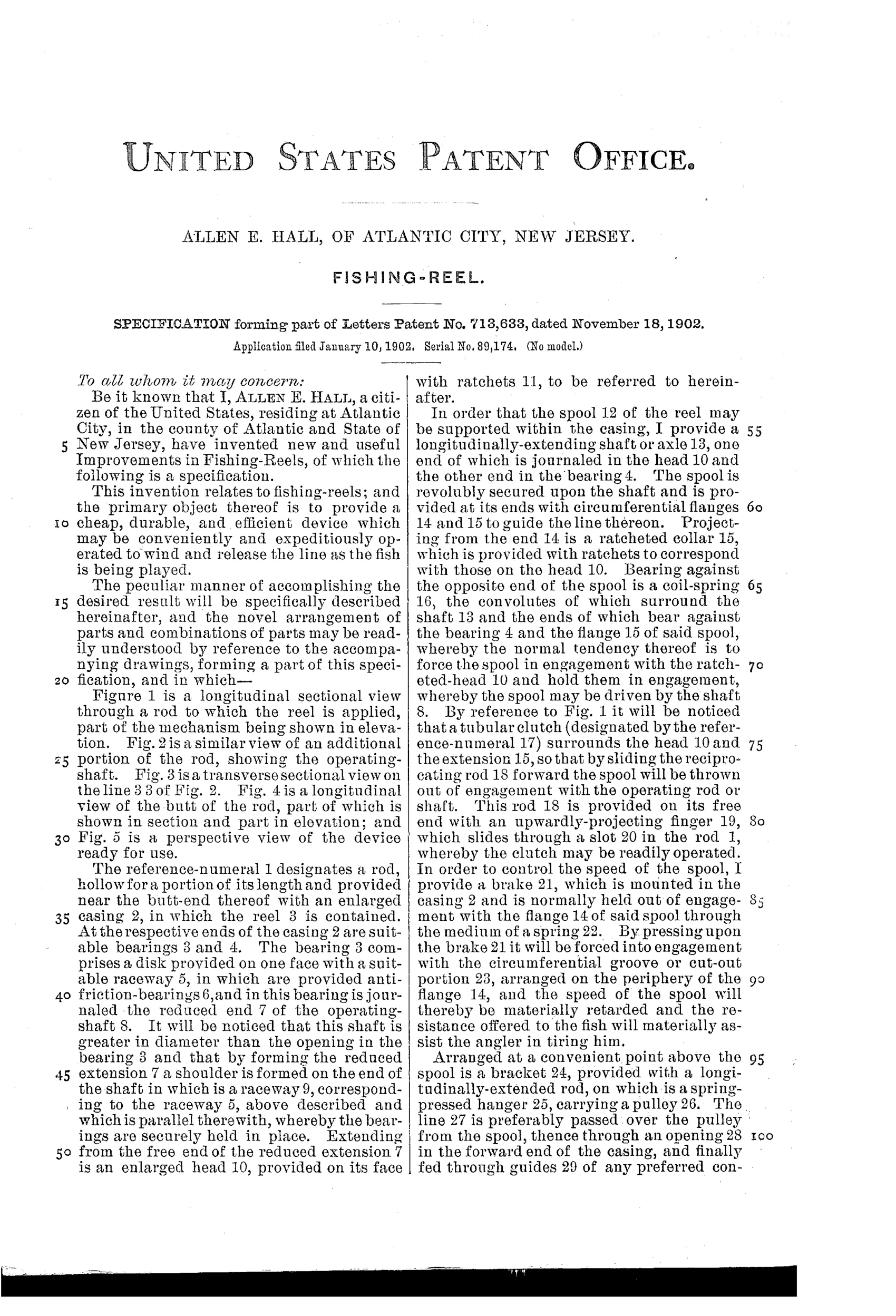
The rod itself houses a driving shaft that is rotated continuously in one direction by a sliding, reciprocating handpiece grasped and moved back and forth along the rod. Oppositely disposed spiral grooves on the shaft engage ratcheted sleeves so that back-and-forth sliding motion is converted into one-way rotation of the shaft, which drives the spool through a ratcheted collar and coil-spring clutch. A sliding clutch rod with a finger projecting through a slot allows the operator to disengage the spool from the shaft to freely release line, while a spring-loaded brake bears against a grooved flange on the spool to retard its speed and tire the fish. A spring-pressed pulley on a bracket above the spool guides the line forward through the rod to line guides, and buffer springs cushion the reciprocating sleeve at the ends of its stroke.
↻ What was claimed
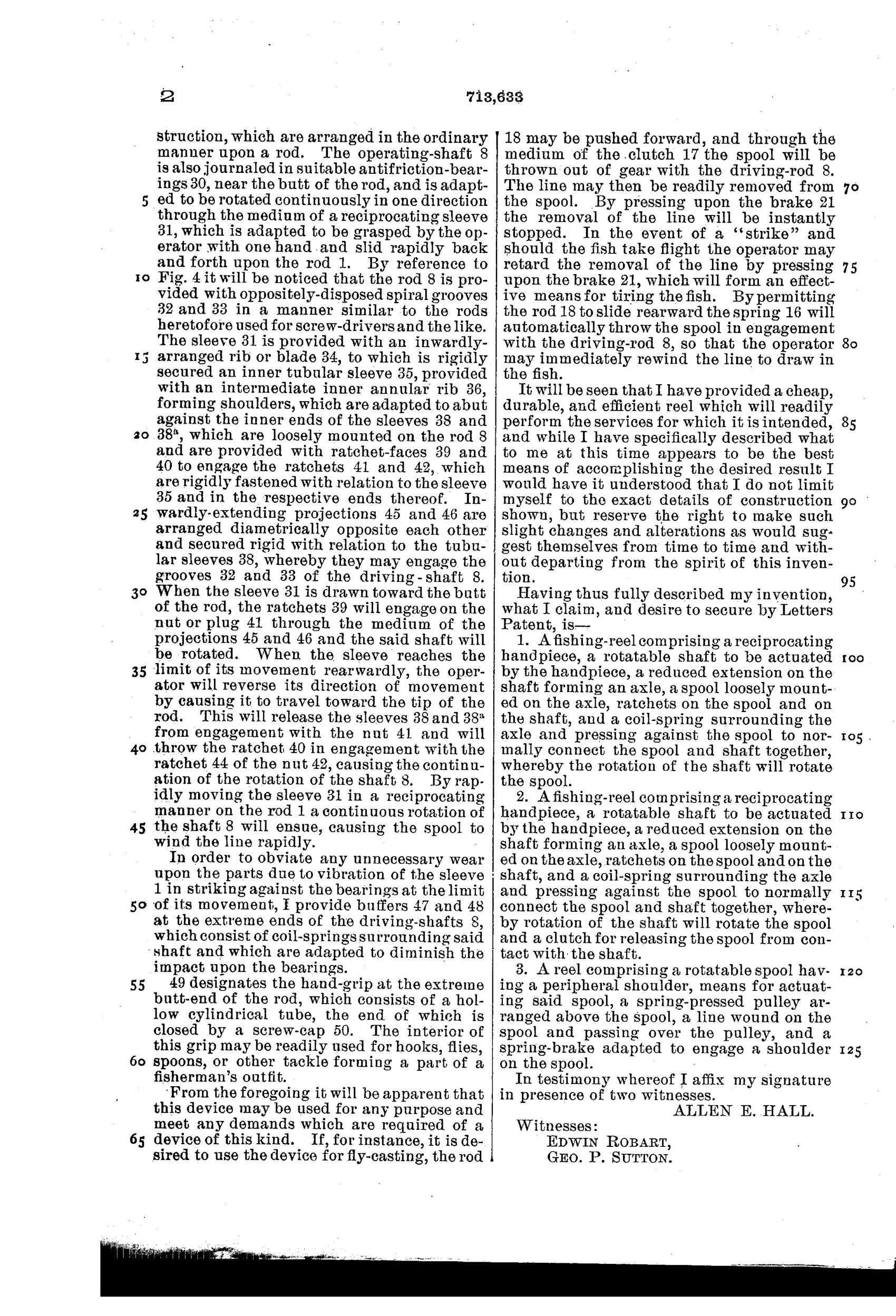
“A fishing-reel comprising a reciprocating handpiece, a rotatable shaft to be actuated by the handpiece, a reduced extension on the shaft forming an axle, a spool loosely mounted on the axle, ratchets on the spool and on the shaft, and a coil-spring surrounding the axle and pressing against the spool to normally connect the spool and shaft together, whereby the rotation of the shaft will rotate the spool.”
In plain English: A reel where sliding a handpiece back and forth rotates a shaft, which is spring-pressed against a ratcheted spool so that turning the shaft turns the spool.
↻ In the inventor’s words
“It will be seen that I have provided a cheap, durable, and efficient reel which will readily perform the services for which it is intended, and while I have specifically described what to me at this time appears to be the best means of accomplishing the desired result I would have it understood that I do not limit myself to the exact details of construction shown.”— Allen E. Hall, from the specification
Paper patent — likely never produced
No production example of this rod-reel combination is known, and the internal spiral-shaft drive would have been costly to build and fatal to rod action; a surviving specimen would be a genuine surprise.
↻ Commentary
Hall's idea is to abolish the crank entirely. The angler grasps a sleeve on the rod and slides it back and forth; inside, oppositely-cut spiral grooves on a shaft, engaging ratcheted collars, turn that reciprocation into one-way rotation, and the rotation is passed to the spool through a coil-spring clutch. It is essentially the mechanism of a push-drill screwdriver — the Yankee drill patented a few years earlier — transplanted into a fishing rod. As a piece of motion-conversion engineering it is entirely sound, and Fig. 2 shows the diamond pattern of those crossed spiral grooves running most of the rod's length.
What a casual reader will miss is how much Hall packed in around the drive: a finger-operated clutch rod to free the spool for the cast, a spring brake riding a grooved flange to act as a drag, buffer springs to cushion the sleeve at each end of its stroke, and a spring-pressed pulley to feed line forward through the hollow rod. That last detail is the killer — the line runs inside the rod, so a tangle means disassembly, and the whole rod becomes a sealed machine that flexes exactly where a machine shouldn't.
Reel-in-rod schemes surface repeatedly in this era, and they all founder on the same rocks: weight at the wrong place, a rod that can't bend, and a mechanism the angler can't reach. Hall's is one of the more mechanically literate attempts, which makes it an honorable dead end rather than a foolish one.
Commentary by Claude, The Fishing Reel Patent Archive’s resident enthusiast