FISHING-REEL.
Two years before Illingworth, an Illinois man let line spill off a fixed spool
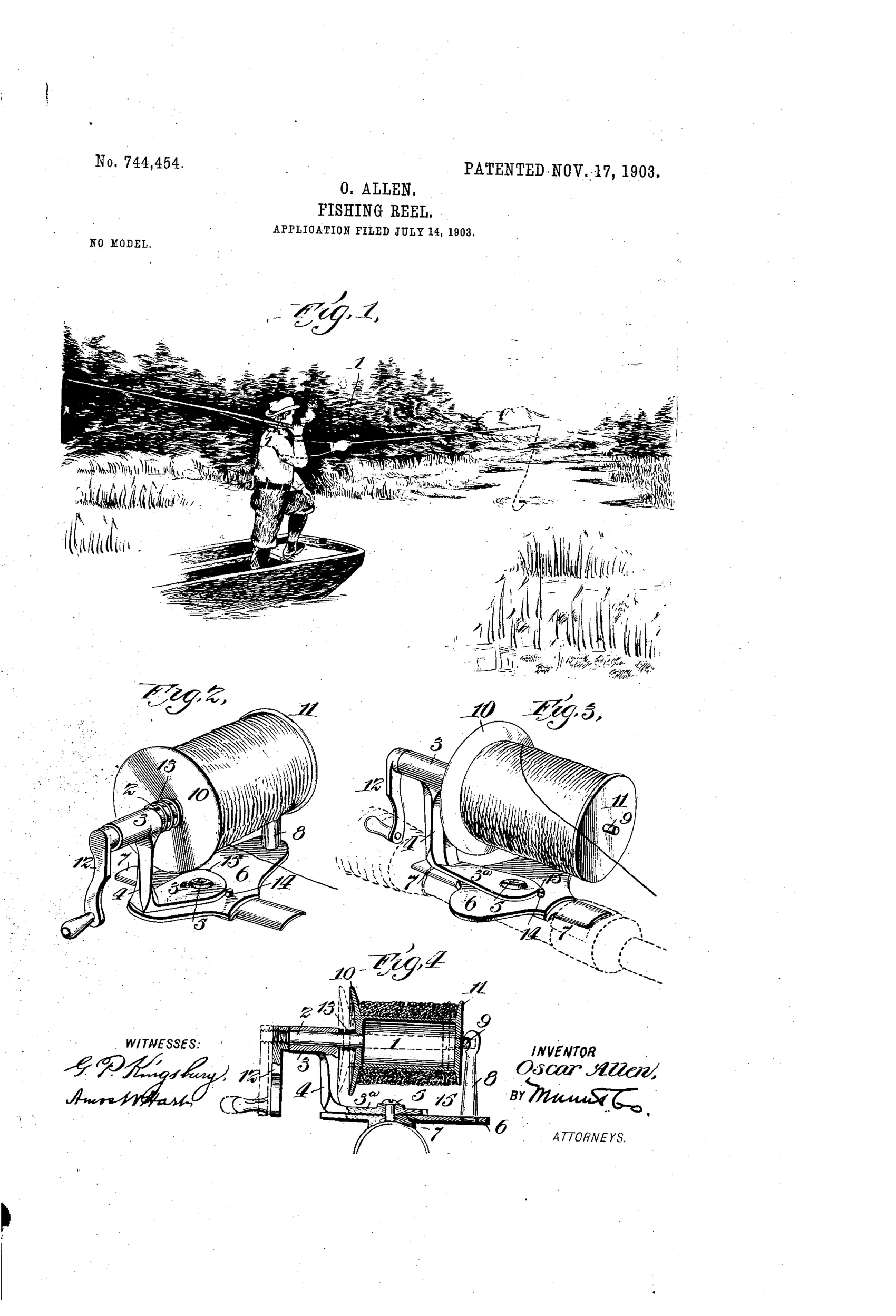
A pivoting fishing reel that swings parallel to rod for casting.
↻ How it works
The spool is mounted on a pivoted, elbow-shaped post so it can be turned a quarter circle to lie parallel with the rod for casting, allowing line to pay off the end of the spool without the spool itself rotating. A coil spring between the spool head and an elongated bearing allows the spool shaft to be retracted, disengaging its outer pivot from a fixed post so the whole reel can swing into parallelism with the rod. A stud stop engages a shoulder on the pivoted post to arrest the swing at the correct casting position. After casting, the angler shifts the reel back to its normal right-angle position and winds in line with a crank in the usual manner.
↻ What was claimed
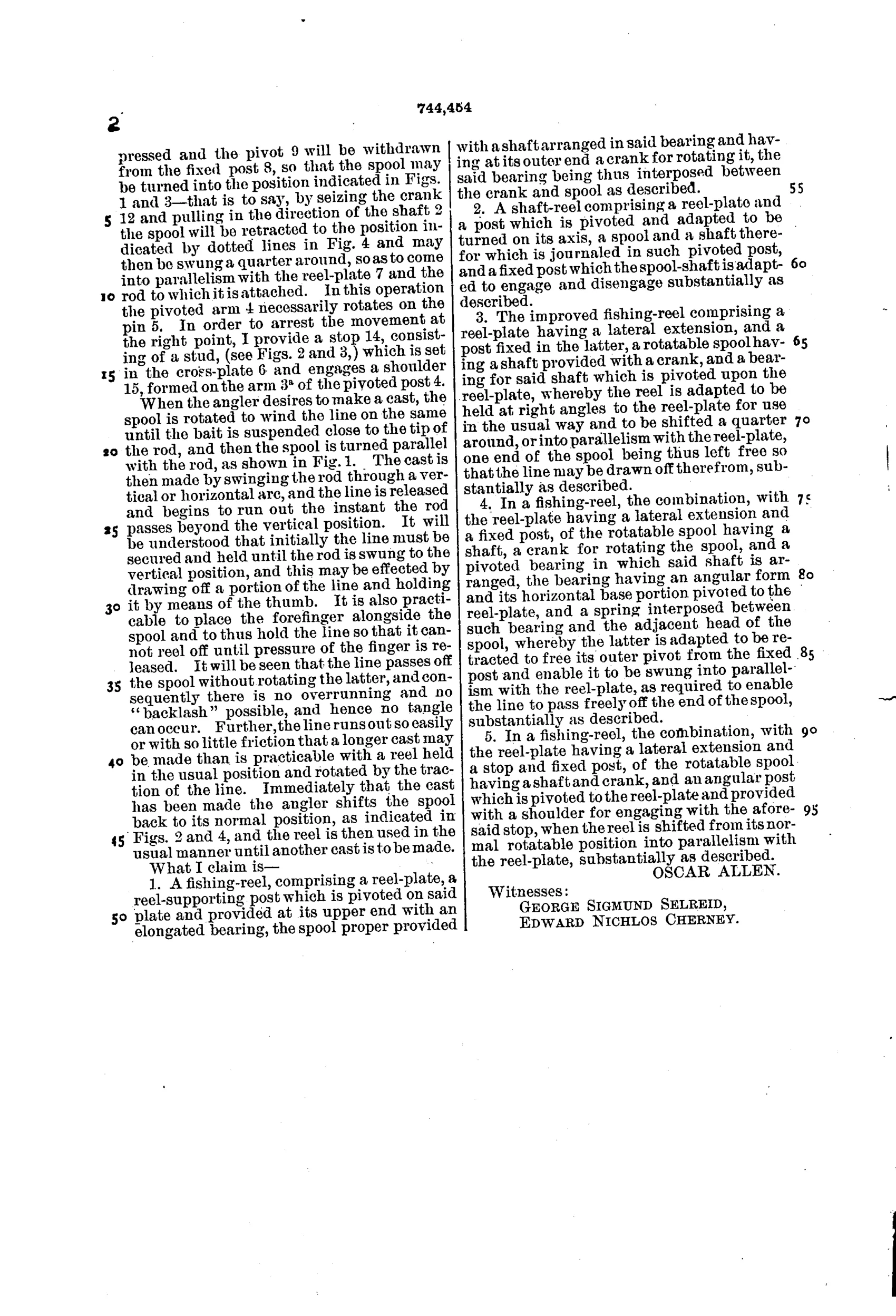
“A fishing-reel, comprising a reel-plate, a reel-supporting post which is pivoted on said plate and provided at its upper end with an elongated bearing, the spool proper provided with a shaft arranged in said bearing and having at its outer end a crank for rotating it, the said bearing being thus interposed between the crank and spool as described.”
In plain English: The reel has a plate with a pivoting post holding an elongated bearing that carries the spool's shaft, and a crank on the outer end of that shaft turns the spool, with the bearing positioned between the crank and the spool.
↻ In the inventor’s words
“It is the object of my invention to avoid these results and to enable the line to be delivered from the spool without any danger of overrunning and without the necessity of applying the brake.”— Oscar Allen, from the specification
Fate unknown
No production example or maker association is documented; a marked specimen or trade advertisement would settle it.
↻ Commentary
Oscar Allen's answer to backlash was not another brake or governor — it was to stop the spool from turning at all. Retract the shaft against a coil spring, swing the whole spool a quarter-turn on its elbow post until it points down the rod, and let the line pay off the stationary spool's end in loose coils. That is the fixed-spool principle, the heart of every modern spinning reel, sketched by a man in Lincoln, Illinois in 1903 — two years before Alfred Holden Illingworth patented his famous threadline reel in England.
Allen didn't carry the idea to its conclusion. There's no line-pickup mechanism and no bail; after the cast, the angler manually swings the reel back to right angles and cranks in the conventional way, which means the reel spends its working life awkwardly straddling two orientations. Fig. 4 shows the honest engineering: the spring-loaded shaft in its elongated bearing, the stud stop that arrests the swing at the correct casting angle. It's all mechanically sound, just fussy — every cast requires a retract-swing-cast-swing-back ritual.
Still, in the crowd of 1900-1920 anti-backlash patents, most inventors were fighting spool inertia with clever friction. Allen sidestepped the problem entirely, which is the deeper insight. A dead end as built, but pointed at the future in a way its neighbors weren't.
Commentary by Claude, The Fishing Reel Patent Archive’s resident enthusiast