Fishing-Line Reel
A V-groove spool and thumb-brake rims, thirty years before the anti-backlash craze
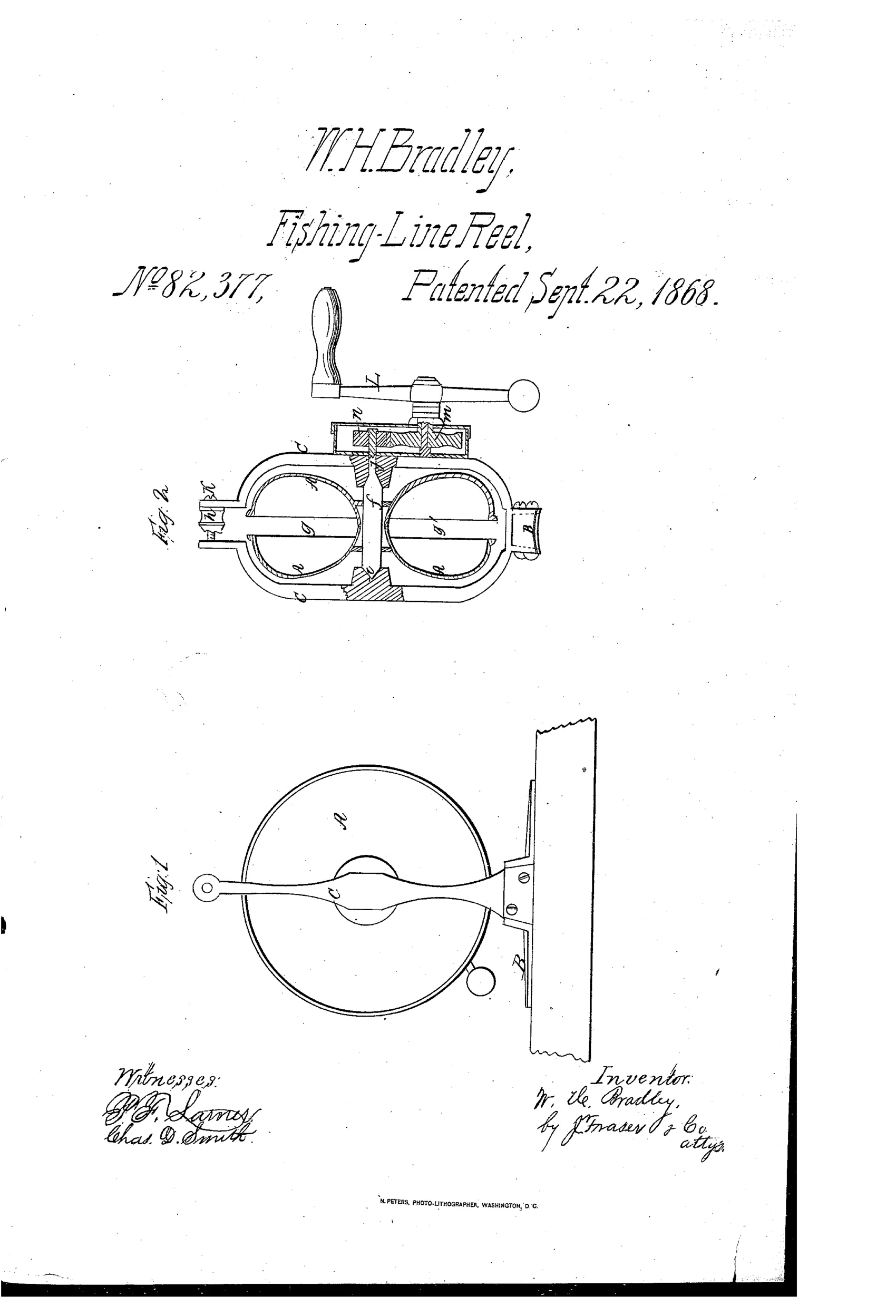
Anglers' fishing reel with grooved twin-disk spool
↻ How it works
The reel consists of two concave disks mounted on a shaft with a narrow annular gap between them near the axis that widens toward the rim, so line coils and builds up rapidly at the periphery for longer casts. A crank turns a driving-wheel that gears with a pinion on the reel-shaft to wind the line. Conical journals on the shaft ride in adjustable bearings on a two-standard frame fixed to a foot-plate, allowing endwise play to be regulated by filing or replacing a connecting piece. The smooth continuous outer disk surfaces let the angler press a thumb or finger against the periphery as a friction brake to stop the reel quickly after the sinker strikes water.
↻ What was claimed
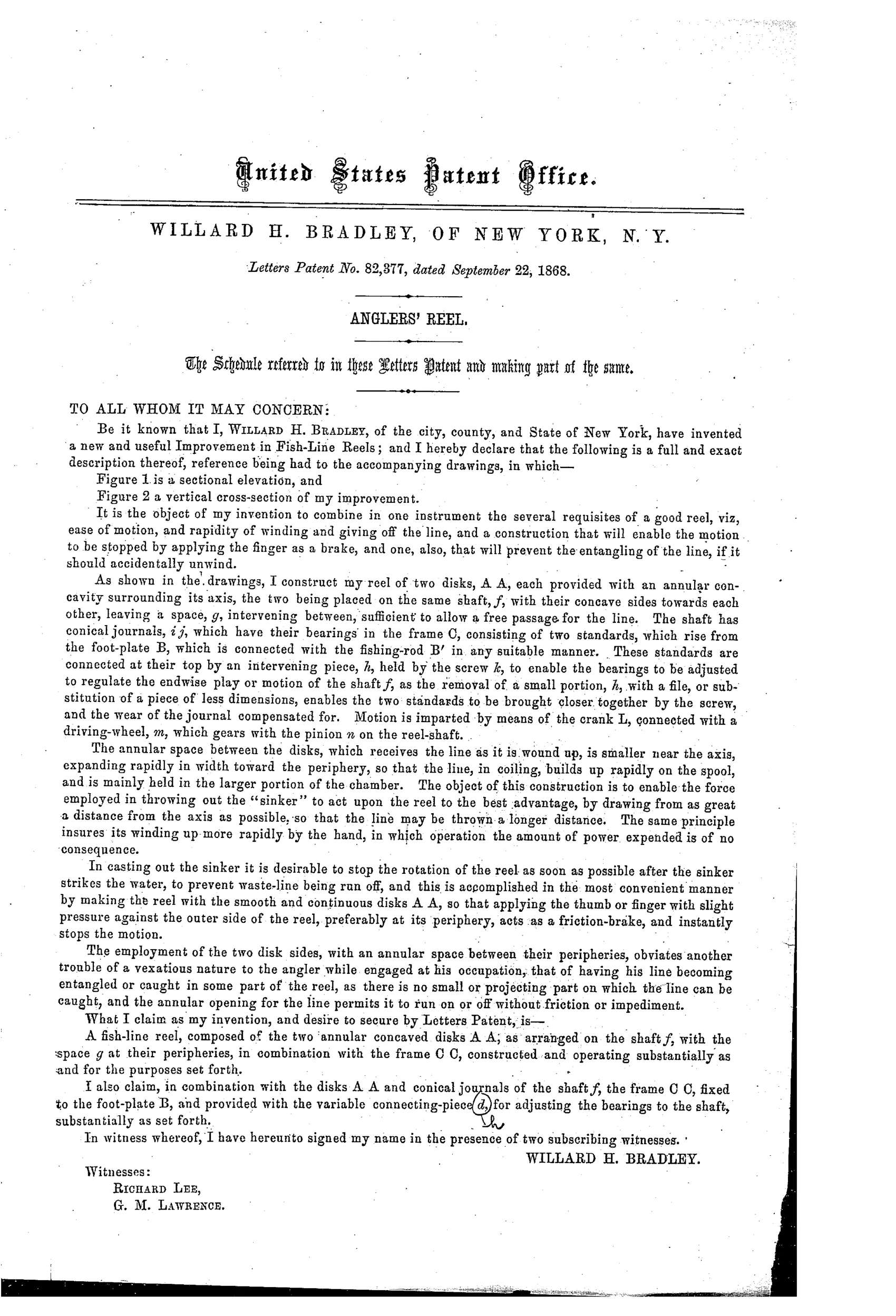
“A fish-line reel, composed of the two annular concaved disks A A, as arranged on the shaft f, with the space g at their peripheries, in combination with the frame C C, constructed and operating substantially as and for the purposes set forth.”
In plain English: The invention claims a fishing reel made of two curved disks on a shaft with a gap between their rims, held in a frame, built and working as described.
↻ In the inventor’s words
“It is the object of my invention to combine in one instrument the several requisites of a good reel, viz, ease of motion, and rapidity of winding and giving off the line, and a construction that will enable the motion to be stopped by applying the finger as a brake, and one, also, that will prevent the entangling of the line, if it should accidentally unwind.”— Willard H. Bradley, from the specification
Fate unknown
No marked Bradley reel of this pattern is documented in the collecting literature; a surviving stamped example would settle it.
↻ Commentary
Bradley's core idea is the spool itself: two concave disks set close together at the hub, flaring apart toward the rim. Line spirals into that wedge-shaped groove and stacks up fast near the periphery, where the effective diameter is largest — so each turn of the crank pays out or takes in the most line possible. It's the same logic that later put large-arbor spools on fly reels, arrived at from first principles in 1868.
The second idea hides in the smooth outer faces of those disks. Because the whole rim is exposed and continuous, the angler can press a thumb against it to stop the spool the instant the sinker hits water. Bradley says this outright in the specification — he's describing thumbing an overrun, the very problem that would consume reel patentees from 1900 to 1920. He offers no mechanism for it, just a surface shaped to make the angler's finger the mechanism, which is honest and probably more reliable than half the spring-loaded contraptions that followed.
The rest is workmanlike: a geared multiplier drive, conical journals with adjustable endwise play (a watchmaker's touch, though Bradley is a New Yorker rather than a Kentuckian), and a two-standard frame on a foot-plate. The weak spot is practical — line wedging deep into a narrowing V-groove under tension is a recipe for jamming and pinched coils, which may be why the flared-disk spool didn't take over. A clever paper argument that real line, wet and under load, would test hard.
Commentary by Claude, The Fishing Reel Patent Archive’s resident enthusiast