HORSE-POWER
A governor-braked horse treadmill — filed in our archive by mistake, worth reading anyway
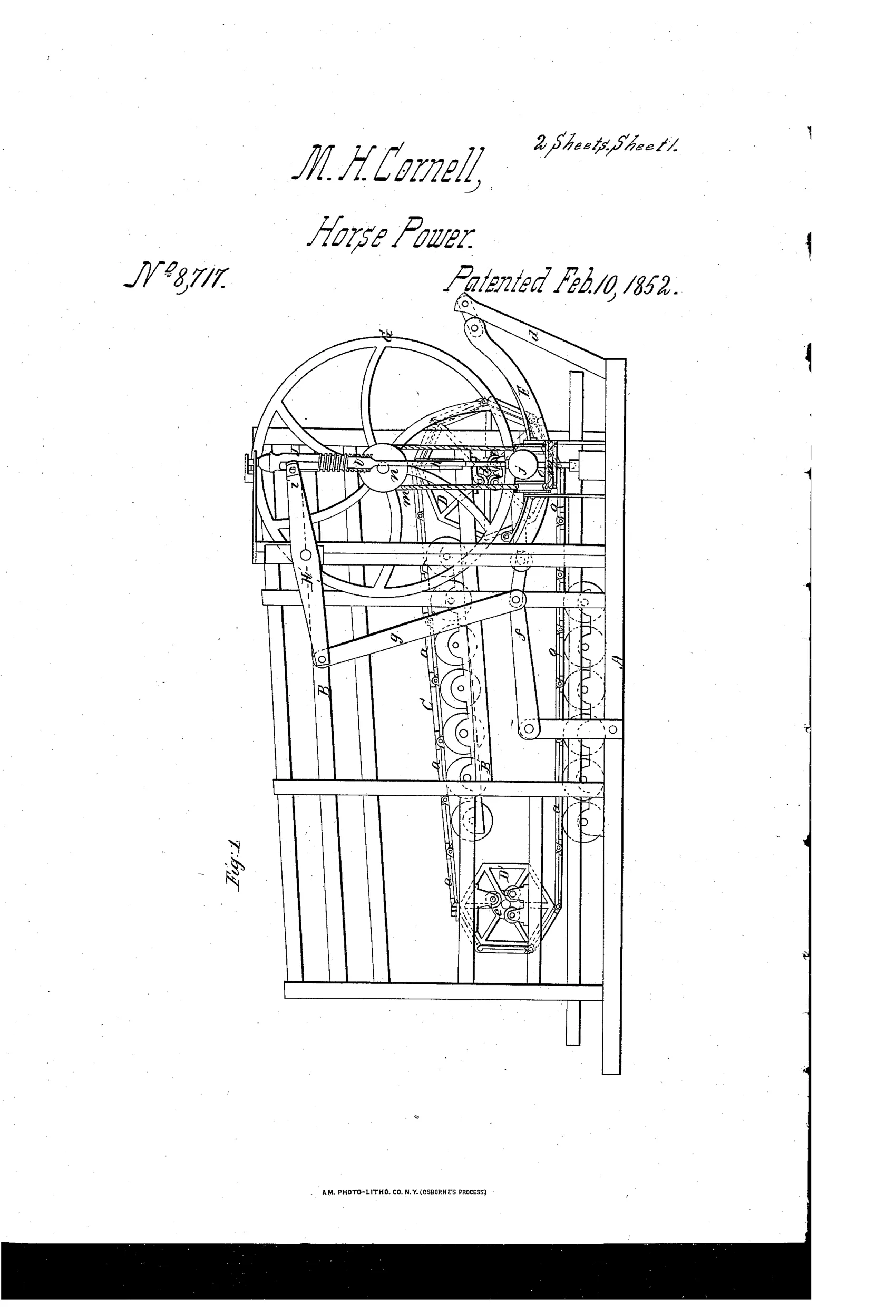
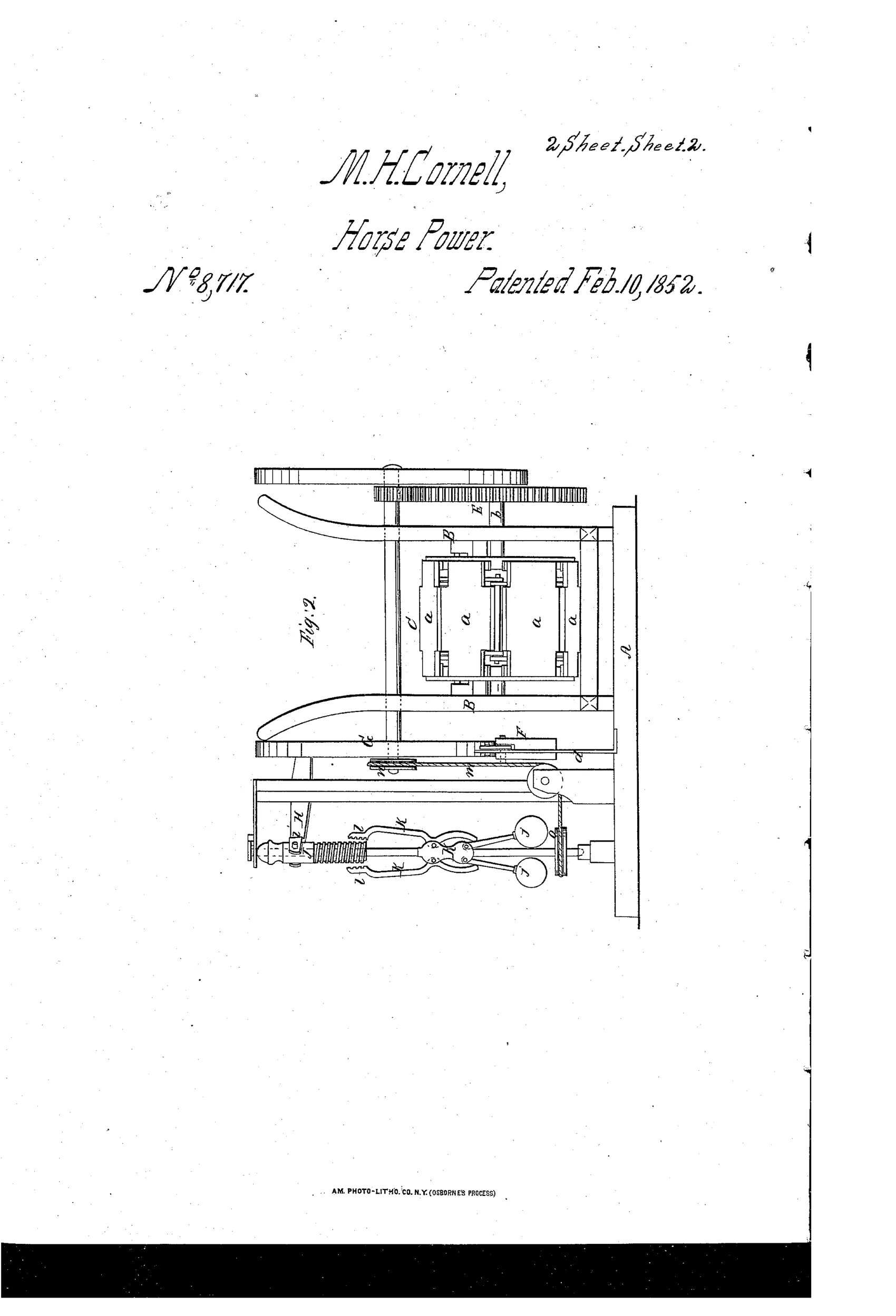
Self-regulating horse-powered treadmill machine with speed governor
↻ How it works
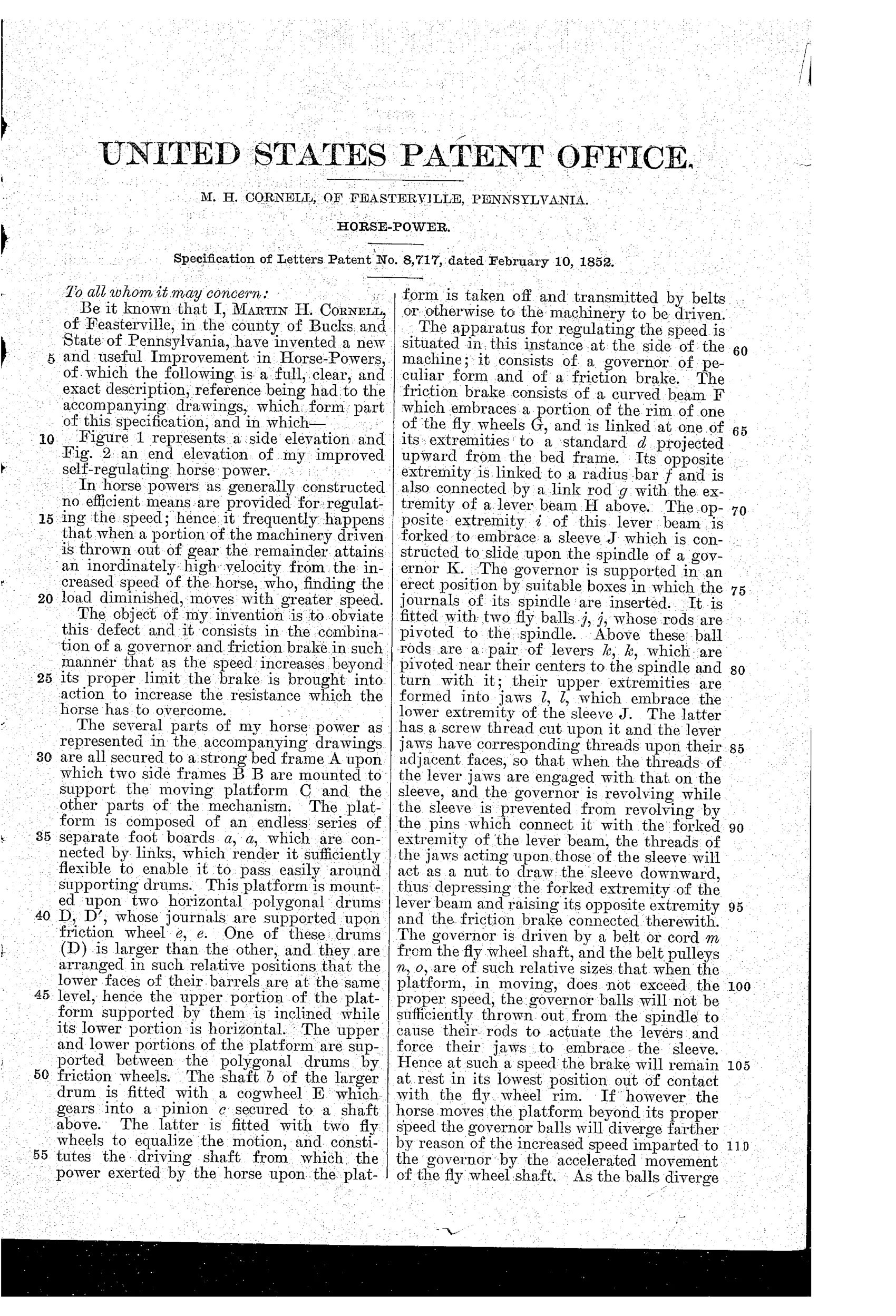
An endless platform of linked foot boards is mounted on two horizontal polygonal drums supported on friction wheels, so a horse walking on it drives a shaft fitted with fly wheels. A belt-driven governor with diverging balls senses overspeed; as speed increases the balls spread, actuating pivoted lever jaws that screw down a sleeve on the governor spindle. This downward screwing action depresses one end of a lever beam and raises the opposite end, forcing a curved friction brake beam against the rim of a fly wheel to increase resistance. When the horse slows and the governor balls collapse, the jaws release the sleeve and the brake drops away, instantly relieving the machine of the extra resistance; a spring bar with friction roller lining the brake beam makes the braking action gradual rather than sudden.
↻ What was claimed
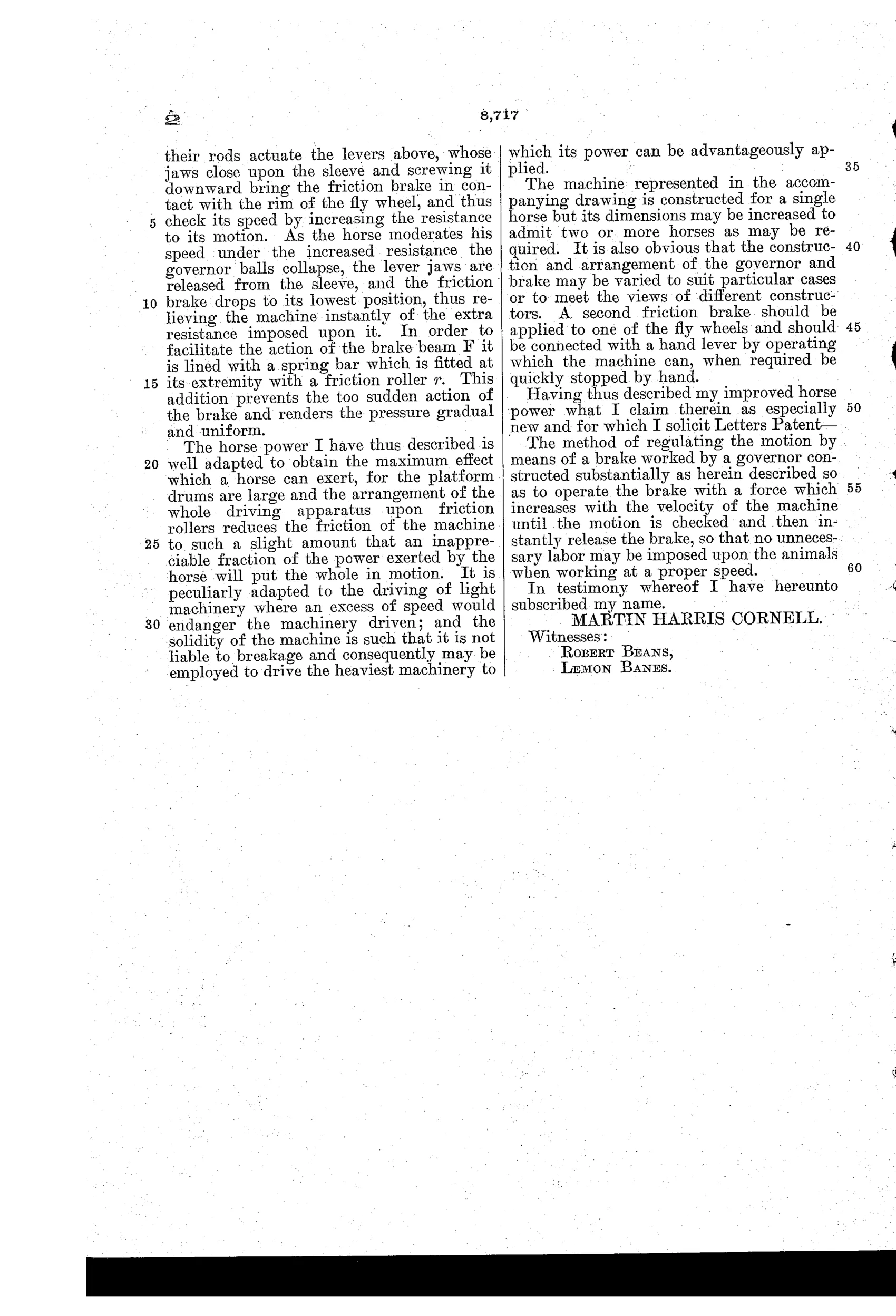
“The method of regulating the motion by means of a brake worked by a governor constructed substantially as herein described so as to operate the brake with a force which increases with the velocity of the machine until the motion is checked and then instantly release the brake, so that no unnecessary labor may be imposed upon the animals when working at a proper speed.”
In plain English: The invention claims a governor-controlled brake system that automatically increases braking force as the machine speeds up, then instantly releases once speed is corrected, avoiding unnecessary strain on the horse.
↻ In the inventor’s words
“In horse powers as generally constructed no efficient means are provided for regulating the speed; hence it frequently happens that when a portion of the machinery driven is thrown out of gear the remainder attains an inordinately high velocity from the increased speed of the horse, who, finding the load diminished, moves with greater speed.”— Martin Harris Cornell, from the specification
Fate unknown
Horse-powers of this general type were widely built, but no evidence ties Cornell's governor-brake design to production; a surviving marked machine or period advertisement would settle it.
↻ Commentary
Let's be honest up front: this is not a fishing reel. Patent 8,717 is a horse-power — the treadmill machine that turned a walking horse into rotary power for threshers and saws — and how it landed in a reel archive is anyone's guess. But since it's here, and since 1852 is the very year our category opens, it deserves a fair reading.
Cornell's problem is a real one, and his quoted complaint is charming: when the driven load drops out of gear, the horse feels the machine lighten, speeds up, and the whole rig races. His fix is a centrifugal ball governor driving a friction brake against a flywheel rim — Watt's steam-engine trick transplanted to the barnyard. The clever detail is in the claim's second half: the brake force builds with speed, then releases *instantly* when the horse slows, so no wasted labor is imposed on the animal at proper pace. The spring bar and roller lining the brake beam, making engagement gradual, shows a man who understood that a snatching brake would spook a horse.
For reel readers, there's a family resemblance worth noting: this is a speed-sensitive drag, sixty years before the anti-backlash inventors of 1900-1920 chased the same idea in miniature — resistance that appears only when the spool overruns. Different scale, same instinct.
Commentary by Claude, The Fishing Reel Patent Archive’s resident enthusiast