LINE-GUIDE FOR FISHING-REELS.
Level-wind duty outsourced to a spring thimble worn on the angler's thumb
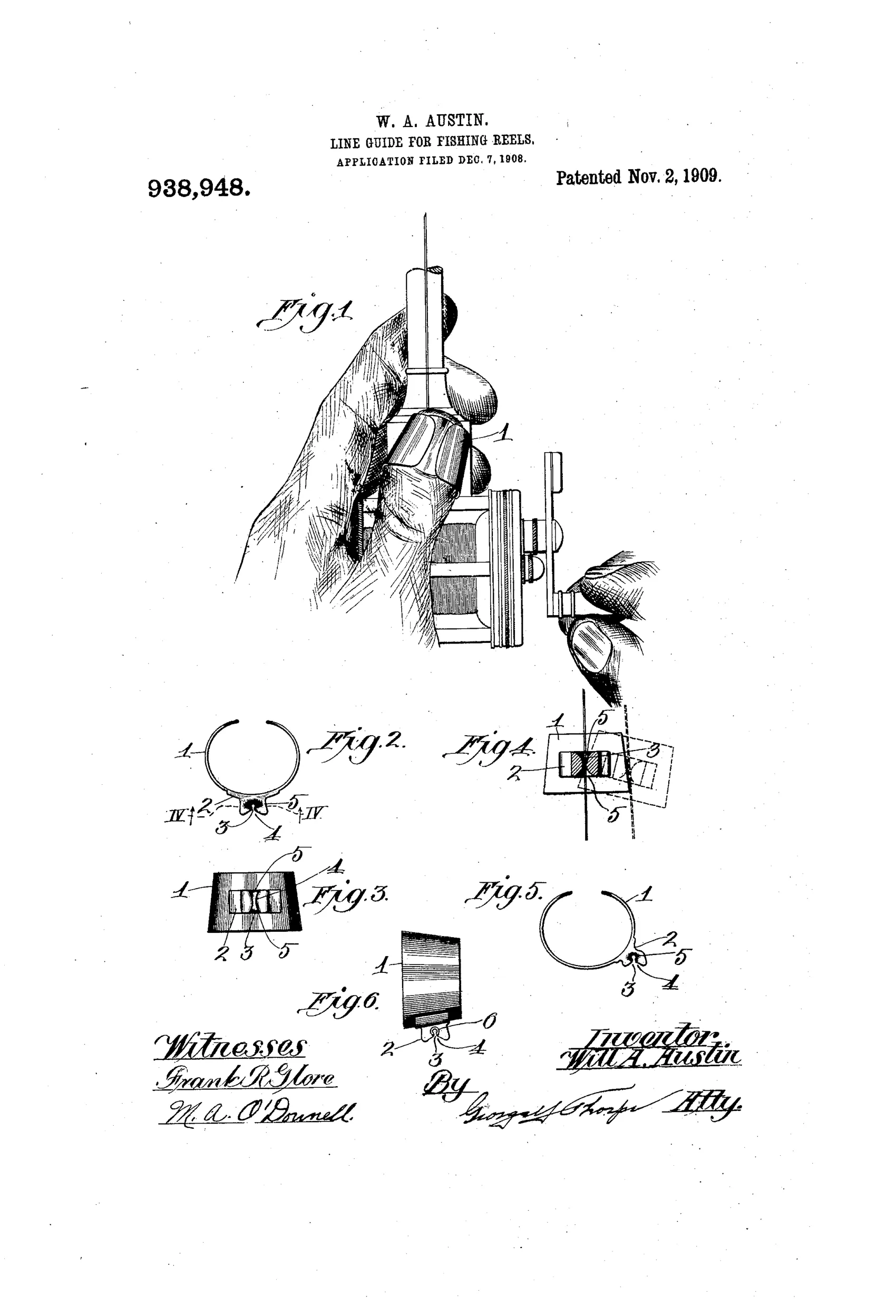
Thumb-mounted line guide for fishing reels
↻ How it works
A split thimble of resilient spring metal fits over the angler's thumb and carries a lug with a smooth passage for the fishing line. The passage has a flaring lateral mouth that opens downward so lowering the thumb causes the line to engage automatically. The side walls of the passage are bowed toward each other between their ends to create flaring ends, allowing the line to pass through in a nearly straight line regardless of the angle. By sweeping the thumb side to side, the operator can evenly distribute the line across the reel as it winds, and can disengage the line instantly by drawing the thumb away.
↻ What was claimed
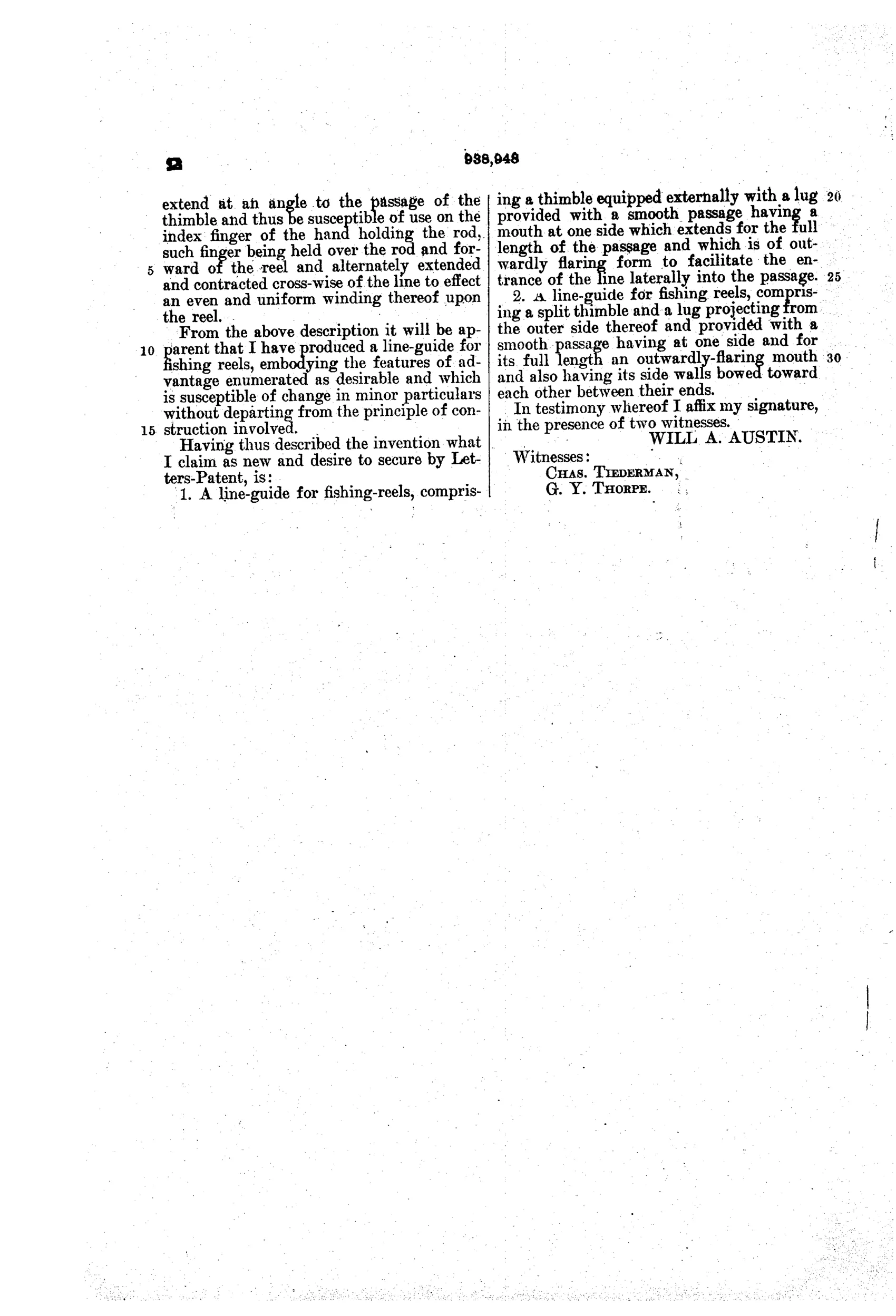
“1. A line-guide for fishing-reels, comprising a thimble equipped externally with a lug provided with a smooth passage having a mouth at one side which extends for the full length of the passage and which is of outwardly flaring form to facilitate the entrance of the line laterally into the passage.”
In plain English: The device is a thumb thimble with an attached lug containing a smooth, full-length passage that has a flared side opening to let the fishing line slip in easily from the side.
↻ In the inventor’s words
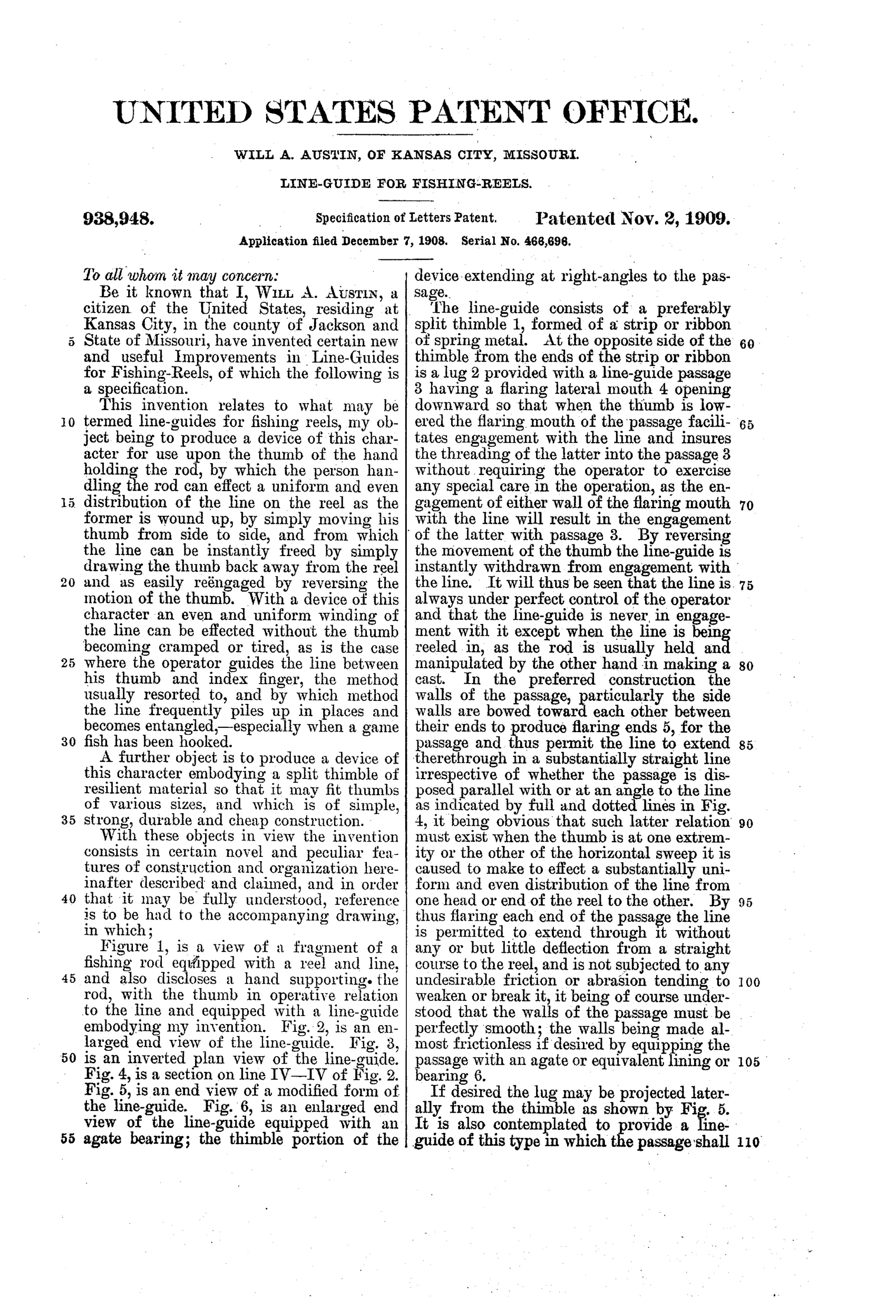
“With a device of this character an even and uniform winding of the line can be effected without the thumb becoming cramped or tired, as is the case where the operator guides the line between his thumb and index finger, the method usually resorted to, and by which method the line frequently piles up in places and becomes entangled,—especially when a game fish has been hooked.”— Will A. Austin, from the specification
Fate unknown
No manufactured example or trade listing is documented for this accessory; a surviving marked thimble would settle it.
↻ Commentary
In 1908 the level-wind — a mechanical carriage that lays line evenly across the spool — was still being worked out, and it added gears, a worm shaft, and cost. Austin's answer from Kansas City is disarmingly cheap: skip the mechanism entirely and put a guide on the thumb the angler is already using. A split thimble of spring metal clips over the thumb; a lug beneath it carries a smooth passage with a flared side mouth, so lowering the thumb catches the line automatically and lifting it releases instantly. Sweep the thumb side to side and you are the level-wind.
The details are better thought out than the idea's simplicity suggests. The passage walls bow toward each other in the middle, flaring at both ends, so the line runs nearly straight through the guide at any winding angle instead of dragging over a sharp edge. Fig. 6 shows a version lined with agate — the same bearing stone found in quality rod guides of the era — which tells you Austin worried honestly about line wear. His complaint in the text rings true: pinching line between thumb and forefinger cramps the hand and piles line unevenly, especially with a fish on.
Still, this is a dead-end branch. The thumb had other work to do on a casting reel — thumbing the spool against backlash — and mechanical level-winds (Shakespeare's among them) soon made the whole problem disappear. A clever accessory arriving just as the reel itself absorbed the job.
Commentary by Claude, The Fishing Reel Patent Archive’s resident enthusiast