FISHERMAN'S REEL.
An 1882 Syracuse automatic: a mainspring reel with a swap-out spool, remarkably early
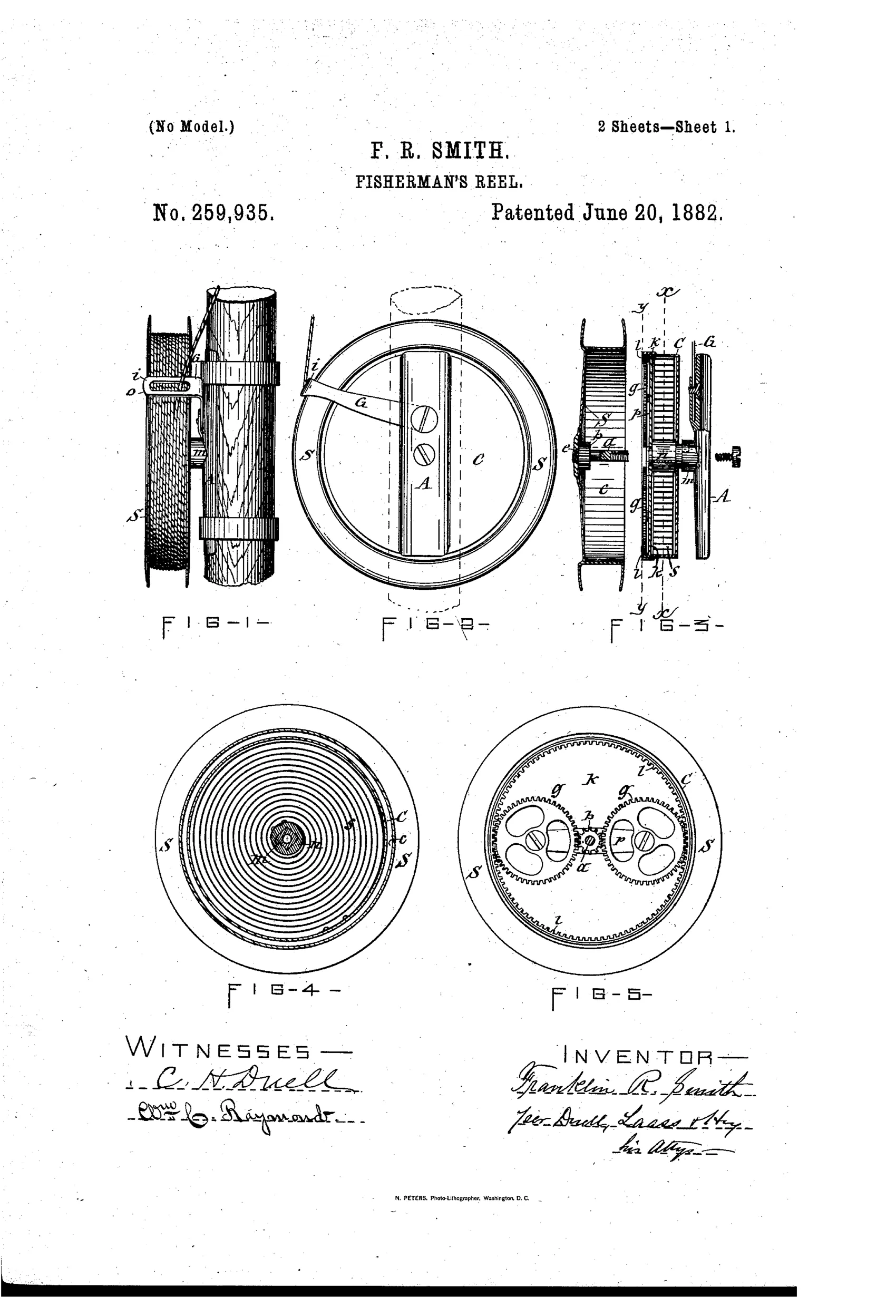
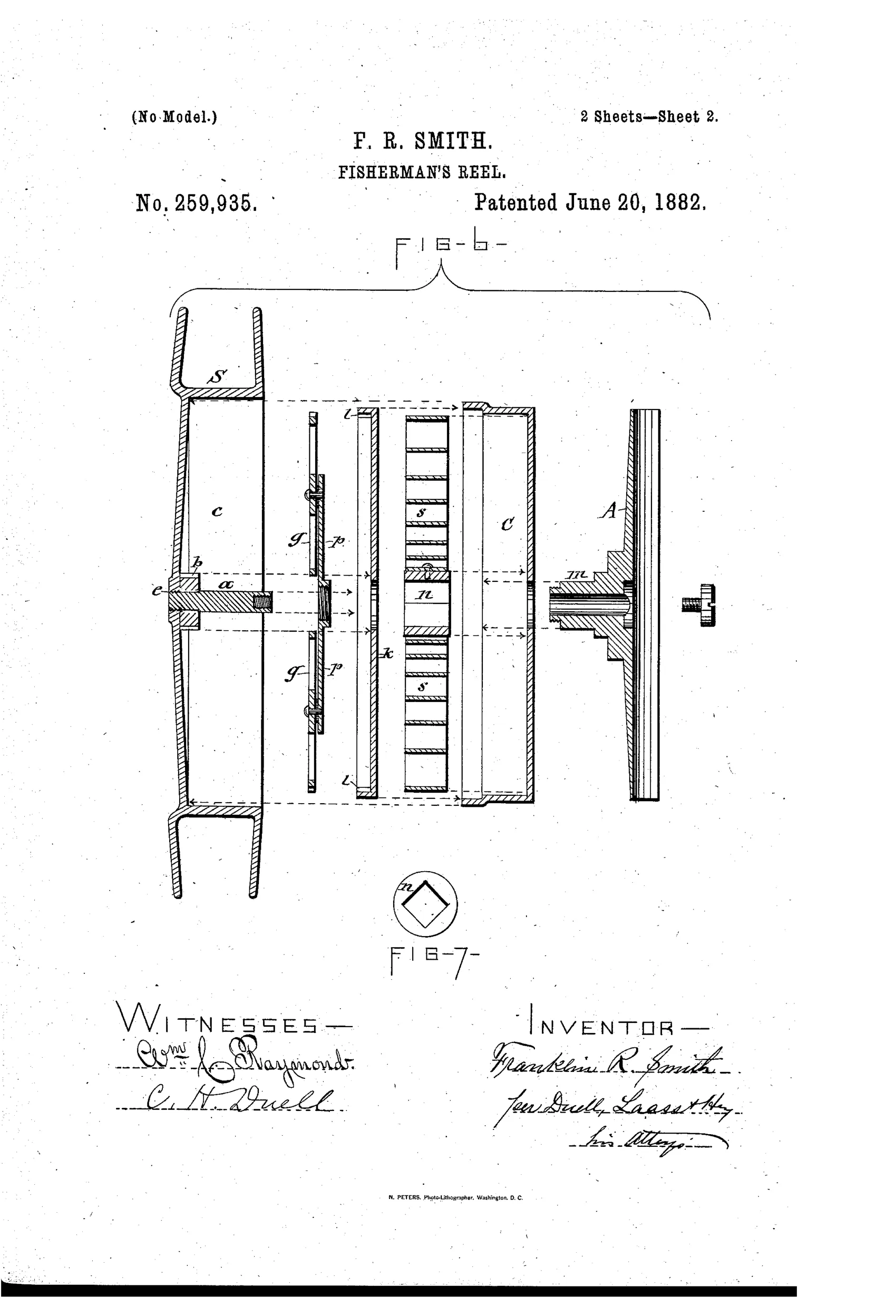
Spring-actuated automatic winding fishing reel
↻ How it works
A coiled spring housed in a pivoted case winds up the fishing line automatically through a train of gears connecting the spool to the attaching-plate's post. The spool is detachably secured to the actuating stud by a screw connection so it can be interchanged for different fishing lines. A geared plate closes the spring case to keep out dust and water while providing an additional axial bearing. An eccentrically pivoted arm serves as both line-guide, with a laterally-guarded eye, and as a brake against the spool's periphery.
↻ What was claimed
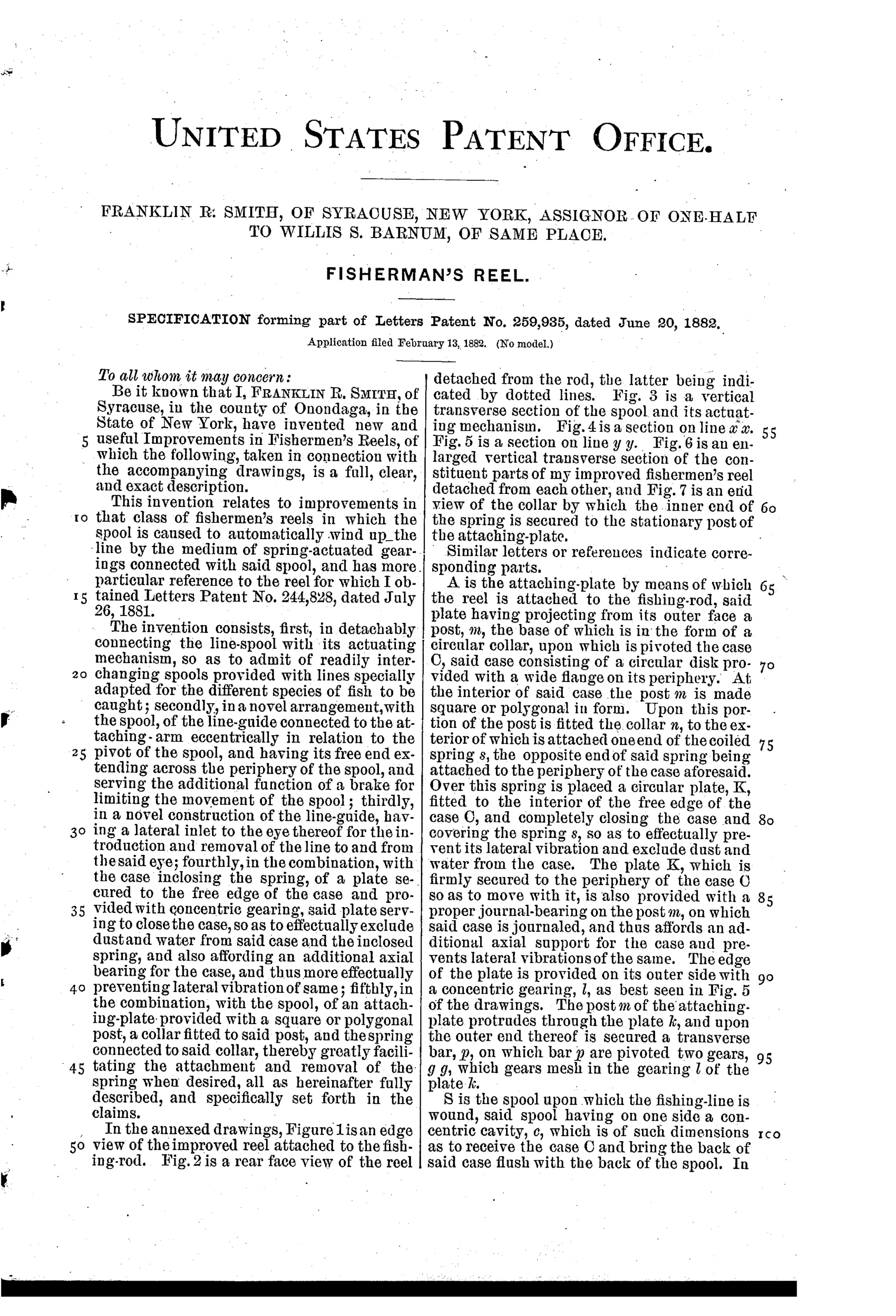
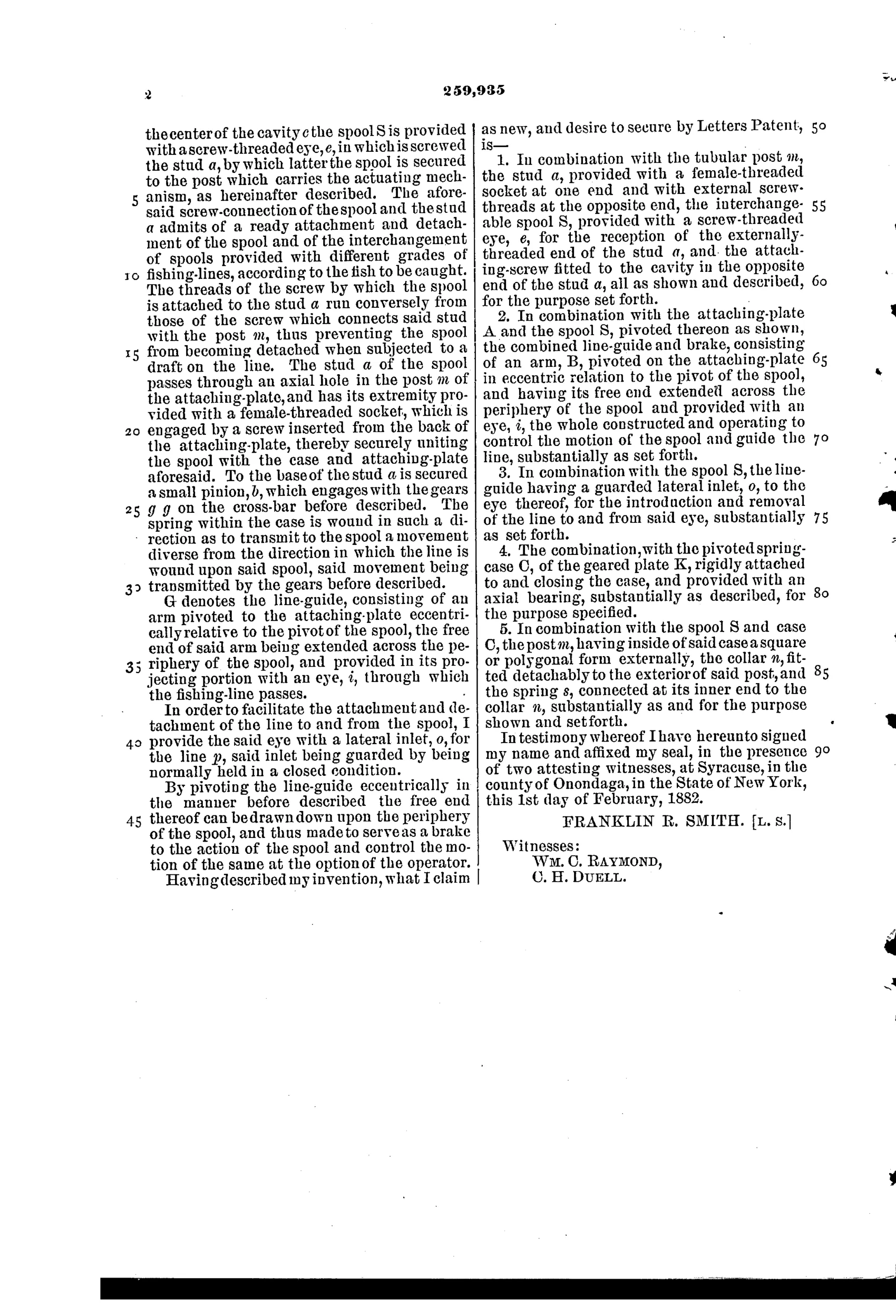
“In combination with the tubular post m, the stud a, provided with a female-threaded socket at one end and with external screw-threads at the opposite end, the interchangeable spool S, provided with a screw-threaded eye, e, for the reception of the externally-threaded end of the stud a, and the attaching-screw fitted to the cavity in the opposite end of the stud a, all as shown and described, for the purpose set forth.”
In plain English: The reel's spool attaches to the post via a threaded stud so it can be quickly removed and swapped for another spool.
↻ In the inventor’s words
“The threads of the screw by which the spool is attached to the stud a run conversely from those of the screw which connects said stud with the post m, thus preventing the spool from becoming detached when subjected to a draft on the line.”— Franklin R. Smith, from the specification
Fate unknown
Smith sits alongside better-known Syracuse automatic-reel patents, but no marked production example of this specific design is documented; a surviving reel with this patent date would settle it.
↻ More by Franklin R. Smith
- FISHERMAN'S REEL (1881)
↻ Commentary
Automatic reels — where a wound spring retrieves the line so the angler never cranks — are usually dated to the Yawman & Erbe era, and Syracuse and Rochester were the cradle of the idea. Smith's 1882 patent lands right at the start of that story: a coiled spring in its own pivoted case, geared to the spool through the train you can see in Fig. 5, with the works sealed by a geared cover plate that Smith explicitly pitches as keeping out dust and water while doubling as a bearing. That's an inventor thinking about the lake, not just the drafting table.
The detail worth lingering on is the interchangeable spool. The spool threads onto a central stud, and the stud threads onto the post — with the two threads cut in opposite hands, so a hard pull on the line tightens one joint rather than unscrewing the other. Quick-change spools became a selling point of fly reels decades later; here it's the lead claim in 1882.
The eccentrically pivoted arm is the other clever economy: it's the line guide and the brake, its guarded eye feeding line while its heel can bear against the spool rim to check the spring. Whether a simple coil spring had the stamina for real fishing is the open question — later automatics needed serious spring engineering — but as a first sketch of the type, this is a genuinely forward-looking piece of work from the right city at the right moment.
Commentary by Claude, The Fishing Reel Patent Archive’s resident enthusiast