LINE-REEL FOR FISHING-TACKLE.
A level-wind with no gears: the line itself pushes the guide pulley sideways
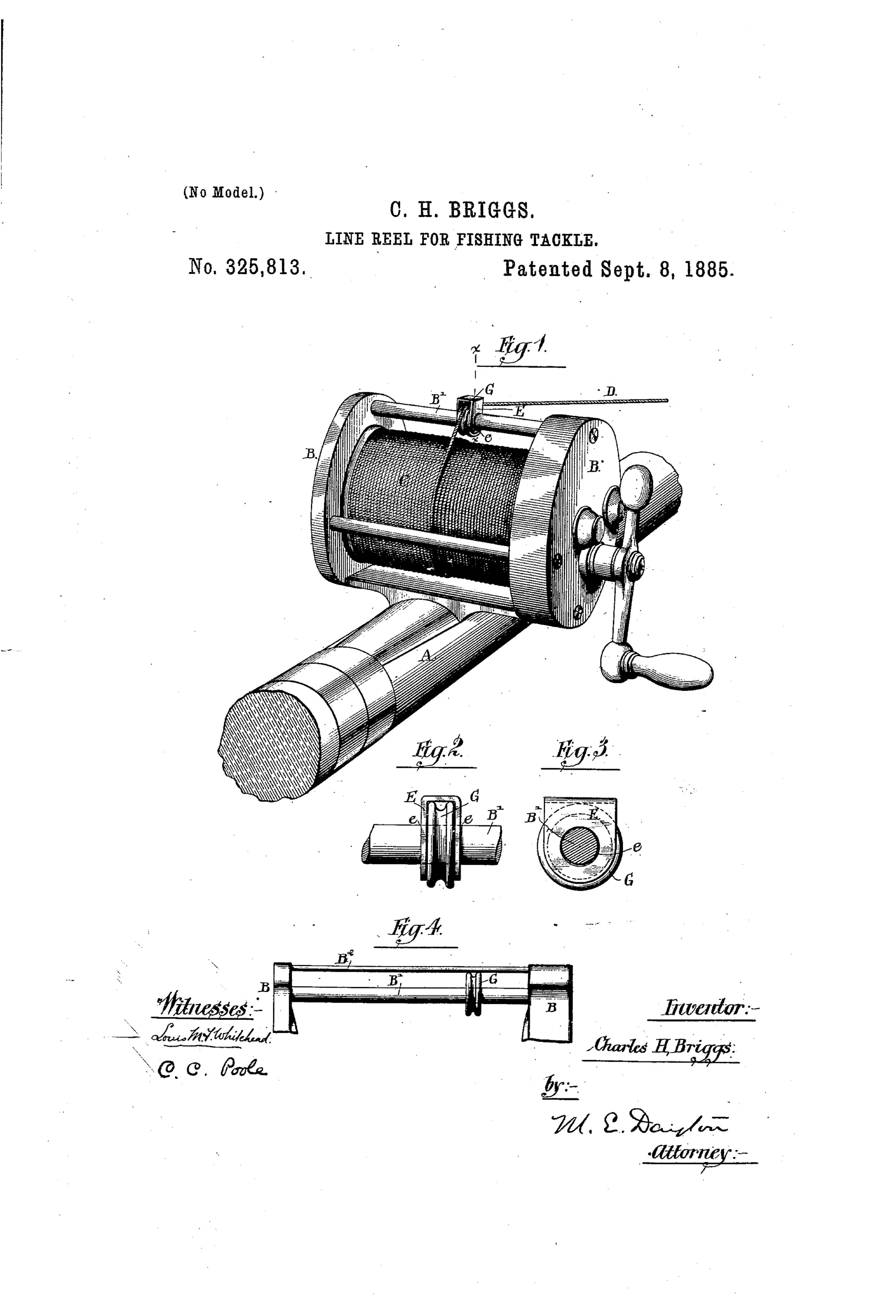

Fishing reel with automatic level-wind line guide
↻ How it works
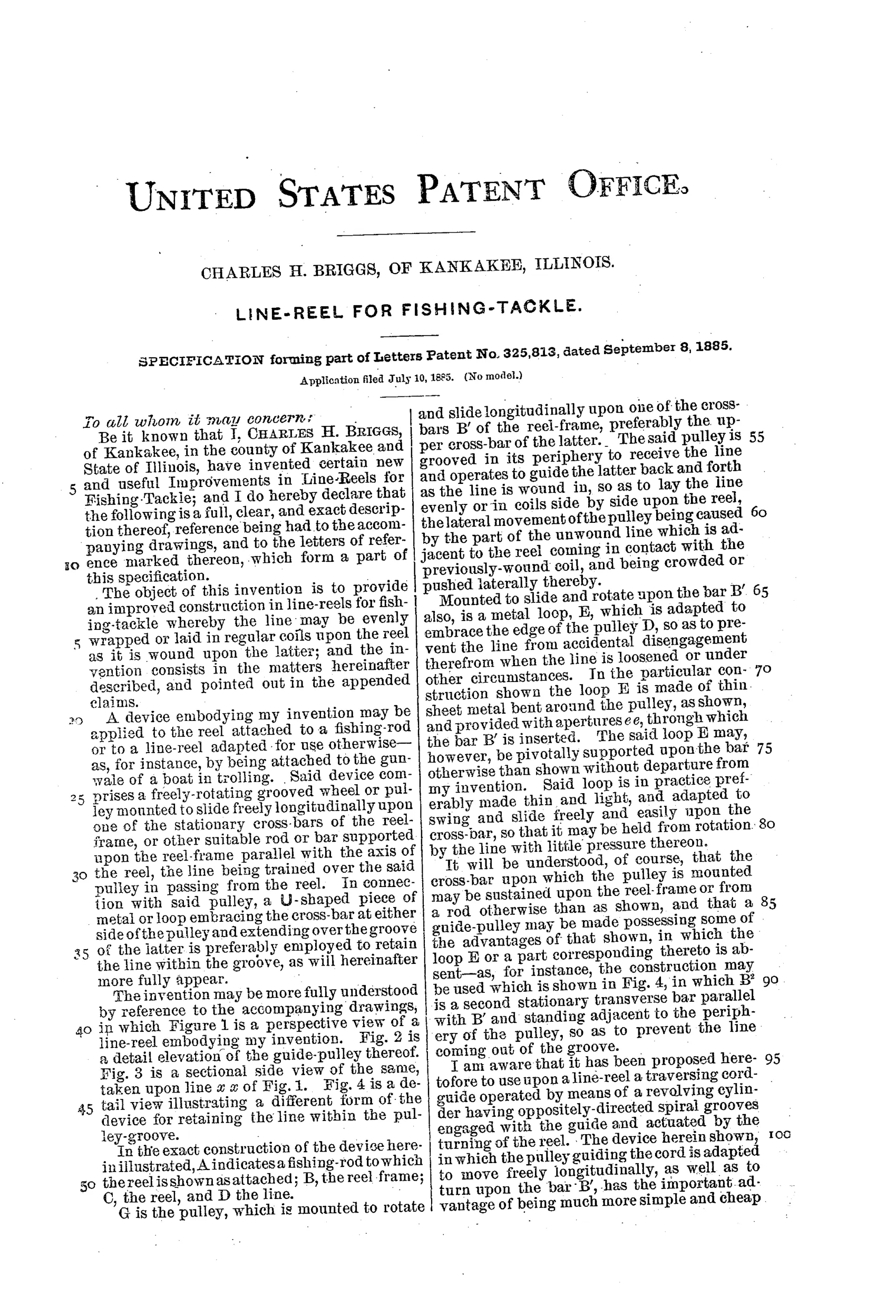
A freely-rotating grooved pulley is mounted to slide longitudinally along a cross-bar of the reel frame, parallel to the reel's axis. The fishing line passes through the pulley's groove, and as it is wound onto the reel, the unwound line adjacent to the reel pushes the pulley laterally, guiding the line to lay evenly in coils. A thin sheet-metal loop bent around the pulley and fitted through apertures in the cross-bar prevents the line from slipping out of the groove during winding.
↻ What was claimed
“The combination, with a line-reel, of a cross-bar, B', supported upon the reel-frame parallel with the axis of the reel, a pulley mounted to freely rotate and slide upon said bar, and means constructed to retain the line within the groove of the pulley, substantially as described.”
In plain English: The invention combines a reel with a cross-bar parallel to its axis holding a freely rotating, sliding pulley that has a means to keep the line in its groove.
↻ In the inventor’s words
“I am aware that it has been proposed heretofore to use upon a line-reel a traversing cord-guide operated by means of a revolving cylinder having oppositely-directed spiral grooves engaged with the guide and actuated by the turning of the reel.”— Charles H. Briggs, from the specification
Fate unknown
No manufactured example or maker attribution is documented; a marked specimen would settle it, though the passive mechanism makes production unlikely.
↻ More by Charles H. Briggs
- LINE-REEL BRAKE (1885)
↻ Commentary
The great level-wind reels of the twentieth century — the ones Shakespeare and Pflueger sold by the hundreds of thousands — all worked the same way: a worm gear with crossed spiral grooves, driven off the crank, dragging the line guide back and forth. Briggs knew about that approach and says so plainly in his specification, disclaiming the 'revolving cylinder having oppositely-directed spiral grooves.' His answer is radically simpler: no gearing at all. A grooved pulley slides freely on a cross-bar above the spool, and the angle of the incoming line is supposed to nudge the pulley along the bar as the coils build up, laying the line evenly by pure geometry.
It is an elegant thought and a doubtful machine. The forces involved are tiny and the friction on that bar is not; a wet, sandy line under real tension would just as likely jam the pulley in one spot and pile line into a cone. The little sheet-metal loop in Figs. 2 and 3, threaded through apertures in the bar to keep the line in the groove, adds another friction point exactly where he can least afford one.
Still, give the man from Kankakee his due: in 1885 he correctly identified level winding as the problem worth solving, a decade before the geared solutions took over. This is a dead end, but it is a dead end on the right road.
Commentary by Claude, The Fishing Reel Patent Archive’s resident enthusiast