FISHING-REEL.
Meisselbach's first patent: the skeleton reel that dries its own line
Antique fishing reel with drag and click
↻ How it works
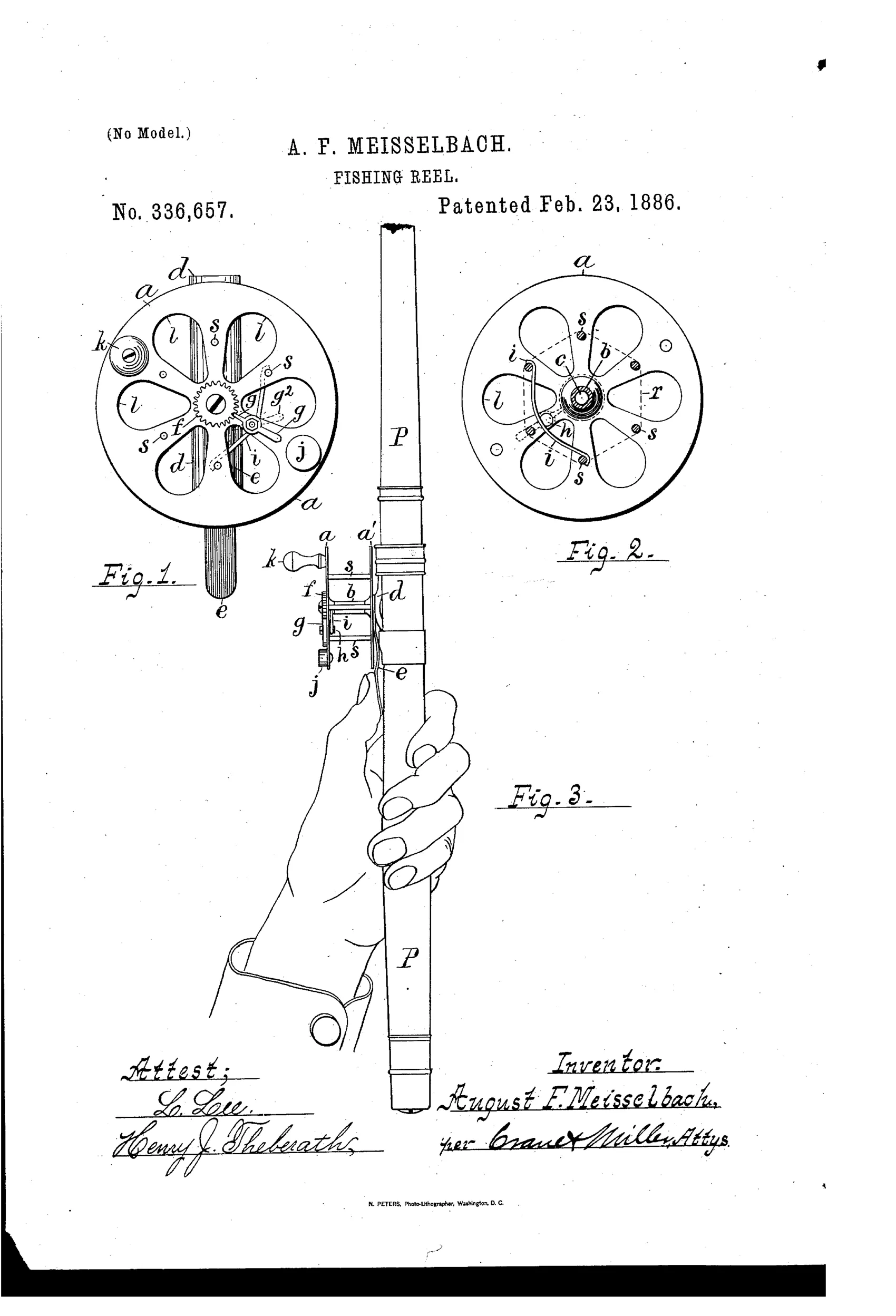
The reel has two flanges, a and a', united centrally by a pipe b that rotates freely on a stationary stud c. A ratchet wheel f is fixed to the outer end of the stud, and a pivoted click g engages it, controlled by a spring i that presses against a flattened head h and rests on transverse pins s. A drag spring e is affixed to the stud or foot and bears with a flat face against the flat side of the outer flange, applying frictional resistance that can be relieved by pressing the reel toward the pole. The flanges include transverse pins s for winding the line into a six-sided form and ventilating holes l to allow air circulation and dry the line.
↻ What was claimed
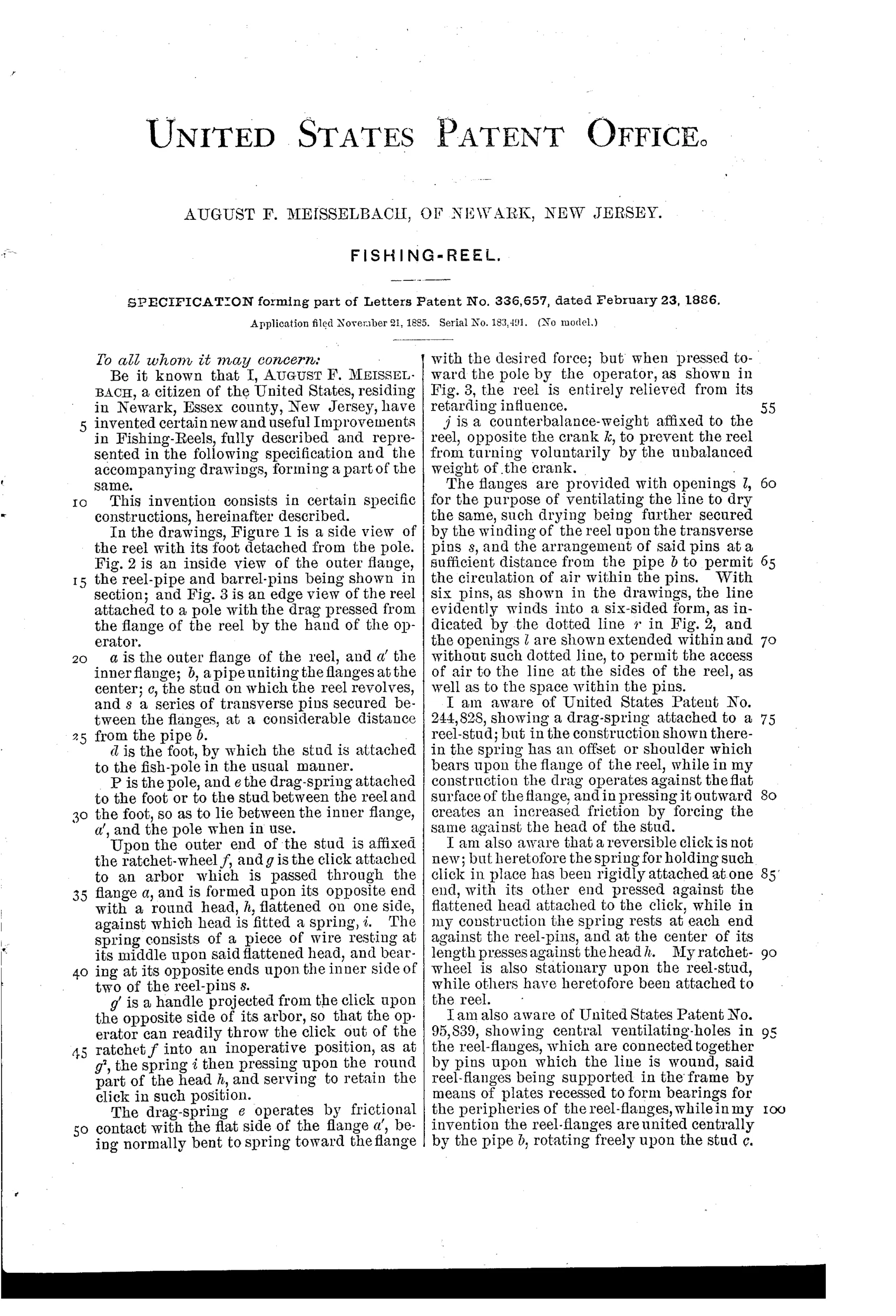
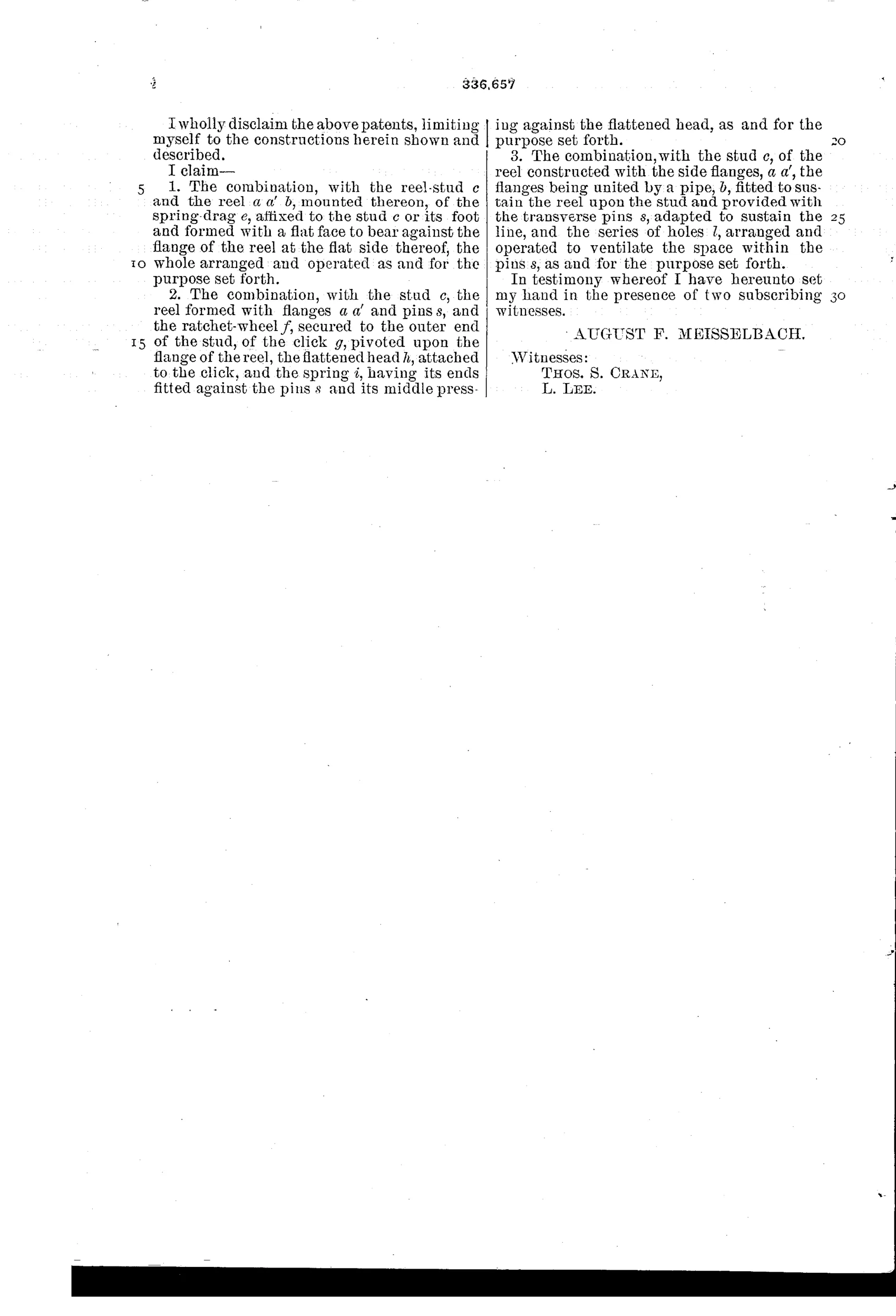
“The combination, with the stud c, the reel formed with flanges a a' and pins s, and the ratchet-wheel f, secured to the outer end of the stud, of the click g, pivoted upon the flange of the reel, the flattened head h, attached to the click, and the spring i, having its ends fitted against the pins s and its middle pressing against the flattened head, as and for the purpose set forth.”
In plain English: The reel combines a stud-mounted ratchet wheel with a pivoted click and a spring that presses against a flattened head and rests on the line-winding pins to control the click action.
↻ In the inventor’s words
“I wholly disclaim the above patents, limiting myself to the constructions herein shown and described.”— August F. Meisselbach, from the specification
Manufactured and sold
Meisselbach's skeleton reels — the Expert line and its successors — went into large-scale production from the late 1880s, and this 1886 patent is the design's documented starting point.
↻ More by August F. Meisselbach
- FISHING-REEL DRAG. (1886)
↻ Commentary
This is the debut patent of August F. Meisselbach of Newark, and it already contains the ideas his firm would ride for three decades. Look at Figs. 1 and 2: the flanges are more hole than metal, and the line doesn't wind on a spool barrel at all — it winds on the transverse pins marked s, forming a six-sided coil with air on every side. Wet silk line was the great enemy of the era; it rotted on solid spools. Meisselbach's answer was to remove the spool almost entirely.
The clever economy is in the click. The same pins that carry the line also anchor the ends of the flat spring i, whose middle bears on the flattened head h of the pivoted click g. One set of pins does double duty as line-winder and spring seat — that's a manufacturer's mind at work, shaving parts. The drag is cruder: a flat spring e rubbing on the outer flange, relieved by pushing the whole reel toward the rod, as the disembodied hand in Fig. 3 demonstrates.
This sits at the head of the skeleton fly-reel line — the Expert and its kin came directly out of this thinking, stamped, ventilated, and cheap enough for the mass market vom Hofe never chased. Not a Kentucky multiplier; a different, democratic branch of the story.
Commentary by Claude, The Fishing Reel Patent Archive’s resident enthusiast