FISHING-REEL DRAG.
Meisselbach's first patent: a thumb-lever drag squeezing both spool flanges at once
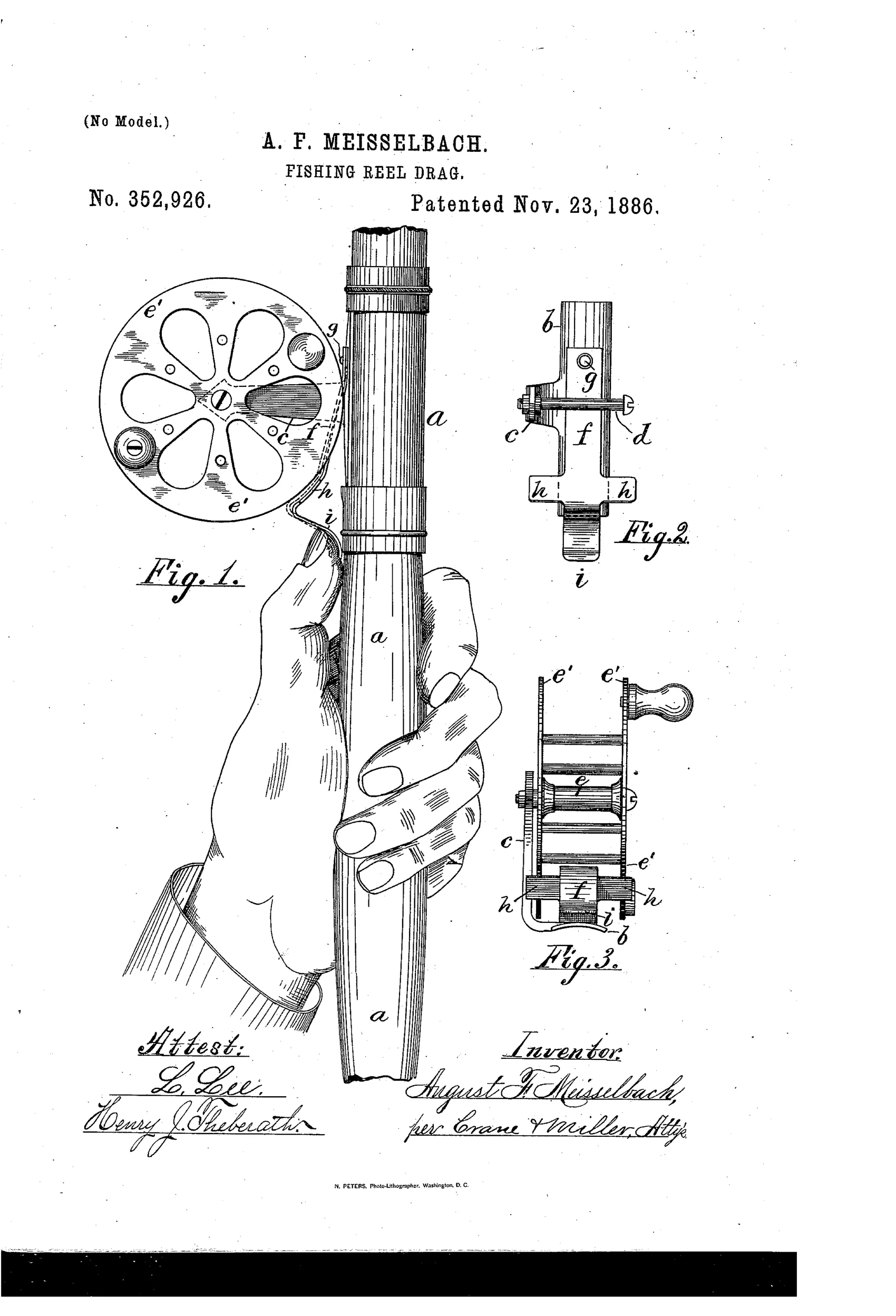
A thumb-operated leaf-spring drag for fishing reels
↻ How it works
A leaf-spring is riveted at one end to the reel foot mounted on the fishing pole. The free end of the spring carries a cross-bar that straddles and presses against the edges of both reel flanges simultaneously. A thumb-piece extends from the cross-bar close to the pole, allowing the angler to press it with the thumb while gripping the rod to increase or decrease drag pressure on the spool. This arrangement lets the operator regulate braking force on the reel gradually and conveniently during casting.
↻ What was claimed
“The combination, with the reel having flanges e' e', of the foot b, provided with standard c and pivot d, and the drag consisting in the spring f, secured to the foot b at one end, and provided with the cross-bar h, and thumb-piece i, adapted to lie adjacent to the pole where the reel is sustained thereon, substantially as herein shown and described.”
In plain English: The invention combines a reel with two flanges, a foot with a standard and pivot, and a spring-based drag with a cross-bar and thumb-piece positioned near the pole so the angler can control reel braking with their thumb.
↻ In the inventor’s words
“My invention is of special use in bait-casting, as the form of drag and the location of the thumb-piece enable the operator to check the reel most perfectly.”— August F. Meisselbach, from the specification
Fate unknown
Meisselbach was a genuine Newark manufacturer and his early skeleton reels are close cousins of the drawing, but I know of no documented reel carrying this specific drag; a specimen marked with the Nov. 23, 1886 date would settle it.
↻ More by August F. Meisselbach
- FISHING-REEL. (1886)
↻ Commentary
Before August Meisselbach's name meant anything to anglers, he filed this — a drag you work with your thumb while your hand stays wrapped around the rod. Fig. 1 makes the argument better than the claims do: the hand grips the butt, and the thumb-piece sits right where the thumb naturally falls. Press harder, more brake; ease off, free spool. It is the thumbing motion every bait-caster already knew, mechanized.
The clever part is the cross-bar. Instead of a pad rubbing one spot on the spool, the leaf-spring carries a bar that straddles the reel and bears on the rims of both flanges simultaneously. That balances the load — no cocking the spool sideways on its pivots — and it brakes at the largest diameter, where a little pressure buys the most torque. Note also that the reel in Fig. 1 has a perforated, skeletonized side plate, the family look Meisselbach would ride to fame with his Expert skeleton reels a few years later.
Where it sits: this is the 1880s wing of the anti-backlash story, a generation before the automatic governors of 1900–1920. It doesn't prevent overrun by itself — the angler is still the brains — but it gives the educated thumb a proper lever instead of bare skin on a spinning spool. Simple, cheap, and it would plainly work; the only question is whether anglers wanted a middleman between thumb and spool.
Commentary by Claude, The Fishing Reel Patent Archive’s resident enthusiast