FISHING-REEL.
A clock movement on a rod butt: spring-wound automatic winding, 1887
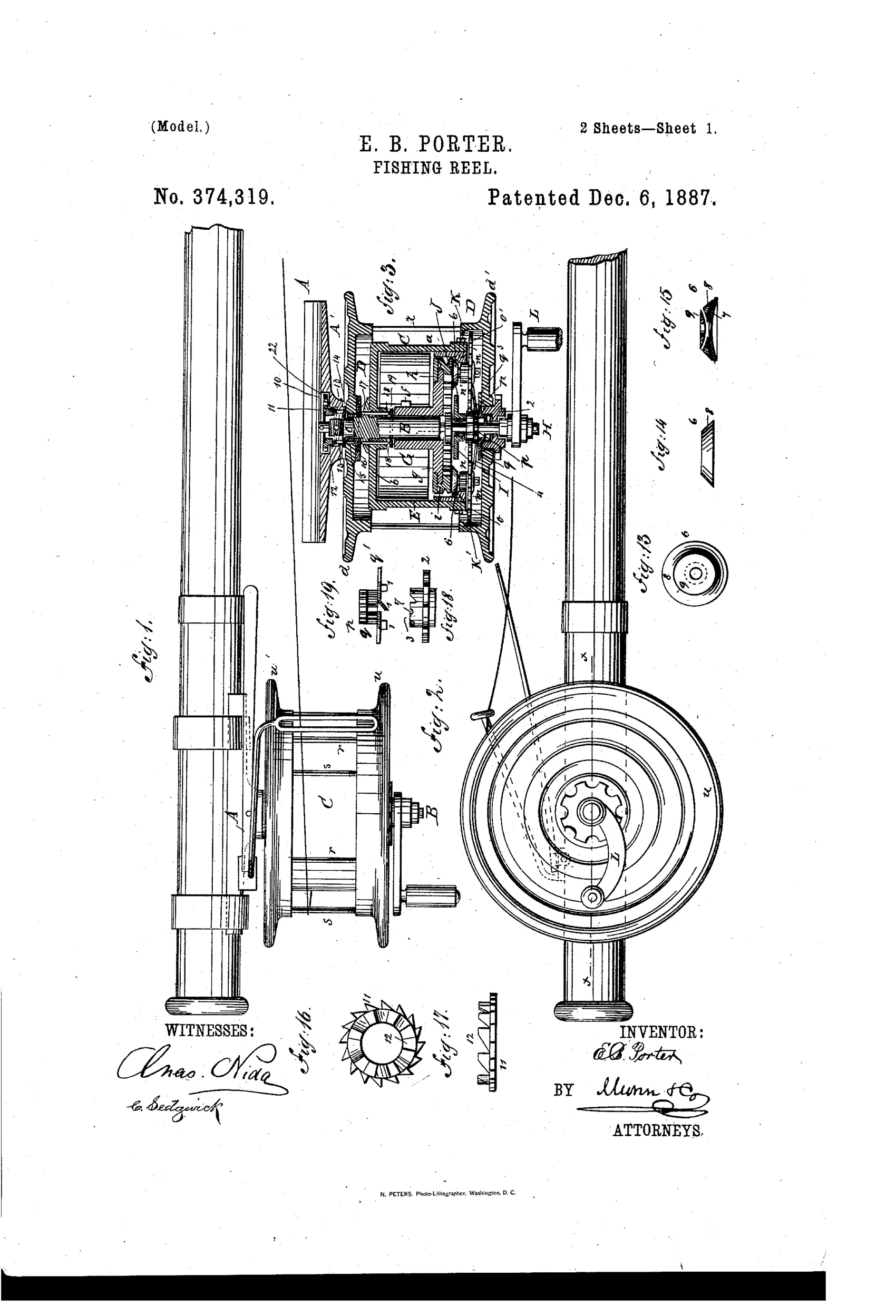
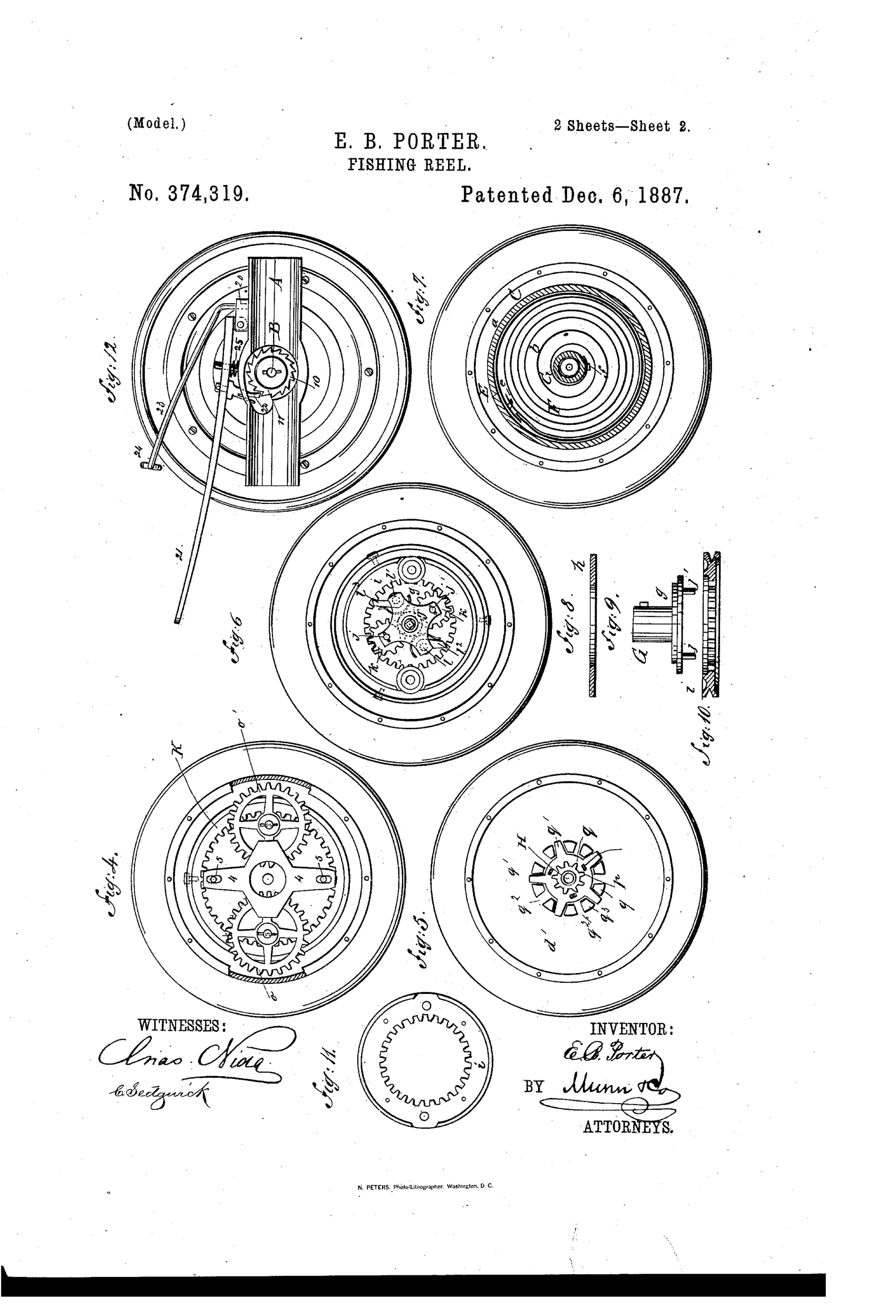
Spring-driven, geared multiplying fishing reel with brake
↻ How it works
A fixed spring-barrel houses a main spring whose outer end bears on a friction spring, and whose inner end drives a sleeve and flange through planetary gearing to turn the reel. A winding arbor with a hand-crank drives a pinion into planet-wheels that ride an internally-toothed traveling ring, storing tension in the main spring while spring-actuated clicks hold the ring against unwinding. Separate pinions and spur-wheels connect the traveling ring to an internally-toothed fixed ring and a floating pinion so that release of a clutch collar lets the stored spring force spin the reel head and take in line automatically. A ratchet, pawl, and key-lever operate beveled friction-wheels against a beveled surface to apply a variable drag brake, and the reel head can be declutched from the pinion to let line pay out freely.
↻ What was claimed
“1. In a fishing-reel, the combination, with the fixed spring-barrel, the reel arranged to revolve around said barrel, a flanged sleeve receiving a stud, intermediate mechanism between the flange of said sleeve and said reel, and the actuating main spring contained by the barrel, of a friction-spring connected with the outer end of the main spring and pressing against the inner wall of the main spring barrel, substantially as described.”
In plain English: The reel combines a fixed spring barrel, a reel that turns around it, a flanged sleeve on a stud, gearing linking the sleeve to the reel, a main spring inside the barrel, and a friction spring pressing on the barrel's inner wall to control the spring's outer end.
↻ In the inventor’s words
“The object of my invention is to provide an efficient reel by which a perfect control of the line and the fish may be secured, and in which the tension upon the line may be accurately regulated; also, to furnish a spring-actuated reel which will wind any desired length of line, and in which the line may be paid out to any extent without interfering with the action of the spring or gearing connected therewith.”— Elbert Ball Porter, from the specification
Paper patent — likely never produced
The watch-grade complexity of planetary gearing, concentric sleeves, and clutch collars would have been very costly to manufacture, and I know of no surviving Porter reel or production record.
↻ More by Elbert Ball Porter
- FISHING-REEL. (1892)
↻ Commentary
Porter's ambition here is total. He wants a reel that stores energy while you crank, holds it under click and pawl, then — on release of a clutch collar — spins the spool and takes in line by itself, with a variable friction drag riding beveled wheels for good measure. This is the automatic-reel idea, arriving in the same decade Yawman & Erbe were commercializing their spring-driven fly reel in Rochester, just down the road from Penn Yan. Porter's answer is far more elaborate: a fixed spring barrel with a friction spring bearing on its inner wall to keep the mainspring from binding, planetary gearing between the winding arbor and a traveling internally-toothed ring, and a second gear path to a fixed ring for the release side.
Look at Fig. 3, the transverse section. That is not a fishing reel cross-section; that is a watch movement. Concentric sleeves, floating pinions, ratchets, clutch collars — twenty-one figures across two sheets, several devoted to individual gear teeth. The friction-spring detail in the first claim is genuinely thoughtful; it addresses the real problem of mainspring coils grabbing the barrel wall as tension varies.
But the parts count is punishing. Every internally-toothed ring means precision cutting, and every sliding clutch means a fit that must survive water and sand. The Yawman & Erbe reel won this race by being drastically simpler. Porter's design reads as a brilliant dead end — mechanically coherent, commercially hopeless.
Commentary by Claude, The Fishing Reel Patent Archive’s resident enthusiast