FISHING-REEL.
A clockwork reel that winds the fish in for you, mostly
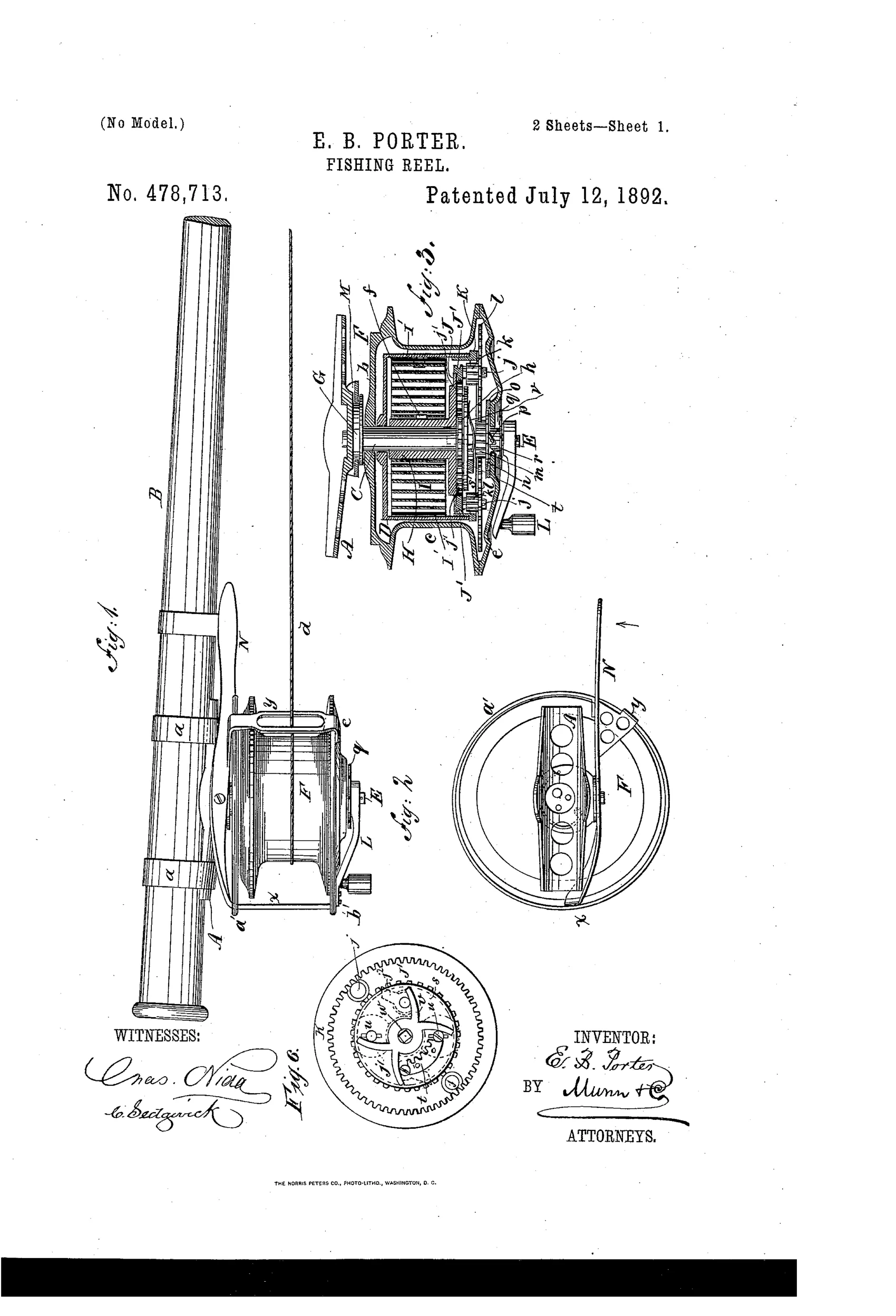
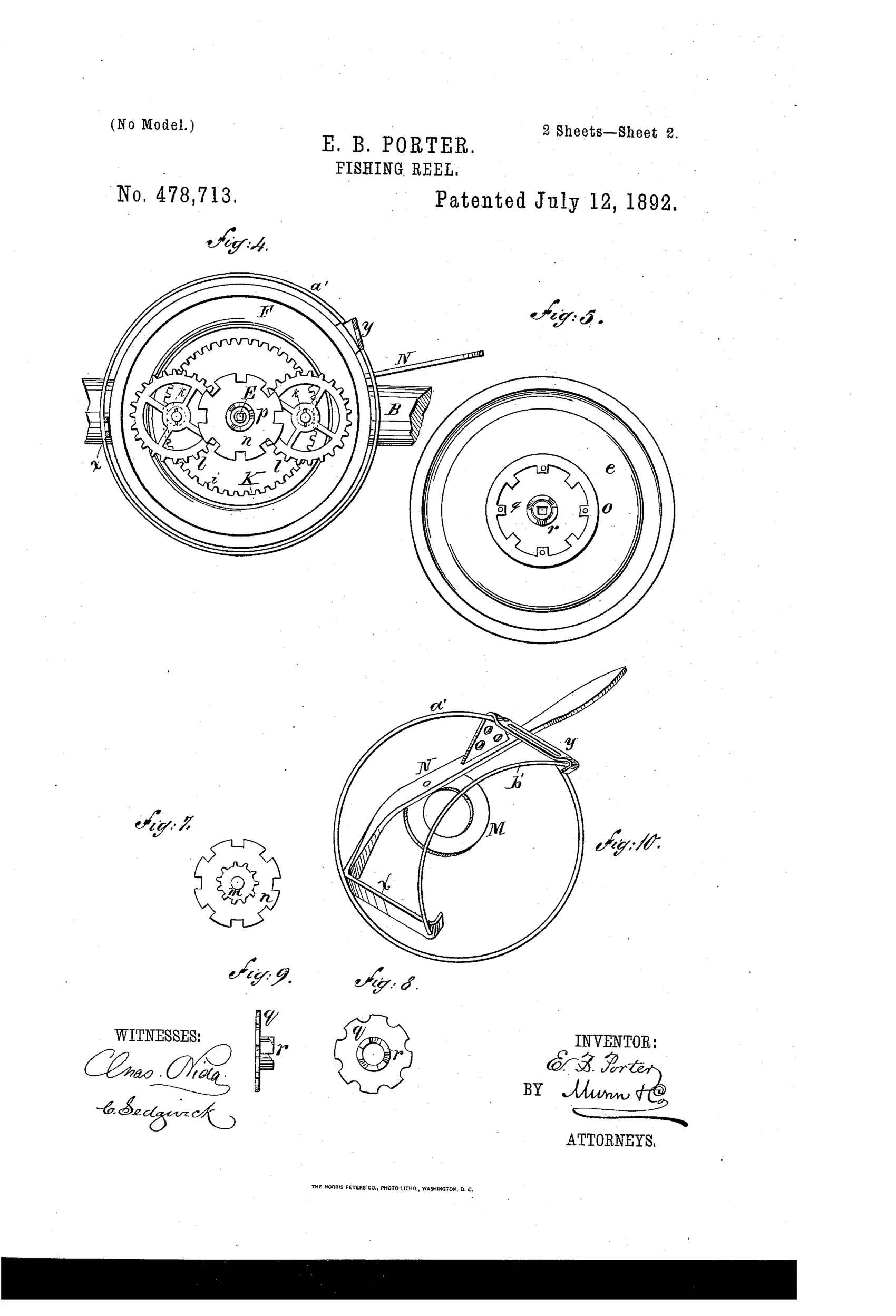
Spring-driven multiplying fishing reel with declutch mechanism
↻ How it works
A spring-driven drum inside the reel body powers a planetary gear train that turns a driving pinion engaging the reel-head; a sliding cam-disk can be turned to disengage the reel-head from the driving pinion for free running, while locking the pinion against a curved rack so the spring stays wound. A crank on the winding arbor turns winding-wheels that both rewind the spring and reconnect the drive, so a single turn instantly restores full spring tension to the line. A separate eccentric-mounted brake lever, spring-biased into contact with the reel body, can be depressed to release drag or left engaged to retard or stop the spool; a wire guard ring and curved wire prevent the line from slipping off the reel's edges.
↻ What was claimed
“In a reel of the character described, a device for disconnecting the winding and driving mechanism, consisting of the following elements, in combination: a reel-head provided with projections on its inner face, a sleeve journaled loosely on the winding-arbor and provided with the cam r, a disk carried by the reel-driving pinion and provided with a cam p and with radial arms or projections adapted to engage with the projections on the reel-head, a spring arranged to normally hold said arms in engagement with said projections, and a detent secured to the winding mechanism for engaging with and locking the driving-pinion when the projections on the disk are carried out of engagement with the projections on the reel-head, substantially as shown and described.”
In plain English: The reel has a clutch-like mechanism that can disconnect the spool from the drive gear (letting it spin free) while automatically locking the drive gear so the wound spring doesn't unwind, and reconnects everything again when the crank is turned.
↻ In the inventor’s words
“For example, if when paying out line a fish strikes the bait and runs with the line the most natural thing to do would be to hook the fish by a gentle pull and, in fishing with a reel, to wind in the fish.”— Elbert Ball Porter, from the specification
Fate unknown
No production example under Porter's name is documented; a marked specimen or trade-catalog listing would settle it.
↻ More by Elbert Ball Porter
- FISHING-REEL. (1887)
↻ Commentary
Porter's answer to the eternal problem of cranking was to put the crank's work in a spring. Wind it once, and a spring-driven drum inside the body stores the energy; a planetary gear train delivers it to the spool through a driving pinion. The genuinely clever bit is the declutch: a cam-disk slides the drive out of engagement so line can pay out freely, and — this is the part most spring-motor designs botched — a detent simultaneously locks the pinion against a curved rack so the spring stays wound instead of uselessly spinning itself flat. One turn of the crank rewinds and reconnects everything.
Look closely at Fig. 3, the diametrical section: that's watchmaker-density gearing packed into a reel body, with the spring drum, planet gears, cam, and clutch disk all nested on one axis. Figs. 6 through 9 peel the mechanism apart layer by layer, which tells you how many parts had to be made and fitted. That complexity is the design's weakness — cost, weight, and grit tolerance all work against it on a wet riverbank.
Porter was working the same vein as the Yawman & Erbe automatic fly reel of the 1880s, which proved spring-retrieve could sell. But that success went to a simpler flat-spring design. Porter's version, filed in 1888 and four years in prosecution, reads like the elaborate cousin that stayed on paper — thoughtful, over-engineered, and part of the dead-end branch of the automatic-reel story.
Commentary by Claude, The Fishing Reel Patent Archive’s resident enthusiast