FISHING-REEL.
An eccentric stud lets the angler re-mesh worn gears — watchmaker thinking, 1889.
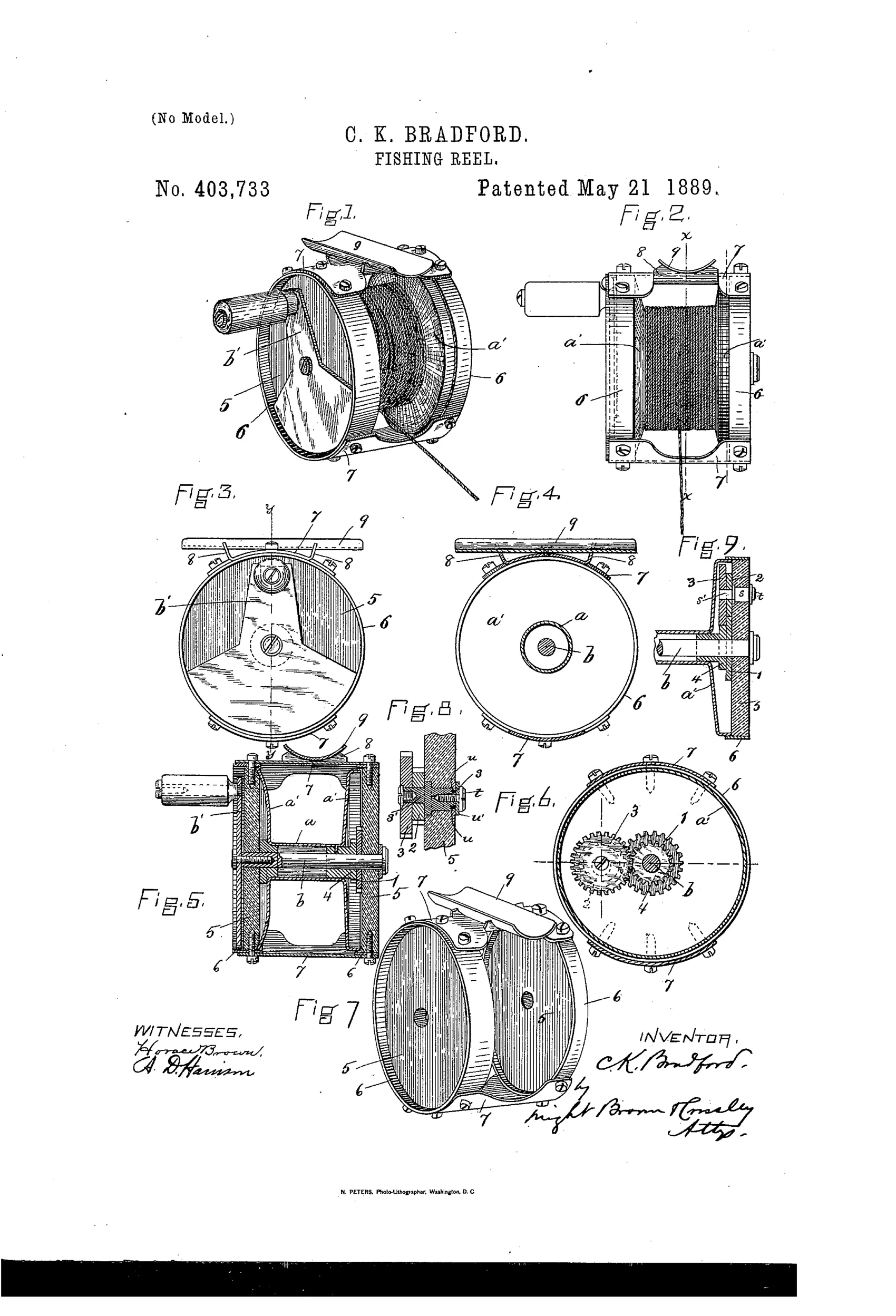
Multiplying fishing reel with lightweight geared frame
↻ How it works
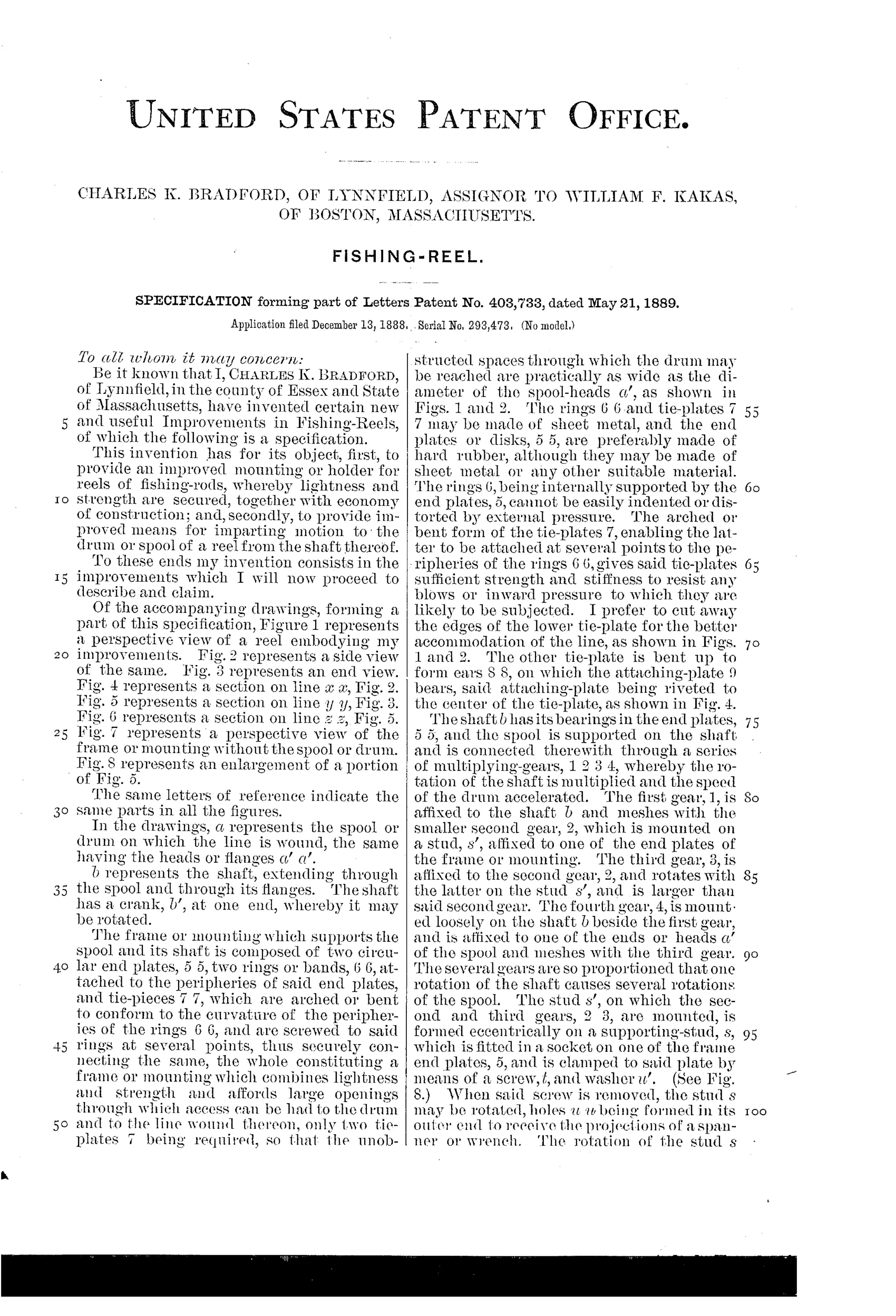
The reel frame is built from two hard-rubber end plates, two sheet-metal rings attached to their peripheries, and arched sheet-metal tie-plates screwed to the rings, creating a light, strong mounting with large open spaces for access to the spool. The shaft carries a crank and passes through the spool, which is connected to the shaft not directly but through a train of multiplying gears (1, 2, 3, 4) so that one turn of the crank produces several rotations of the spool. Gear 2 and gear 3 are mounted on an eccentric stud that itself sits on an adjustable supporting-stud, so rotating the stud moves gears 2-3 toward or away from gears 1 and 4 to set proper engagement depth and compensate for tooth wear. One tie-plate is cut away at the edges to better accommodate the line, while the other is bent up into ears that support a pole-attaching plate.
↻ What was claimed
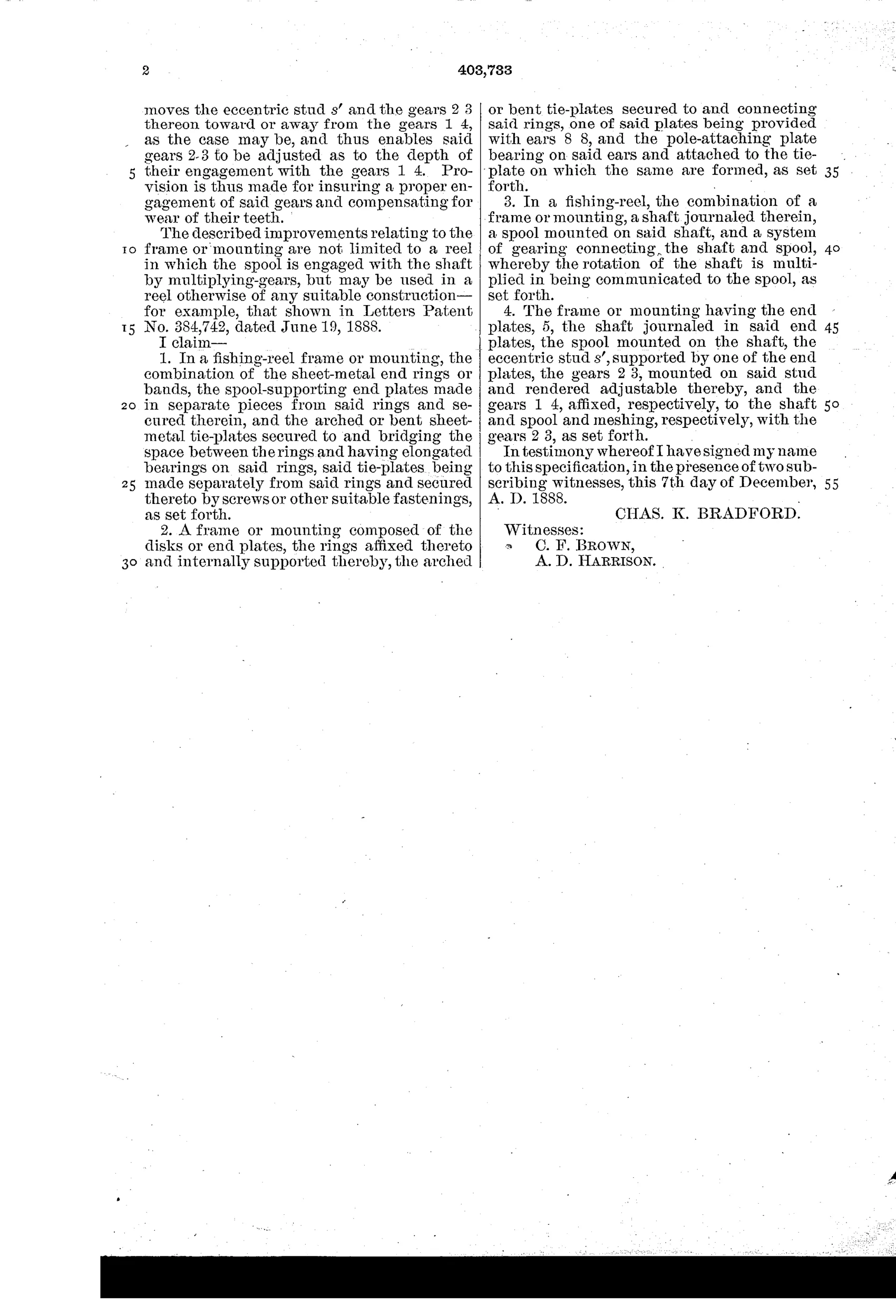
“1. In a fishing-reel frame or mounting, the combination of the sheet-metal end rings or bands, the spool-supporting end plates made in separate pieces from said rings and secured therein, and the arched or bent sheet-metal tie-plates secured to and bridging the space between the rings and having elongated bearings on said rings, said tie-plates being made separately from said rings and secured thereto by screws or other suitable fastenings, as set forth.”
In plain English: The reel's frame combines separate metal end rings, separate spool-supporting end plates fitted inside those rings, and curved metal tie-plates screwed on to bridge and reinforce the gap between the rings.
↻ In the inventor’s words
“Provision is thus made for insuring a proper engagement of said gears and compensating for wear of their teeth.”— Charles K. Bradford, from the specification
Fate unknown
The assignment to a Boston party hints at commercial intent, but no marked Bradford or Kakas reel is documented; a surviving specimen would settle it.
↻ More by Charles K. Bradford
- FISHING-REEL. (1888)
↻ Commentary
Two ideas share this patent, and the smaller one is the better one. The frame construction — hard-rubber end plates seated in sheet-metal rings, bridged by arched tie-plates screwed on separately — is a sensible bid to make a multiplying reel light and cheap without the German-silver machining that Kentucky makers like Meek and Milam lavished on their reels. Fig. 7, the frame stripped of its spool, shows how open the whole cage is: big windows for cleaning and access, with the tie-plates doing the structural work the traditional turned pillars would do.
But look at Fig. 9. Bradford mounts the intermediate gears of his multiplying train on an eccentric stud that sits on a second, adjustable stud. Rotate it and the idler gears swing toward or away from the driving and driven gears, setting the depth of engagement. His own words: 'compensating for wear of their teeth.' That is a machinist's answer to the real weakness of cheap multipliers — sloppy gear mesh that gets sloppier with use. Most makers just fitted the gears tight and hoped; Bradford built in a service adjustment.
The curiosity is the assignment to William F. Kakas of Boston, which suggests someone intended to make and sell these. Whether anyone did is another matter — the design sits outside the known lineages of vom Hofe, Pflueger, and the Frankfort shops, and hard-rubber-and-sheet-metal reels of this pattern are not a recognized type. A clever, buildable design in search of a factory.
Commentary by Claude, The Fishing Reel Patent Archive’s resident enthusiast