FISHING-REEL.
Rim-edge cam controls and an 1892 bet on aluminum, five years after Hall
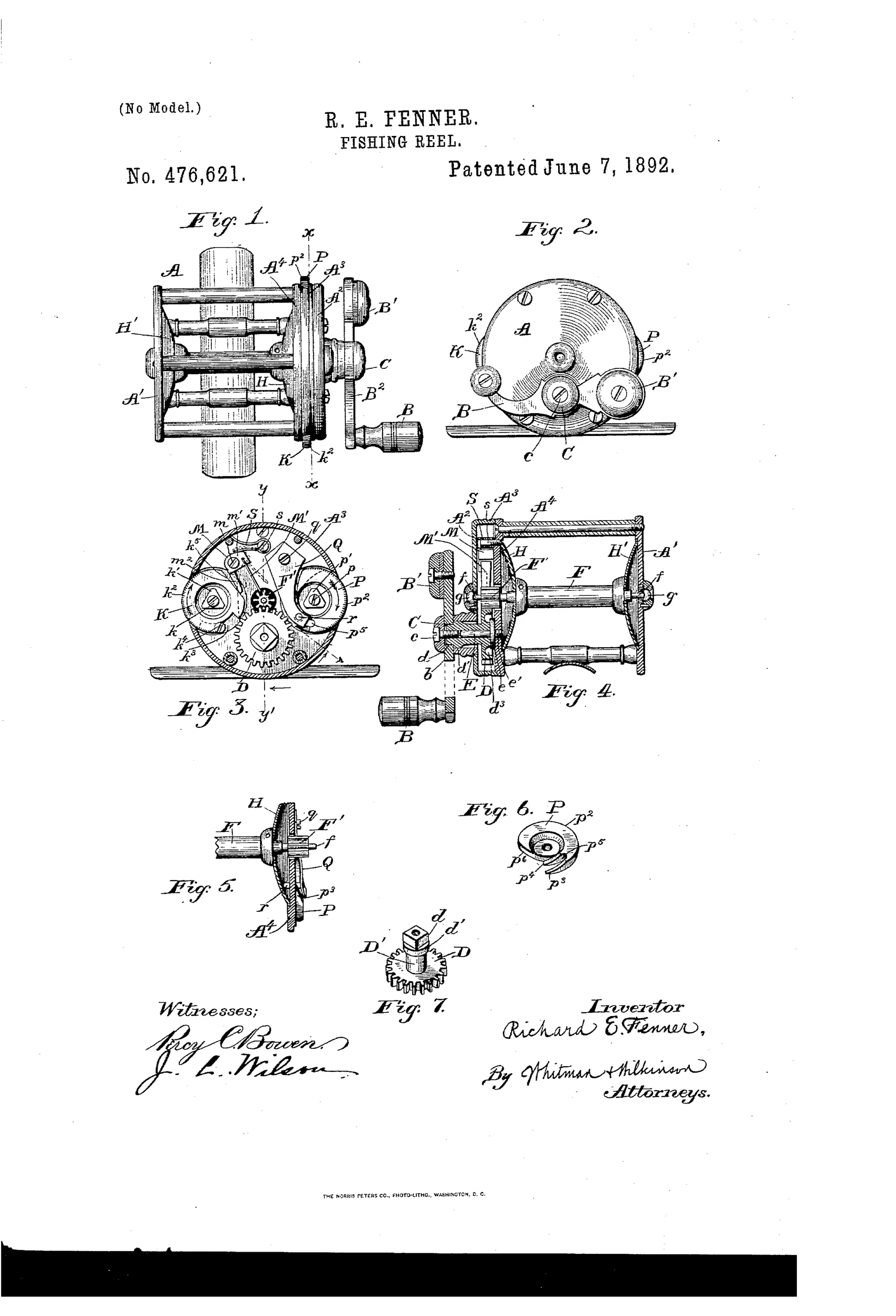
Fishing reel with click and drag mechanisms
↻ How it works
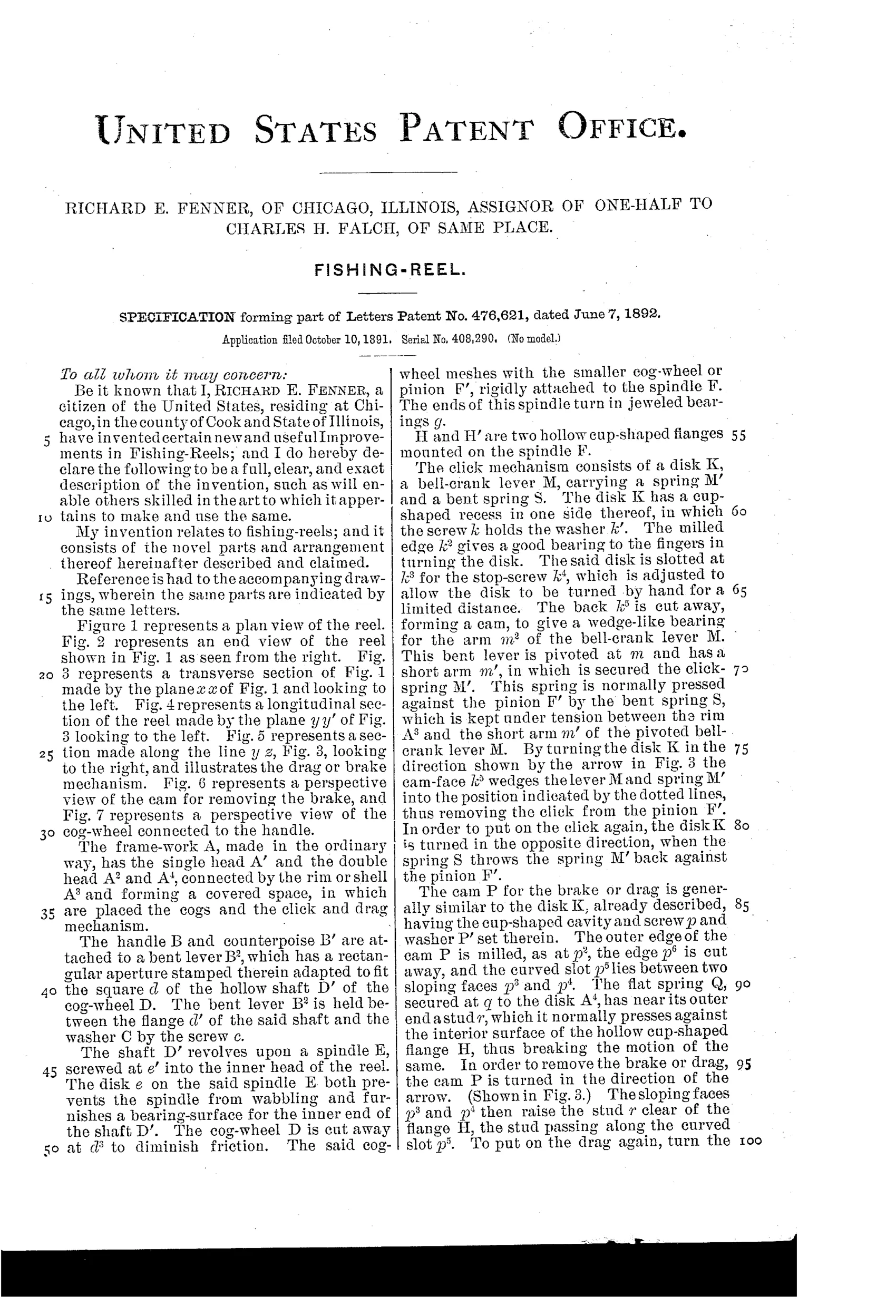
The reel's frame holds a spindle with a pinion and click disk K, whose cam-face engages a spring-loaded bell-crank lever to engage or disengage a click spring against the pinion. A separate cam P with milled edge and inclined faces raises or lowers a spring-loaded stud against a cup-shaped flange to apply or release a brake or drag. Both the click disk and drag cam protrude through the reel rim so they can be adjusted by hand while the handle is turning. The frame and exposed parts are made from an aluminium-copper alloy chosen for lightness and resistance to tarnishing in salt or fresh water.
↻ What was claimed
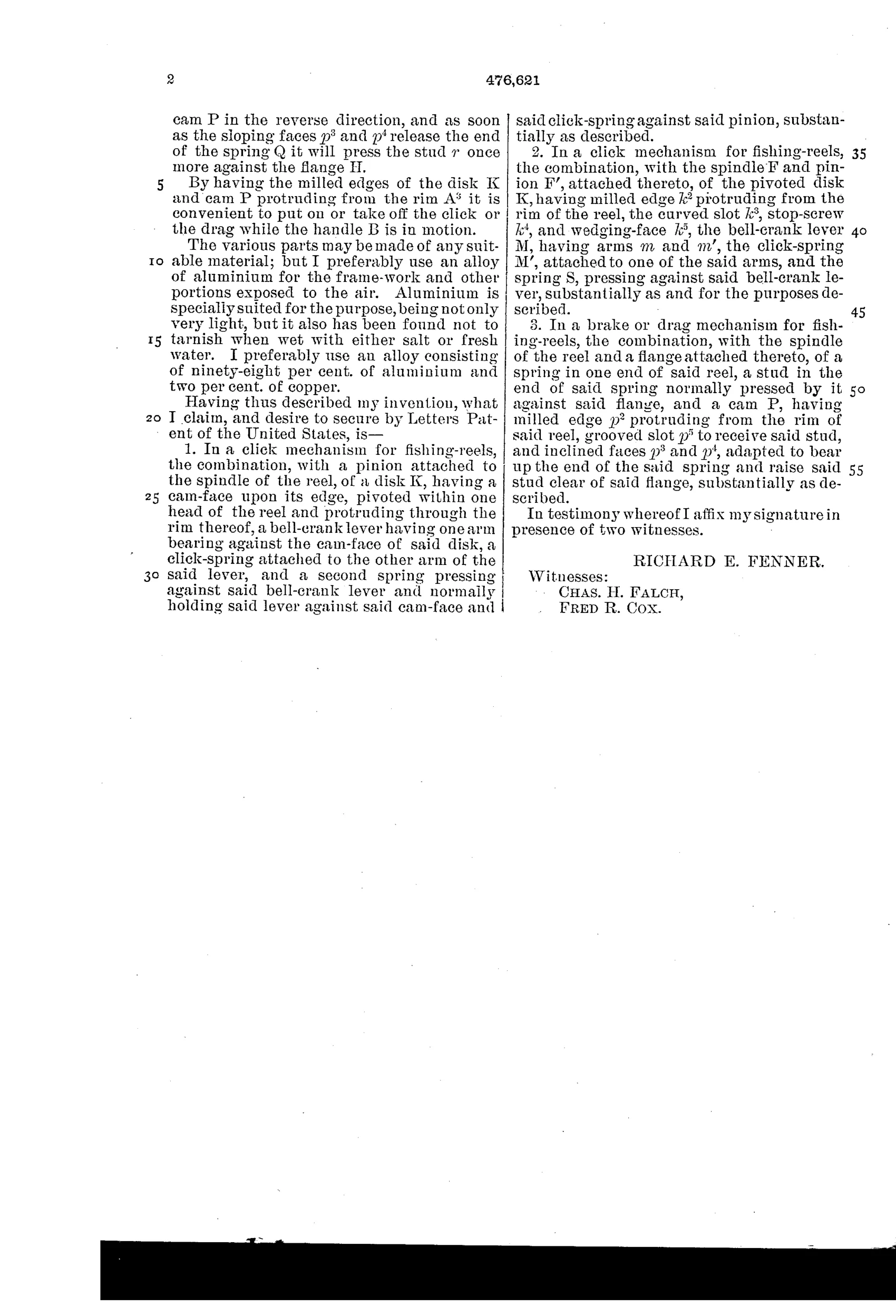
“In a click mechanism for fishing-reels, the combination, with a pinion attached to the spindle of the reel, of a disk K, having a cam-face upon its edge, pivoted within one head of the reel and protruding through the rim thereof, a bell-crank lever having one arm bearing against the cam-face of said disk, a click-spring attached to the other arm of the said lever, and a second spring pressing against said bell-crank lever and normally holding said lever against said cam-face and said click-spring against said pinion, substantially as described.”
In plain English: A pivoted cam disk protruding through the reel's rim works with a spring-loaded bell-crank lever to press or release a click spring against the reel's pinion.
↻ In the inventor’s words
“Aluminium is specially suited for the purpose, being not only very light, but it also has been found not to tarnish when wet with either salt or fresh water.”— Richard E. Fenner, from the specification
Fate unknown
Neither Fenner nor assignee Falch is a documented reel maker, and no marked example is recorded; a surviving aluminum-framed reel with this rim-cam arrangement would settle it.
↻ Patented the same day
- FISHING-REEL — Andrew B. Hendryx
↻ Commentary
Two things make Fenner's Chicago patent worth slowing down for. The first is ergonomic: both the click disk K and the drag cam P poke through the rim of the head plate, so the angler can thumb them on or off while the handle is still turning. Most reels of the era hid these adjustments behind small sliding buttons on the back plate that demanded a pause and a second hand. Figures 2 and 3 show the arrangement — the milled edges just breaking the circle of the rim, positioned for a fingertip mid-fight.
The second is the material. Fenner specifies an aluminium-copper alloy for the frame, noting it is light and 'has been found not to tarnish when wet with either salt or fresh water.' In 1892 that was a fresh idea — the Hall-Héroult process had made aluminum commercially plausible only about five years earlier, and the fishing trade was still overwhelmingly brass and German silver. Whether the alloy of the day would have held threads and pivots as well as he hoped is another question; early aluminum castings were notoriously soft.
The internal mechanics are honest rather than novel. The bell-crank lever translating cam motion into click-spring pressure (Fig. 3) is neat watchwork, and the cup-flange drag in Fig. 5 is a serviceable friction brake. As drag design it is a footnote; as an early argument for aluminum tackle and for controls you can reach mid-cast, it reads ahead of its time. The assignment to Charles H. Falch suggests someone thought it had commercial legs.
Commentary by Claude, The Fishing Reel Patent Archive’s resident enthusiast