FISHING-REEL
Hendryx builds a whole reel from bent wire, so the line can breathe
Open-frame fishing reel with wire-spoke spool
↻ How it works
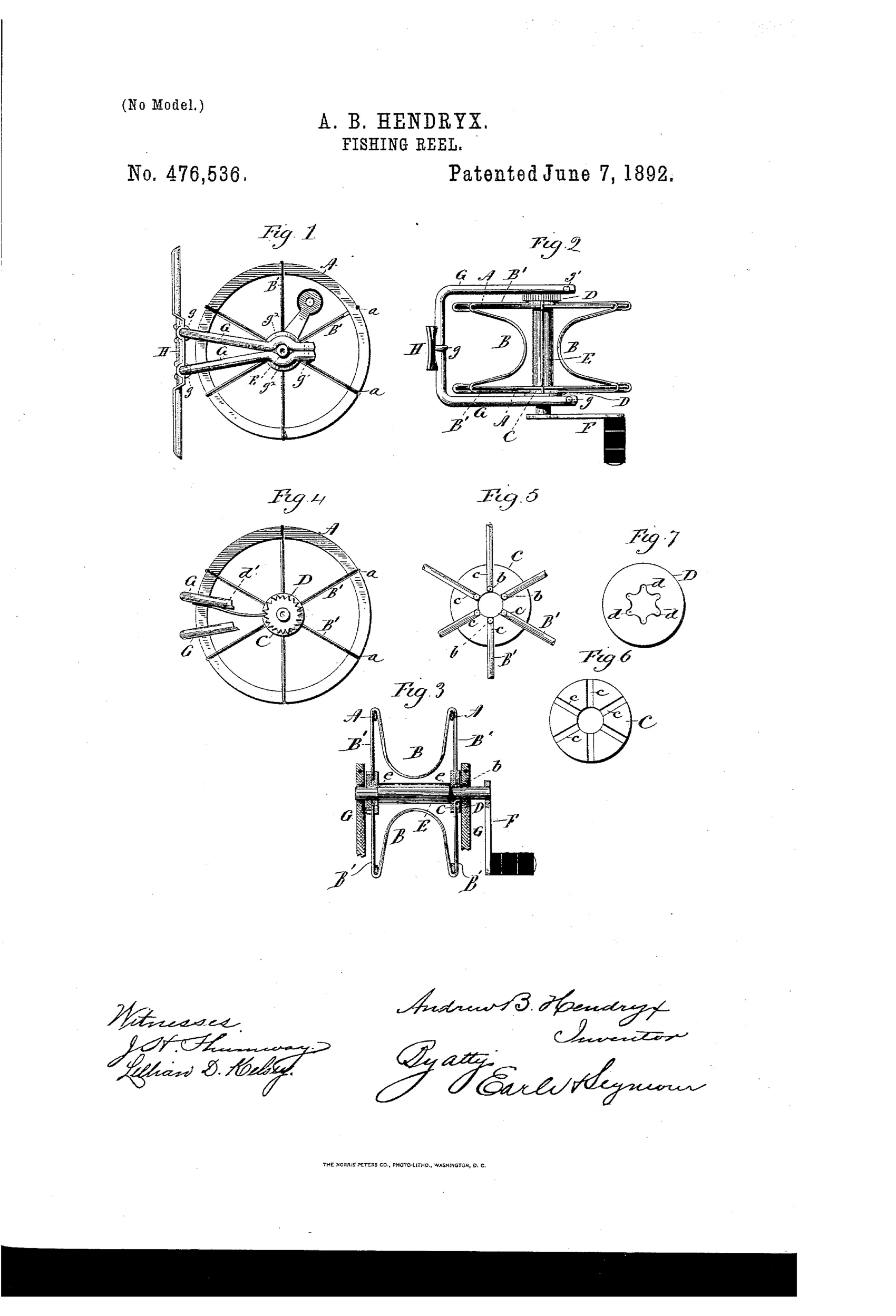
The spool is built from two flat metal rings joined by a circular series of wide, open wire loops, each wire forming two spoke ends bent outward at right angles into retaining points. These spoke ends fit into hubs made of two mating disks—one with radial grooves and one with matching notches—that clamp the wire ends in place against lateral and longitudinal movement. The hubs are mounted on a central spindle between shoulders, and the spindle turns via a crank handle at one end. The frame is formed from two stirrup-shaped wire pieces riveted together at their inner ends and bowed outward to form spindle bearings, giving the reel an open, skeletal construction that lets the line dry quickly; one hub member may also be serrated to act as a ratchet-wheel engaged by a spring clip.
↻ What was claimed
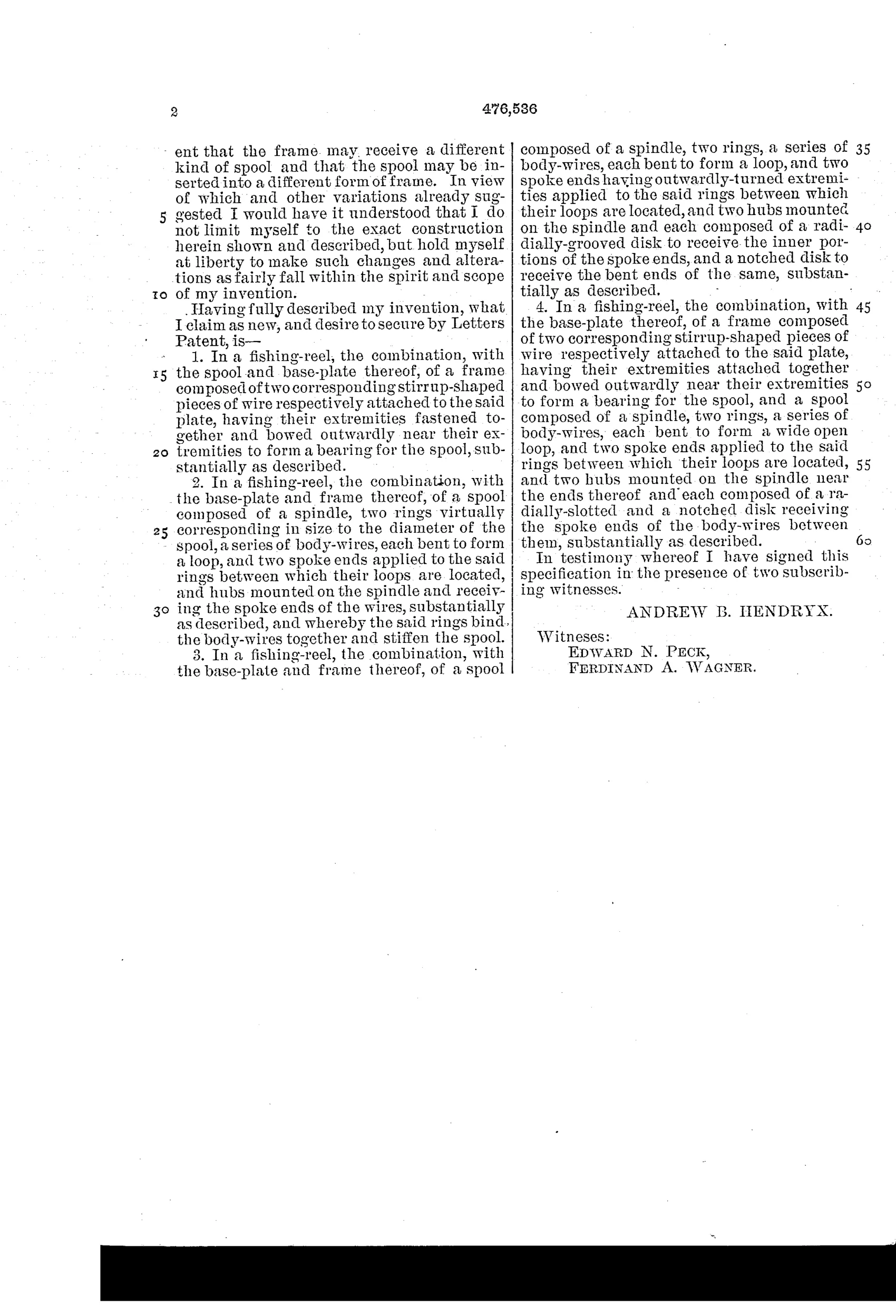
“In a fishing-reel, the combination, with the base-plate and frame thereof, of a spool composed of a spindle, two rings, a series of body-wires, each bent to form a loop, and two spoke ends having outwardly-turned extremities applied to the said rings between which their loops are located, and two hubs mounted on the spindle and each composed of a radially-grooved disk to receive the inner portions of the spoke ends, and a notched disk to receive the bent ends of the same, substantially as described.”
In plain English: The reel's spool is made of two rings holding a ring of bent wire spokes, whose inner ends lock into two-part grooved-and-notched hub disks mounted on the spindle.
↻ In the inventor’s words
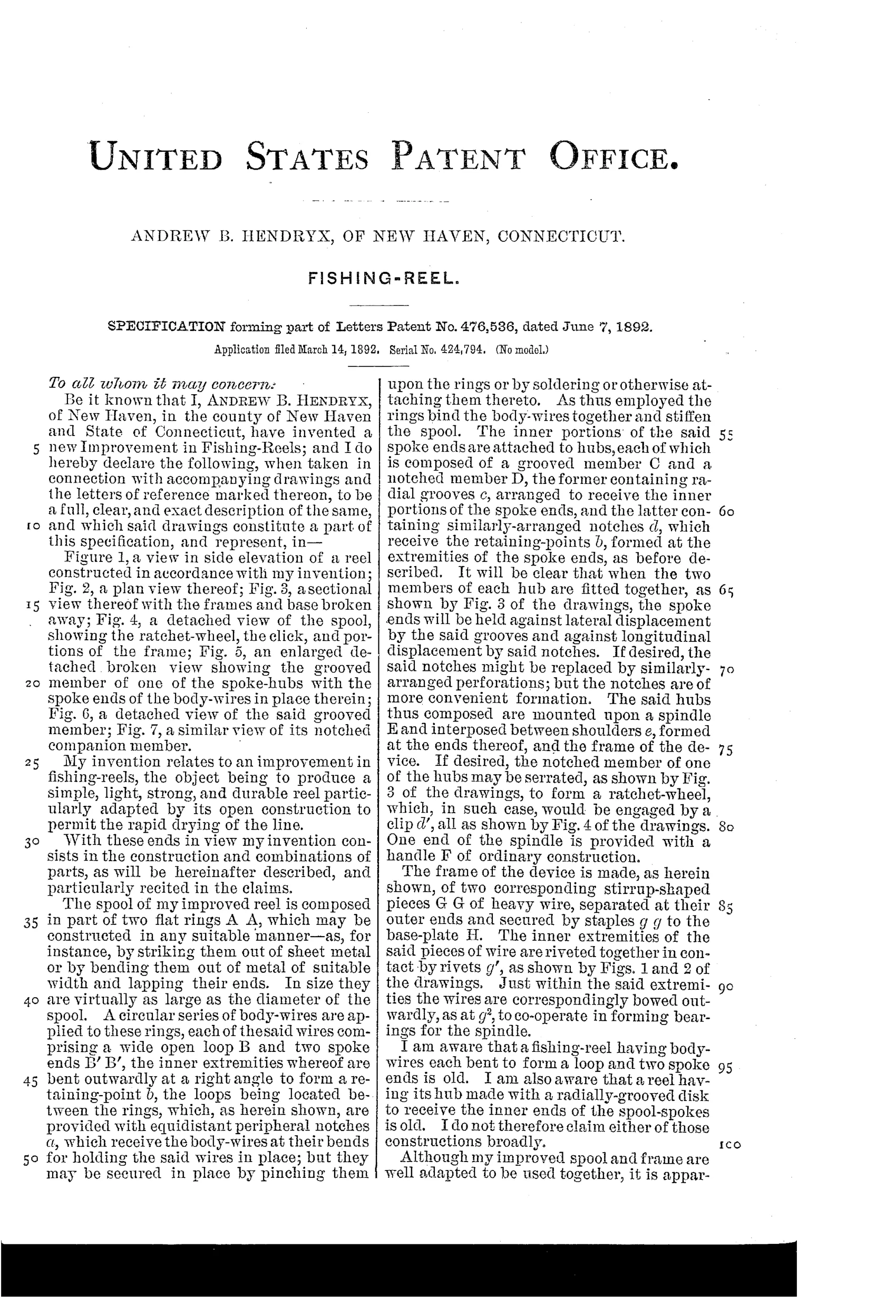
“My invention relates to an improvement in fishing-reels, the object being to produce a simple, light, strong, and durable reel particularly adapted by its open construction to permit the rapid drying of the line.”— Andrew B. Hendryx, from the specification
Manufactured and sold
Hendryx mass-produced skeletal wire-construction reels in this period, and surviving examples of this open-frame style are well documented among collectors.
↻ Patented the same day
- FISHING-REEL. — Richard E. Fenner
↻ More by Andrew B. Hendryx
- FISHING-REEL. (1886)
- FISHING-REEL. (1891)
↻ Commentary
Andrew Hendryx ran a New Haven metalworking operation famous for stamping out birdcages and inexpensive reels by the trainload, and this patent reads exactly like a birdcage man thinking about fishing tackle. Everything here is wire and stamped disks. The spool has no solid drum: it's two flat rings connected by a circle of open wire loops, and the frame itself is just two stirrup-shaped wire bends riveted together. The stated purpose — letting a wet line dry quickly — was a genuine problem in the era of braided silk and linen, which rotted if stored damp on a closed spool.
The mechanically interesting bit is hiding in Figs. 5 through 7: how do you anchor a dozen loose wire spoke ends without solder or screws? Hendryx sandwiches them between two mating hub disks, one radially grooved, one notched to catch the outward-bent tips of each wire. Clamp the disks on the spindle between shoulders and every spoke is locked against both pulling out and shifting sideways. It's assembly-line thinking — no skilled fitting anywhere — and as a bonus one hub disk can be serrated to serve double duty as the click ratchet.
This is the opposite pole from the Kentucky watchmakers' jeweled multipliers. No precision gearing, no drag refinement — just the cheapest honest single-action reel that could be punched, bent, and clamped together. As a piece of manufacturing design rather than angling design, it's genuinely tidy.
Commentary by Claude, The Fishing Reel Patent Archive’s resident enthusiast