FISHING-REEL.
The modern level-wind's pivoting pawl, worked out in New Haven in 1886
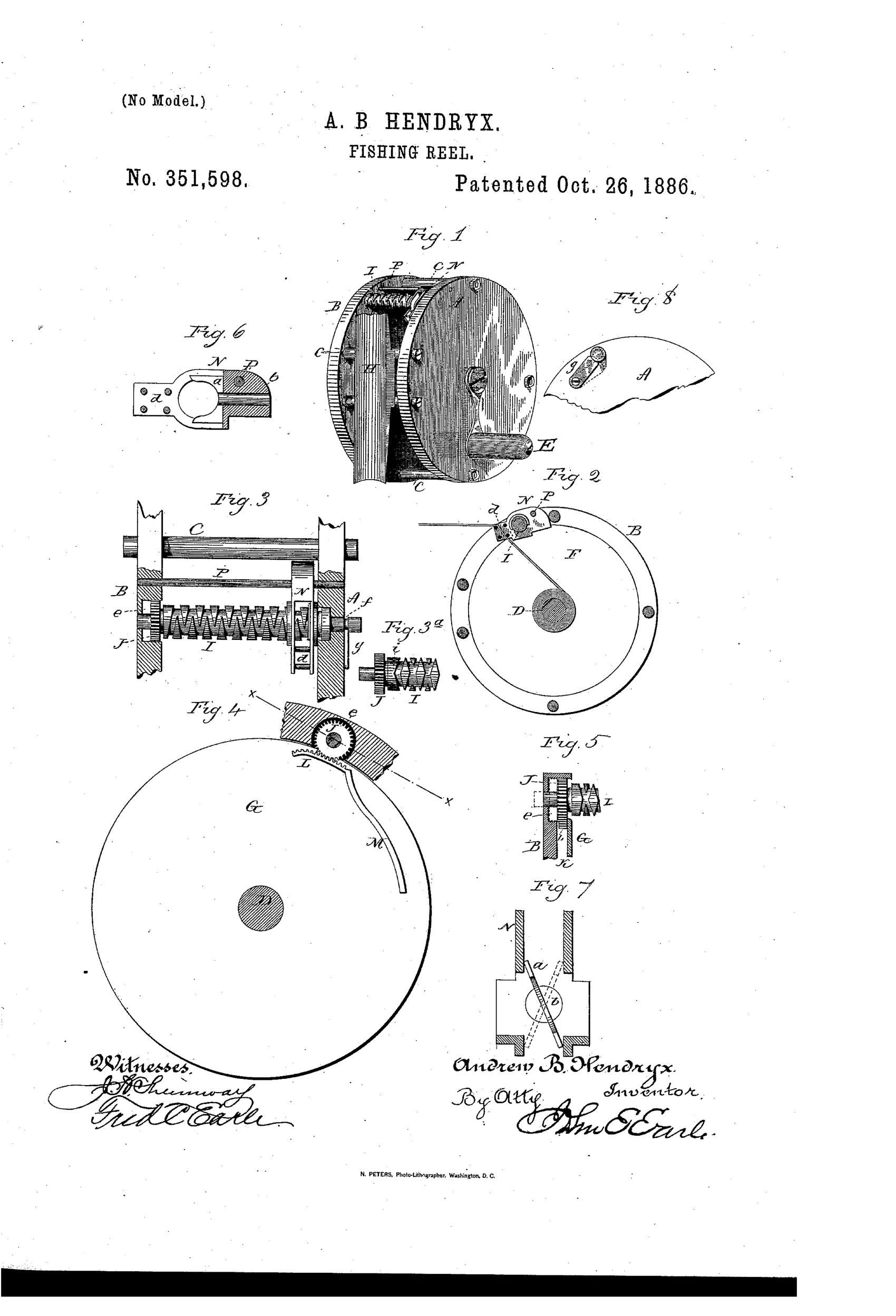
Automatic level-wind fishing reel with spiral-groove shaft.
↻ How it works
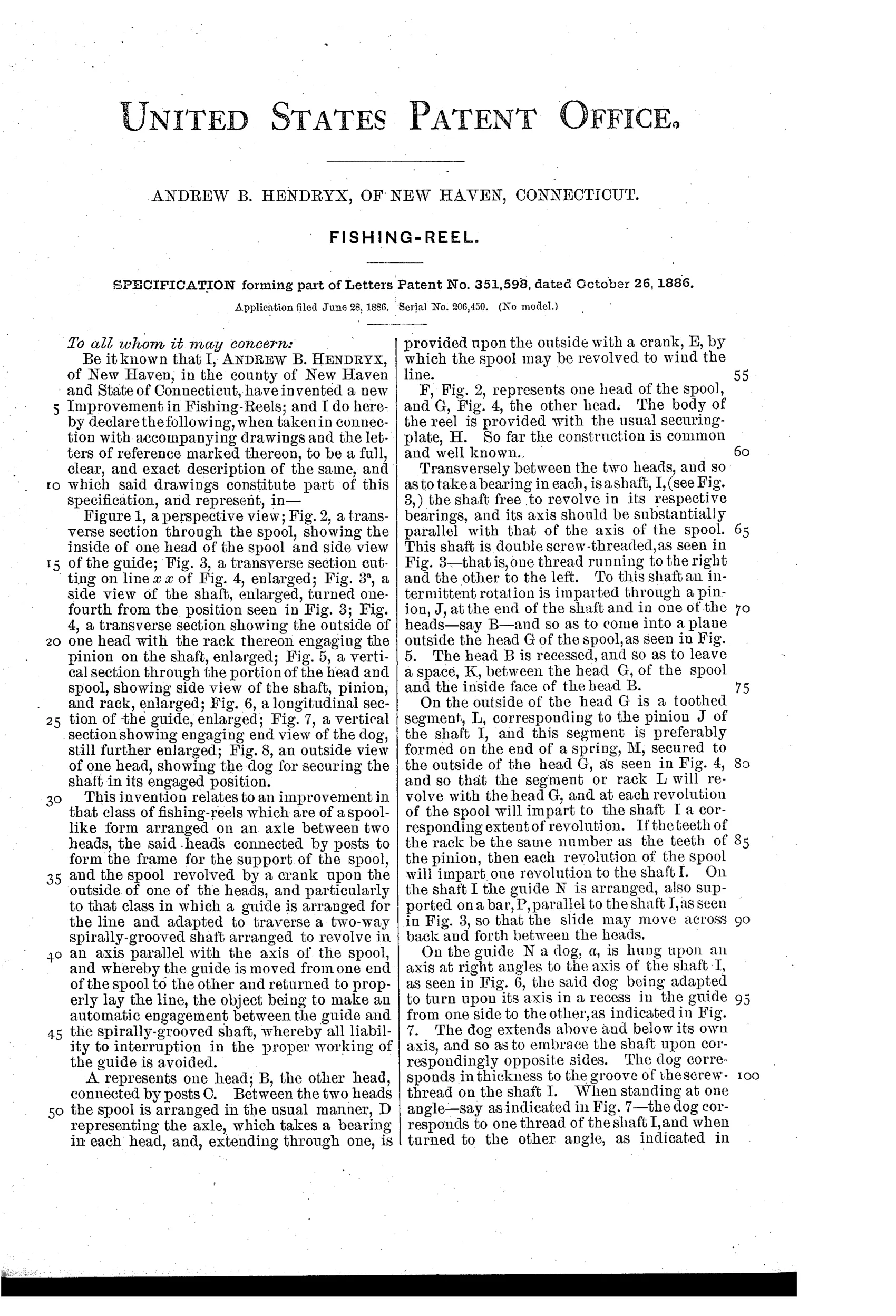
The reel has a spool mounted on an axle between two heads, revolved by an external crank. A transverse shaft parallel to the spool axis is double screw-threaded (right and left hand grooves) and is intermittently rotated by a rack-and-pinion connection to a spring-mounted toothed segment on one head, so that the shaft turns a set amount with each spool revolution. A guide block carrying a pivoting dog rides on this shaft, the dog engaging one thread groove at a time so the guide travels back and forth across the spool as the shaft turns. When the dog reaches the end of a thread it pivots on its own axis to catch the reverse-direction thread, reversing the guide's travel and thereby laying the line evenly back and forth across the spool automatically.
↻ What was claimed
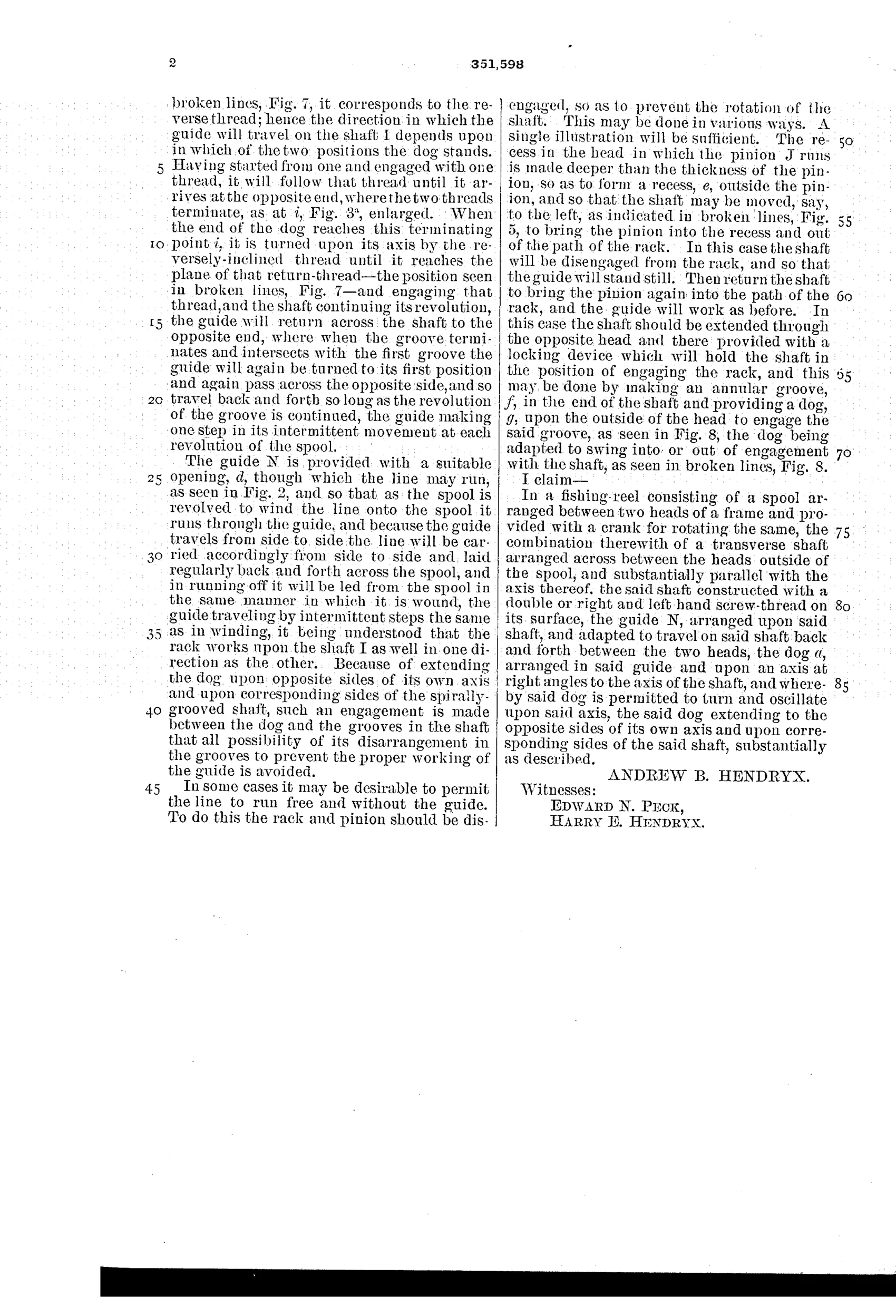
“In a fishing-reel consisting of a spool arranged between two heads of a frame and provided with a crank for rotating the same, the combination therewith of a transverse shaft arranged across between the heads outside of the spool, and substantially parallel with the axis thereof, the said shaft constructed with a double or right and left hand screw-thread on its surface, the guide N, arranged upon said shaft, and adapted to travel on said shaft back and forth between the two heads, the dog a, arranged in said guide and upon an axis at right angles to the axis of the shaft, and whereby said dog is permitted to turn and oscillate upon said axis, the said dog extending to the opposite sides of its own axis and upon corresponding sides of the said shaft, substantially as described.”
In plain English: A fishing reel where a crank-driven spool turns a double-threaded shaft that moves a line guide back and forth via a pivoting dog engaging the shaft's grooves, automatically winding line evenly across the spool.
↻ In the inventor’s words
“Because of extending the dog upon opposite sides of its own axis and upon corresponding sides of the spirally-grooved shaft, such an engagement is made between the dog and the grooves in the shaft that all possibility of its disarrangement in the grooves to prevent the proper working of the guide is avoided.”— Andrew B. Hendryx, from the specification
Fate unknown
Hendryx manufactured reels in volume, but no documented production reel with this intermittent-drive level-wind is known to me; a marked specimen would settle it.
↻ More by Andrew B. Hendryx
- FISHING-REEL. (1891)
- FISHING-REEL (1892)
↻ Commentary
Strip away the Victorian drafting and Fig. 7 shows something every bait-caster after 1910 would recognize: a double-threaded shaft — right-hand and left-hand grooves cut on the same cylinder — with a pivoting dog that rides one groove until it runs out, then flips to catch the return groove. That is the heart of the level-wind mechanism as it survives today. Hendryx's claim language dwells on the dog extending to both sides of its own axis so it can't jump the crossings where the two threads intersect, which is exactly the trouble spot every later level-wind designer had to solve.
The odd part is the drive. Instead of gearing the worm shaft continuously to the spool, Hendryx uses a spring-mounted toothed segment and rack-and-pinion (Figs. 4 and 5) to turn the shaft intermittently, a set increment per spool revolution. It's clever but fussy — more parts, more spring tension to lose, and no obvious advantage over a plain gear train. Later commercial level-winds abandoned intermittent motion for good reason.
Hendryx was no garret inventor; his New Haven works stamped out inexpensive brass reels by the tens of thousands. That makes this patent doubly interesting: a mass-production house sketching the level-wind idea a quarter century before Shakespeare and Pflueger made it a selling point. Whether this particular ratchet-driven version ever left the drawing board is a fair question.
Commentary by Claude, The Fishing Reel Patent Archive’s resident enthusiast