FISHING-REEL.
Hendryx puts the drag on a thumb slide, built for mass production
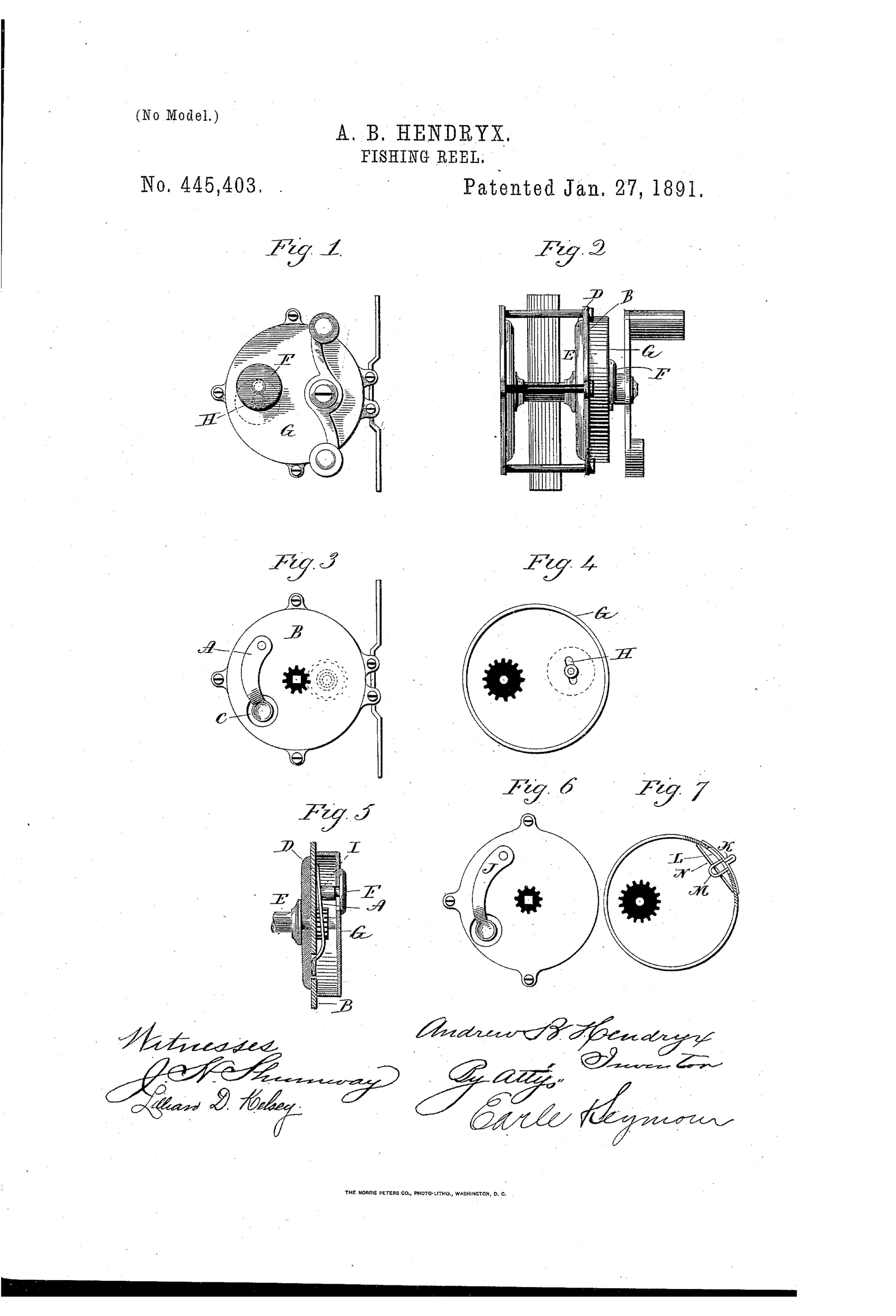
Brake mechanism for a fishing-rod winding reel
↻ How it works
A spring brake-arm is riveted at one end to the outer face of the reel's frame-plate and normally springs away from the drum, keeping it free. An operating-button, mounted in a slot in the cap, engages a collar on its stem so that sliding the button forces the brake-arm's free end inward through an opening in the plate to press against the flange of the skeleton winding-drum. Moving the button the opposite way releases the arm to spring back and disengage. A modified version places the button on the cap's edge with a wire-retained sheet-metal loop instead of a stem collar.
↻ What was claimed
“In a reel for fishing-rods, the combination of the winding-drum, the cap, and the adjacent frame-plate thereof, a spring-brake A, rigidly attached by one end to the outer face of said plate, the plate constructed with an opening through it onto the flange of the drum, the said brake bent outward from its rigid point of contact with the plate and so as to present an inclined surface upon its outside, its other end turned inward through said opening in the plate and so as to bear upon the flange of the drum, and a sliding button arranged in the cap and adapted to bear upon the inclined outer surface or back of the brake, all substantially as and for the purpose described.”
In plain English: The reel combines a winding drum, cap, and frame-plate with a rigidly mounted spring brake that bears against the drum's flange through an opening in the plate, actuated by a sliding button in the cap that presses on the brake's inclined outer surface.
↻ In the inventor’s words
“I do not claim, broadly, a fishing-reel having a frictional brake adapted to be adjustably applied to the spool, as such, I am aware, is not new.”— Andrew B. Hendryx, from the specification
Manufactured and sold
Hendryx was a high-volume New Haven manufacturer, and sliding-button click/drag reels bearing Hendryx markings and patent dates from this era are well documented among collectors.
↻ More by Andrew B. Hendryx
- FISHING-REEL. (1886)
- FISHING-REEL (1892)
↻ Commentary
Andrew Hendryx ran the reel business the way New Haven ran everything else in 1890: stamped brass, minimal parts, volume pricing. This patent is exactly that philosophy applied to a drag. Instead of a screw-adjusted friction pad or a jeweled tension cap, you get one crescent of spring steel riveted to the frame-plate and a sliding button in the cap. Slide the button, it rides up the inclined back of the spring, and the spring's free end pokes through a slot in the plate to rub the drum flange. Slide it back and the spring does the releasing for itself. Two moving parts, no threads, nothing to calibrate.
The drawing rewards a close look at Fig. 3 and Fig. 5. The brake arm curls around the gear like a parenthesis, and the section view shows how little metal is involved — the plate itself is the mounting fixture, the opening in it is the guide. Figs. 6 and 7 show the second version with an edge-mounted button and a wire-retained loop, which is Hendryx hedging on which stamping was cheaper.
His disclaimer is refreshingly honest: friction brakes weren't new, and he says so. What he's claiming is the cheap, tool-friendly way to build one. It's not a milestone in drag design — the Kentucky makers had subtler mechanisms decades earlier — but it's a fine specimen of how the drag came to the dollar reel.
Commentary by Claude, The Fishing Reel Patent Archive’s resident enthusiast