FISH-LINE REEL.
An 1894 level-wind that puts the crank on the worm shaft itself
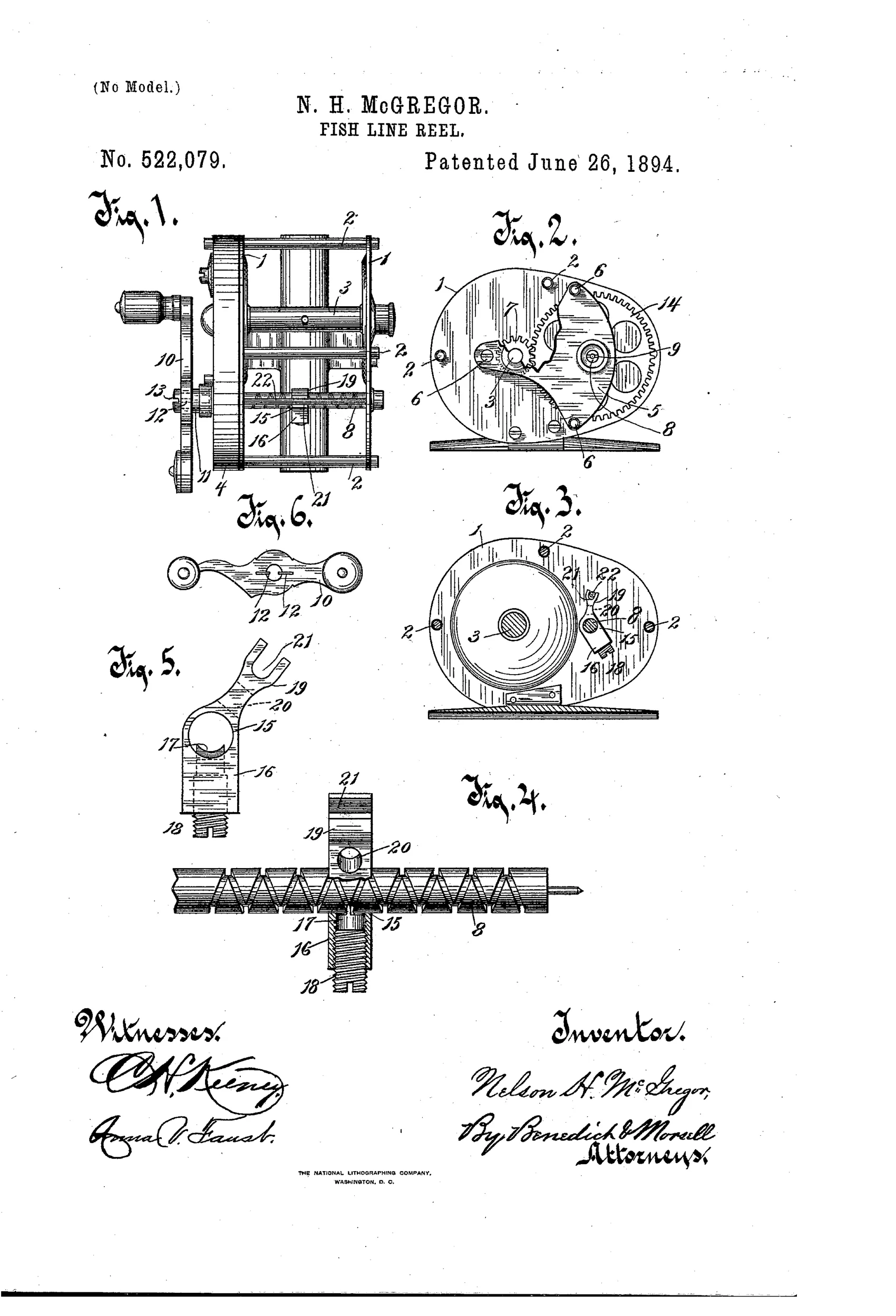
Geared level-wind fishing reel with reverse-grooved shaft
↻ How it works
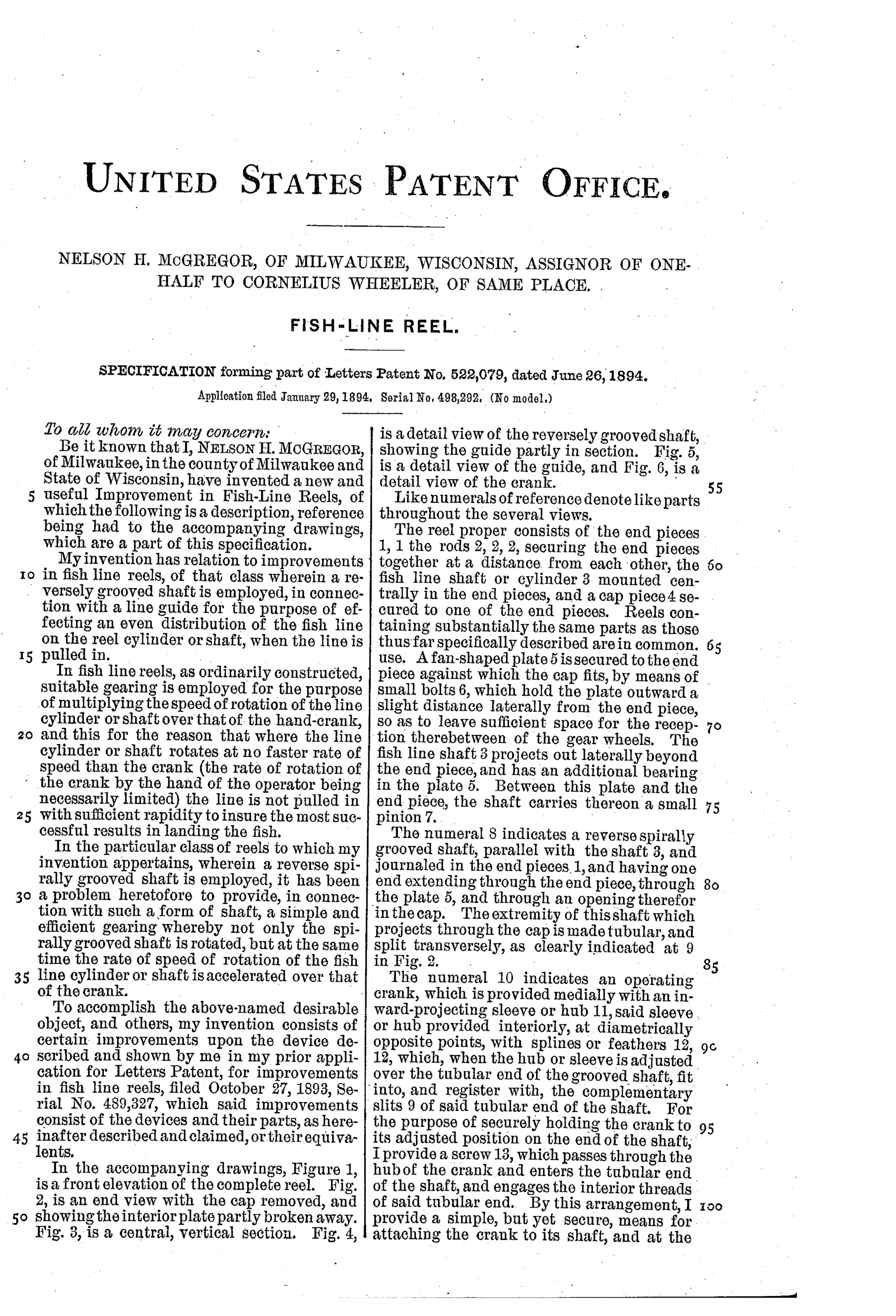
A fish-line shaft carrying a small pinion meshes with a large gear fixed on a parallel reverse spirally grooved shaft, so that turning the crank (attached directly to the grooved shaft) multiplies the rotational speed of the line shaft. A loose ring riding on the grooved shaft carries an apertured lug through which the line passes, and a pin projecting from the ring's boss rides in the shaft's grooves, causing the ring to travel back and forth and evenly distribute the line. A guide rod engages a recessed lug on the ring to prevent the ring from rotating with the shaft. The crank attaches to the grooved shaft via a splined hub that fits into slits in the shaft's tubular end, secured by a screw, allowing the crank to be detached easily to access the cap and gears.
↻ What was claimed
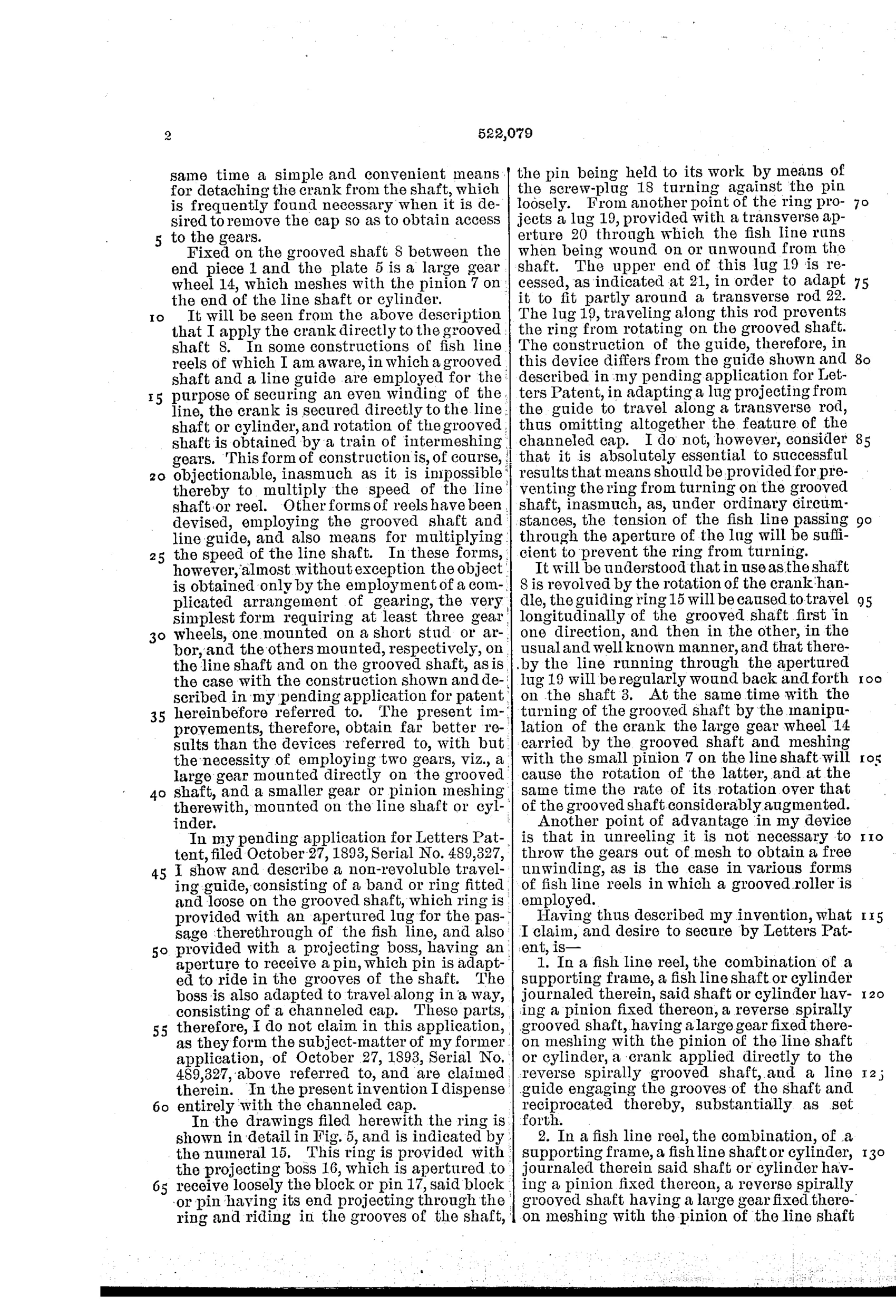
“In a fish line reel, the combination of a supporting frame, a fish line shaft or cylinder journaled therein, said shaft or cylinder having a pinion fixed thereon, a reverse spirally grooved shaft, having a large gear fixed thereon meshing with the pinion of the line shaft or cylinder, a crank applied directly to the reverse spirally grooved shaft, and a line guide engaging the grooves of the shaft and reciprocated thereby, substantially as set forth.”
In plain English: A reel where the crank turns a grooved shaft with a large gear that drives a pinion on the line shaft, spinning it faster, while a line guide riding in the shaft's grooves moves back and forth to wind the line evenly.
↻ In the inventor’s words
“In the particular class of reels to which my invention appertains, wherein a reverse spirally grooved shaft is employed, it has been a problem heretofore to provide, in connection with such a form of shaft, a simple and efficient gearing whereby not only the spirally grooved shaft is rotated, but at the same time the rate of speed of rotation of the fish line cylinder or shaft is accelerated over that of the crank.”— Nelson H. McGregor, from the specification
Fate unknown
No marked McGregor or Wheeler reel is documented to my knowledge; a surviving example stamped with this patent date would settle it.
↻ More by Nelson H. McGregor
- FISH-LINE REEL (1894)
↻ Commentary
Level-wind reels are usually told as a 1900s story — Shakespeare's early efforts, the Marhoff patent Pflueger built an empire on — so a Milwaukee inventor working out the reverse-spiral worm and traveling line guide in 1894 deserves a look. All the essential furniture of the twentieth-century baitcaster is here: the endless-groove shaft, the pawl riding in it, the apertured guide carrying the line back and forth across the spool.
McGregor's twist is where he puts the crank. Instead of cranking the spool and driving the level-wind off it through gearing, he attaches the handle directly to the grooved shaft, then uses a large gear on that shaft meshing with a small pinion on the spool to get his multiplication. It is an elegant economy — one gear pair does both jobs, speeding the spool and timing the guide — but it means the angler is cranking the worm, and every ounce of drag from the pawl and guide is felt at the handle before any line moves.
The detachable splined crank in Fig. 6 is a thoughtful touch for servicing the gears, and Fig. 4 shows he understood the reversing groove properly. As a mechanism it would work; as a fishing tool it likely felt heavy in the hand compared to spool-cranked designs. Call it an early, honest attempt at the problem the industry would solve differently fifteen years later.
Commentary by Claude, The Fishing Reel Patent Archive’s resident enthusiast