FISH-LINE REEL
A replaceable level-wind pawl in 1894, years before Shakespeare made it standard
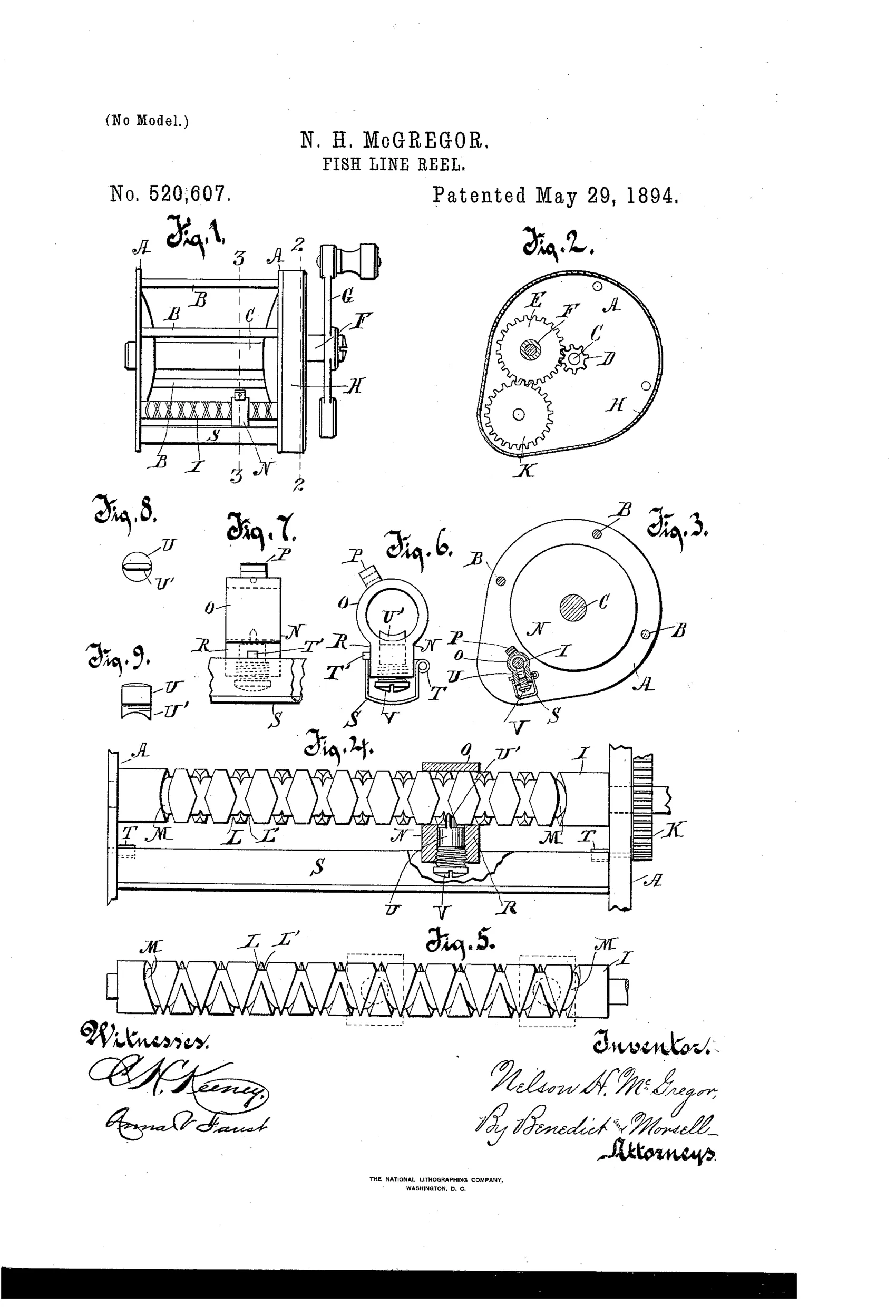
Level-wind fishing reel with reversing worm-drive line guide
↻ How it works
A revolving reversely-grooved worm shaft I, driven via gears from the main spool shaft C, engages a loose traveling guide ring N through a spring-loaded pin U seated in a threaded boss R. As the worm rotates, the pin follows the crossing spiral grooves L, L', causing the non-rotating guide to travel back and forth along the shaft so the line winds evenly in successive layers on the reel. A hinged channeled cap S covers the guide and boss, both guiding its travel and permitting the worn pin to be unscrewed and replaced without disassembling the reel.
↻ What was claimed
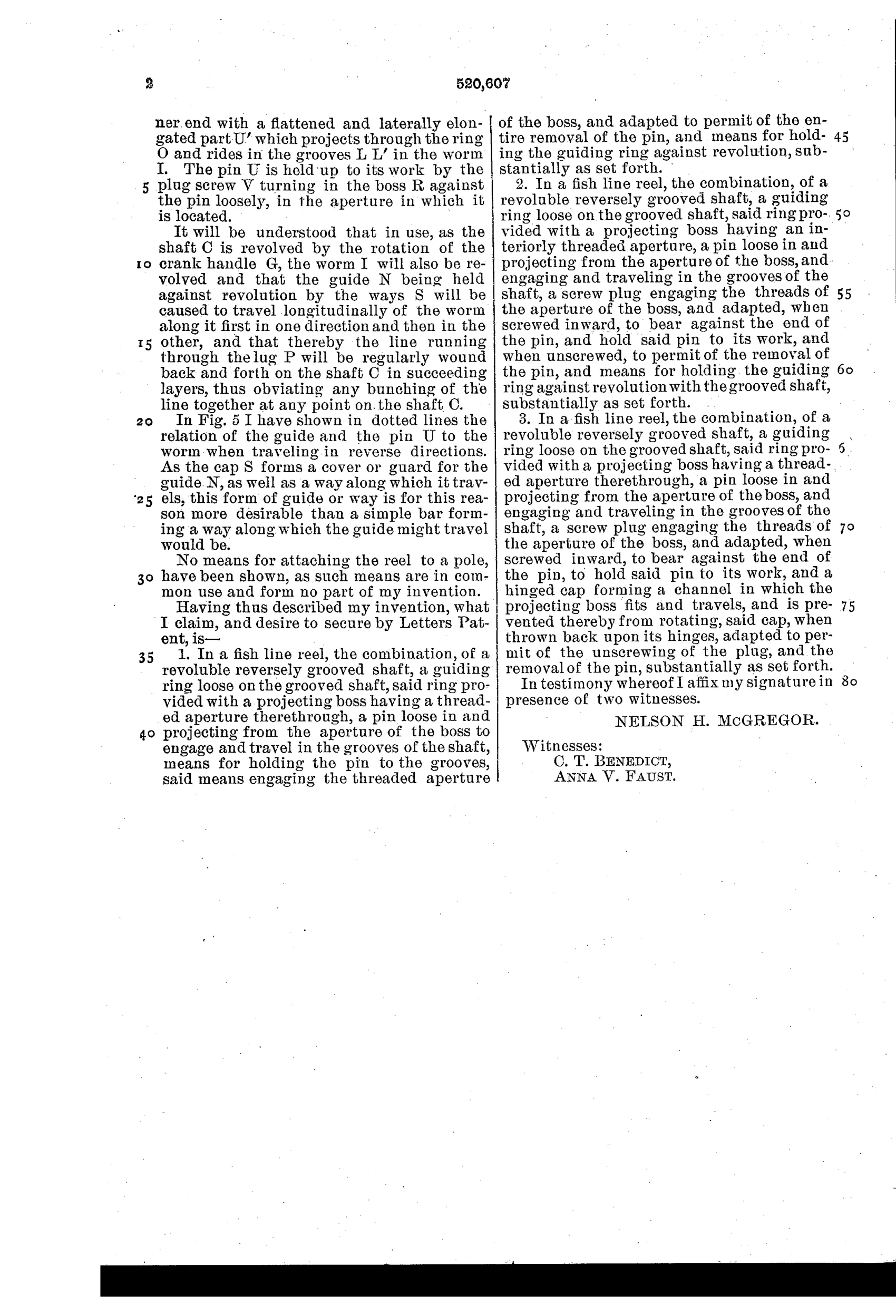
“In a fish line reel, the combination, of a revoluble reversely grooved shaft, a guiding ring loose on the grooved shaft, said ring provided with a projecting boss having a threaded aperture therethrough, a pin loose in and projecting from the aperture of the boss to engage and travel in the grooves of the shaft, means for holding the pin to the grooves, said means engaging the threaded aperture of the boss, and adapted to permit of the entire removal of the pin, and means for holding the guiding ring against revolution, substantially as set forth.”
In plain English: The reel combines a rotating double-spiral-grooved shaft with a loose guide ring whose boss holds a removable, spring-loaded pin that rides in the grooves, while a separate guide way keeps the ring from spinning with the shaft.
↻ In the inventor’s words
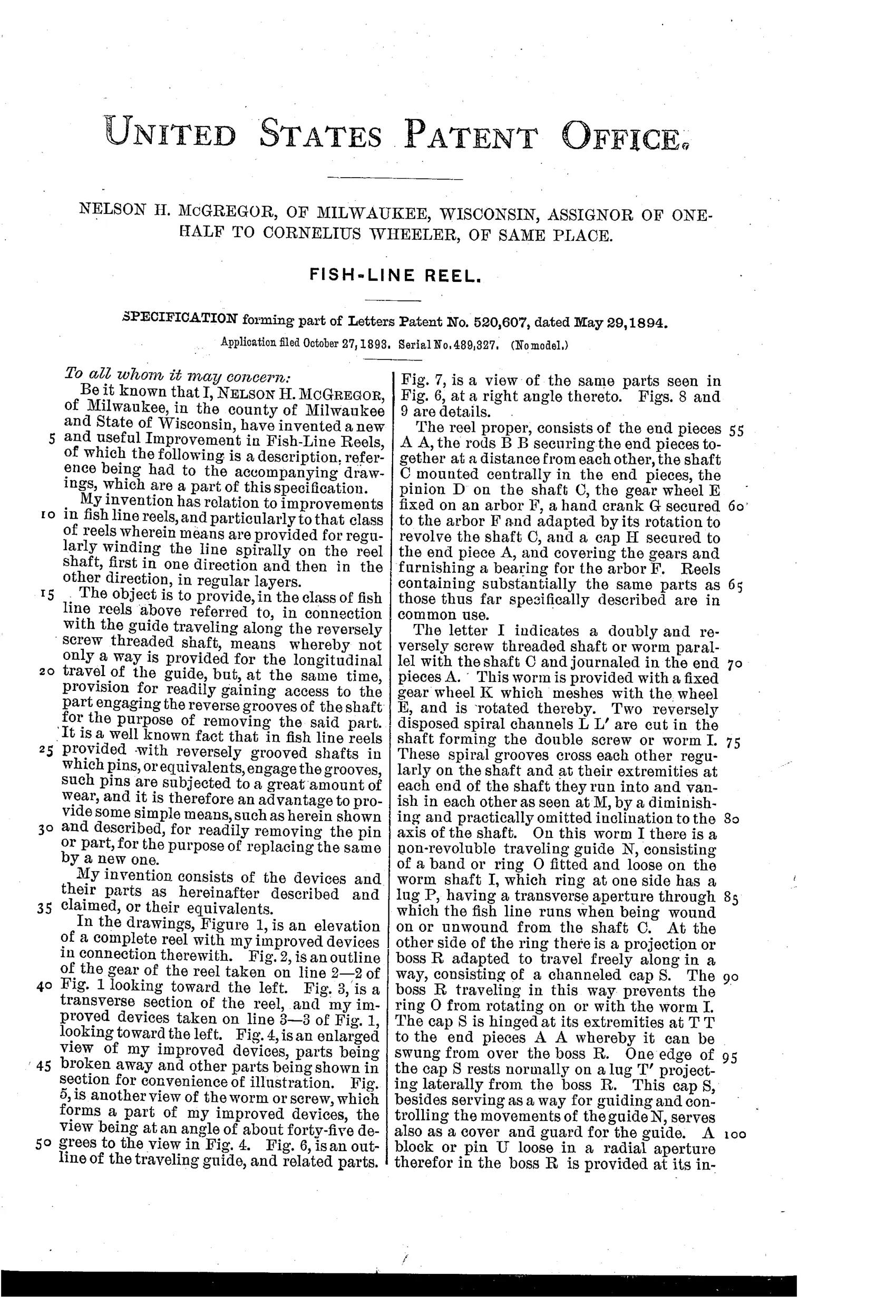
“It is a well known fact that in fish line reels provided with reversely grooved shafts in which pins, or equivalents, engage the grooves, such pins are subjected to a great amount of wear, and it is therefore an advantage to provide some simple means, such as herein shown and described, for readily removing the pin or part, for the purpose of replacing the same by a new one.”— Nelson H. McGregor, from the specification
Fate unknown
McGregor is not a documented reel maker and no marked example is known to me; a surviving reel with this hinged pawl cap would settle it.
↻ Patented the same day
- FISH-LINE REEL. — Charles B. Corbin
↻ More by Nelson H. McGregor
- FISH-LINE REEL. (1894)
↻ Commentary
The reversely-grooved worm shaft — one continuous spiral crossing another so a pawl shuttles back and forth without any reversing gearwork — is the heart of every classic level-wind reel. McGregor didn't invent that geometry, but in 1894 he attacked the part of it everyone else was ignoring: the pawl wears out. His own specification says it plainly, that pins riding those crossing grooves take "a great amount of wear," and his answer is a spring-loaded pin seated in a threaded boss under a hinged channeled cap, so an angler can unscrew and replace the worn pin without tearing the reel apart.
That is precisely the arrangement that later became universal on Shakespeare, Pflueger, and South Bend level-winds — the little screw-off pawl cap on the carriage is one of the most-serviced parts on any baitcaster. Figures 6 through 9 are worth a close look: the whole drawing sheet is really about that one small pin U and its retainer, drawn from two angles plus two detail views. The hinged cap S doubles as the keyway that keeps the guide ring from rotating with the shaft, which is a tidy bit of double duty.
Shakespeare's celebrated level-wind patent was still three years away when this issued, which makes McGregor a genuinely early entry in the line-laying race, filed from Milwaukee rather than the usual Brooklyn or Kentucky addresses. Whether anyone built it is another question.
Commentary by Claude, The Fishing Reel Patent Archive’s resident enthusiast