FISH-LINE REEL.
Spring drive, hand crank, and free-spool in one drum — pick your mode.
Spring-wound automatic fishing reel with brake
↻ How it works
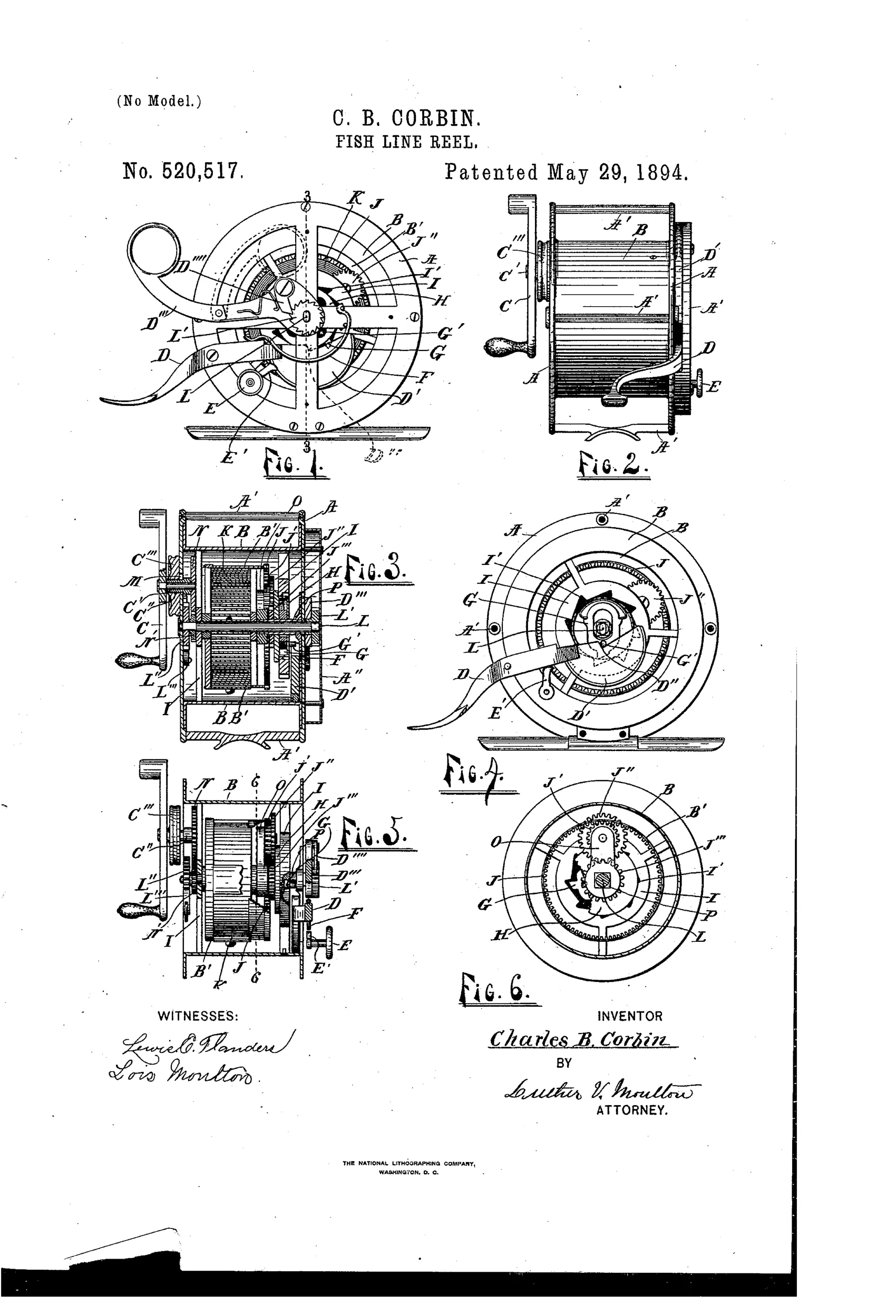
A mainspring wound by a folding crank lever drives a train of gears and a pawl-and-ratchet mechanism that rotates the line drum. A spring-actuated brake shoe engages the drum and, when depressed, disengages the pawl from the ratchet to allow free-running line. An auxiliary hand crank with an adjustable pinion can be engaged separately to wind the drum manually, bypassing the spring drive entirely. A dog and milled head can lock the brake lever in the disengaged position for free-spooling.
↻ What was claimed
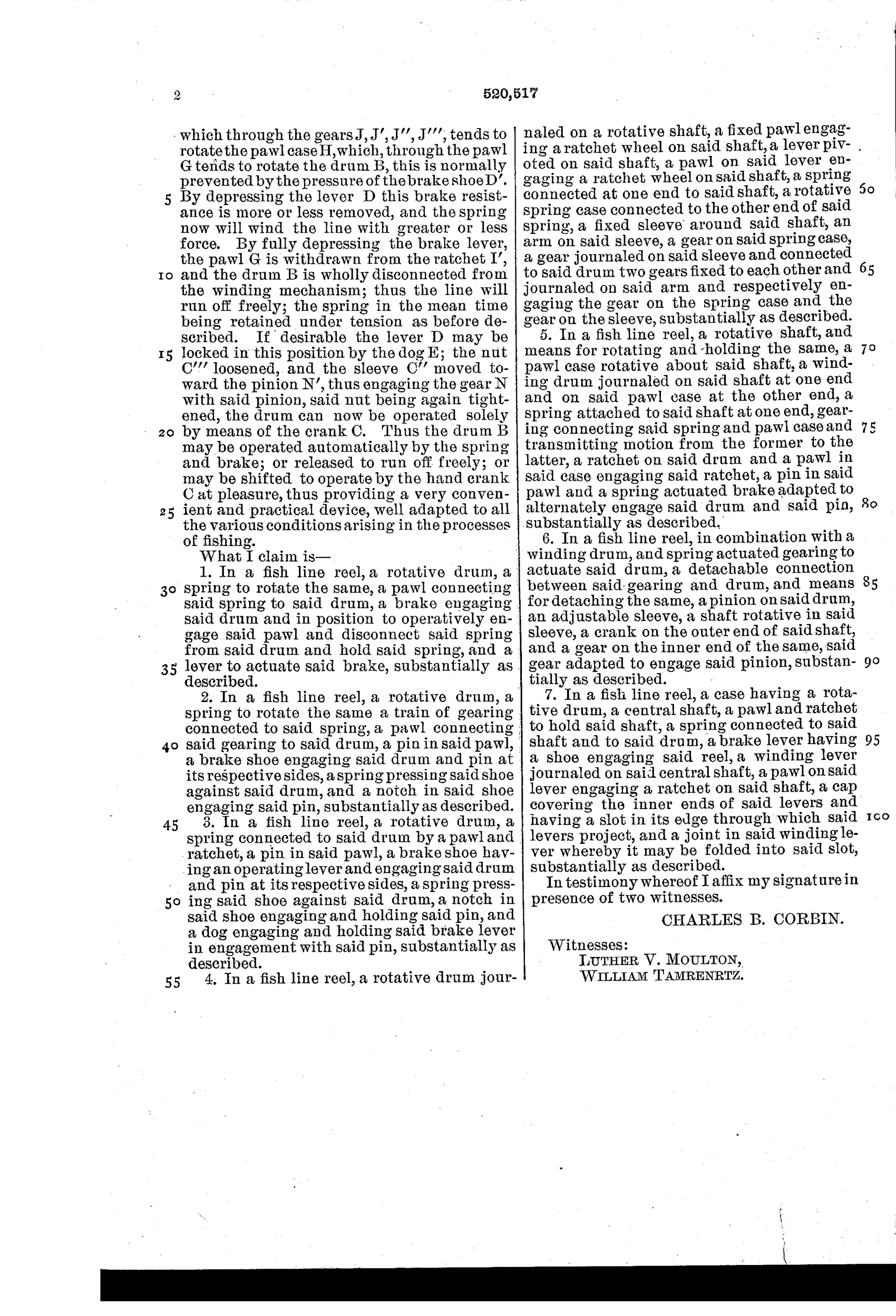
“In a fish line reel, a case having a rotative drum, a central shaft, a pawl and ratchet to hold said shaft, a spring connected to said shaft and to said drum, a brake lever having a shoe engaging said reel, a winding lever journaled on said central shaft, a pawl on said lever engaging a ratchet on said shaft, a cap covering the inner ends of said levers and having a slot in its edge through which said levers project, and a joint in said winding lever whereby it may be folded into said slot, substantially as described.”
In plain English: The reel has a spring-driven drum controlled by a pawl-and-ratchet held shaft, a brake lever with a shoe pressing the drum, and a foldable winding crank lever that tucks into a slotted cap covering the mechanism.
↻ In the inventor’s words
“Thus the drum B may be operated automatically by the spring and brake; or released to run off freely; or may be shifted to operate by the hand crank C at pleasure, thus providing a very convenient and practical device, well adapted to all the various conditions arising in the processes of fishing.”— Charles B. Corbin, from the specification
Fate unknown
Corbin is not a documented maker and no surviving example is recorded to my knowledge; a marked specimen or trade listing would settle it.
↻ Patented the same day
- FISH-LINE REEL — Nelson H. McGregor
↻ Commentary
Automatic reels — spool driven by a wound mainspring so the angler can retrieve line by pressing a lever — were a real current in the 1880s and 90s, and Yawman & Erbe of Rochester had already made them commercially familiar. Corbin's contribution here isn't the spring drive itself but the insistence that one reel should do everything: spring retrieve, manual crank retrieve through a separately engaged pinion, and true free-running line with the pawl kicked out of the ratchet. His own quote gives the game away — a device 'well adapted to all the various conditions arising in the processes of fishing.'
The detail worth studying is the folding winding lever, claimed specifically: it hinges flat and tucks into a slot in the cap covering the mechanism, so the spring-winding arm doesn't snag line or clothing when stowed. That's a genuinely thoughtful touch on a class of reel that tended toward protruding hardware. The brake lever pulls double duty too — its shoe modulates the drum's speed under spring power, and depressing it further disengages the pawl, with a dog to lock it there for casting.
The worry is what the section views in Figs. 3 and 6 make plain: this is a lot of clockwork in a small case, three drive paths sharing one shaft. Each mode works on paper; keeping the engagements crisp in a wet, sandy pocket is another matter. It reads as an ambitious dead-end branch of the automatic-reel line rather than a refinement anyone followed.
Commentary by Claude, The Fishing Reel Patent Archive’s resident enthusiast