REEL FOR FISHING-RODS.
Not a reel at all — a stick-mounted rig for drying wet fishing line
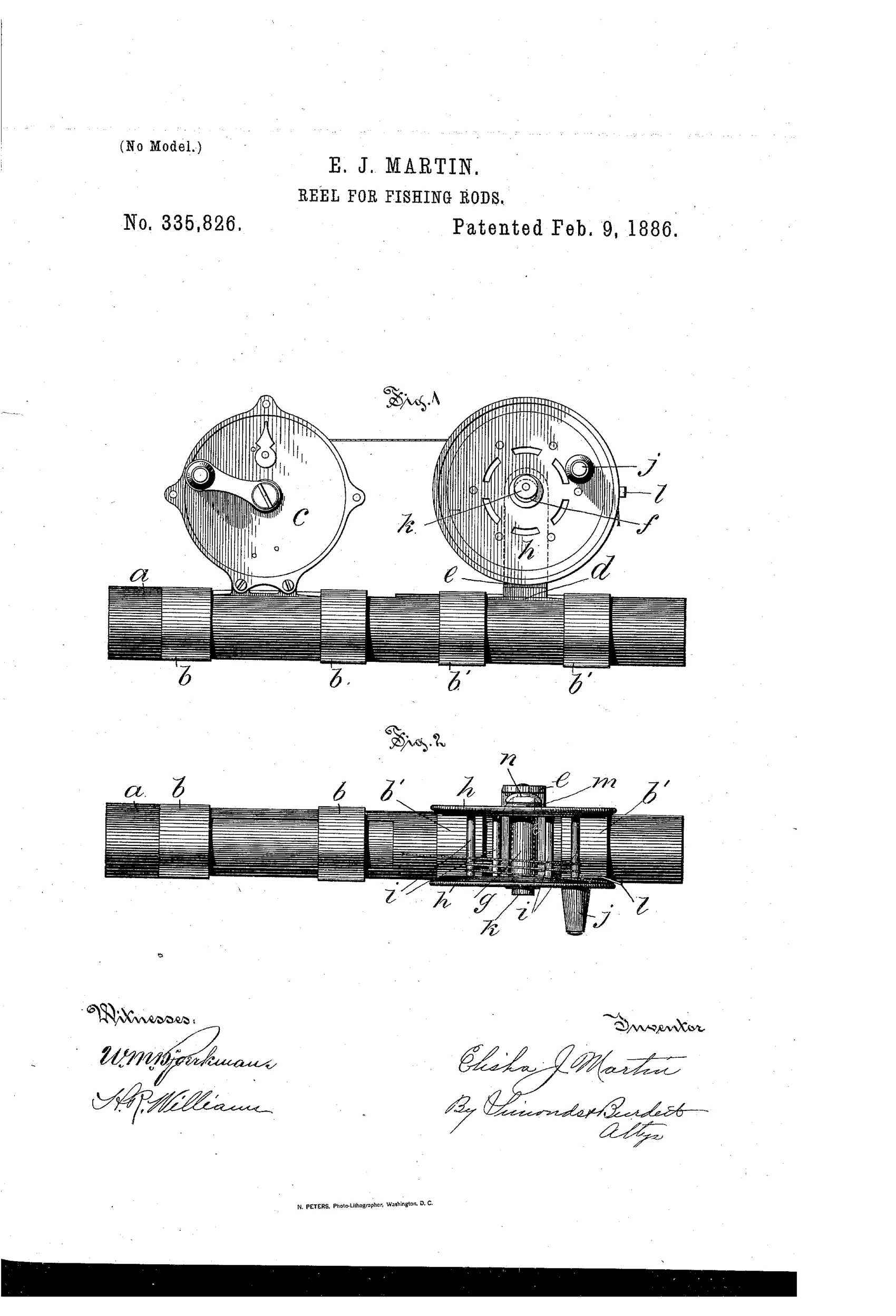
Device for transferring fish-line between reels
↻ How it works
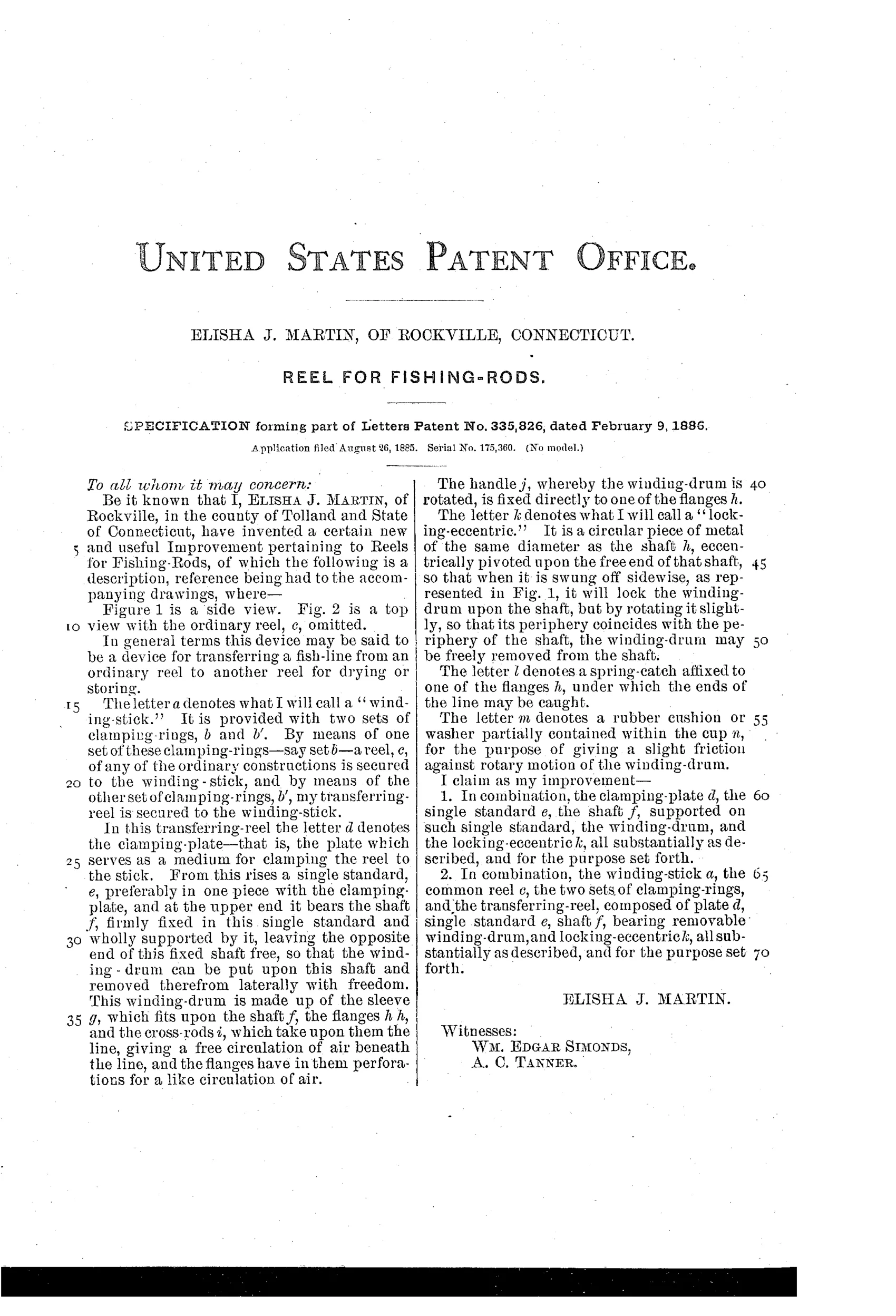
A winding-stick has two sets of clamping-rings; one holds an ordinary fishing reel and the other secures a transferring-reel to the stick. The transferring-reel has a clamping-plate and single standard supporting a fixed shaft, on which a removable winding-drum with sleeve, flanges, and cross-rods can be mounted or removed laterally. A locking-eccentric pivoted on the free end of the shaft locks the winding-drum in place unless rotated slightly to align with the shaft's periphery, allowing removal, and a handle fixed to a flange rotates the drum while a spring-catch secures the line end.
↻ What was claimed
“In combination, the clamping-plate d, the single standard e, the shaft f, supported on such single standard, the winding-drum, and the locking-eccentric k, all substantially as described, and for the purpose set forth.”
In plain English: The invention combines a clamping plate, a single support standard, a fixed shaft on that standard, a removable winding drum, and a locking eccentric that secures or releases the drum from the shaft.
↻ In the inventor’s words
“In general terms this device may be said to be a device for transferring a fish-line from an ordinary reel to another reel for drying or storing.”— Elisha J. Martin, from the specification
Fate unknown
Line dryers of this era were made by several firms, but no marked example of Martin's specific stick-mounted design is documented; a surviving specimen would settle it.
↻ Patented the same day
- FISHING ROD AND REEL. — Abram H. Dailey
- FISH-LINE REEL. — Abram H. Dailey
↻ Commentary
This is one of those patents that sneaks into the reel category on a technicality. Martin isn't proposing a new casting or winding mechanism; he's solving the housekeeping problem that plagued every angler of the era. Line in 1885 meant braided silk or linen, and if you left it wound tight and wet on the spool it would rot. The conscientious fisherman stripped his line off after every outing to dry it. Martin's answer is a winding-stick that clamps your ordinary reel at one end and a purpose-built transfer drum at the other, so the line can be cranked across in a minute and stored loosely on the open drum.
The mechanically thoughtful bit is the removable drum on a fixed shaft held by a single standard. Because the shaft is cantilevered from one side, the drum with its dried line slides off laterally — no disassembly, no threading the line back through anything. The locking eccentric on the shaft's free end is a neat touch: rotate it flush with the shaft and the drum comes off; turn it a few degrees and it stands proud as a keeper. Fig. 2 shows the open cross-rod construction of the drum, which is the whole point — maximum air circulation around the wet line.
As reel history it's a footnote, but an honest one. Line-drying accessories were a real cottage industry until synthetic lines killed the problem entirely in the mid-twentieth century, and Martin's version is simpler than most.
Commentary by Claude, The Fishing Reel Patent Archive’s resident enthusiast