FISHING-REEL
The Meisselbach brothers' first reel patent: a thumb-drag band that became the Expert
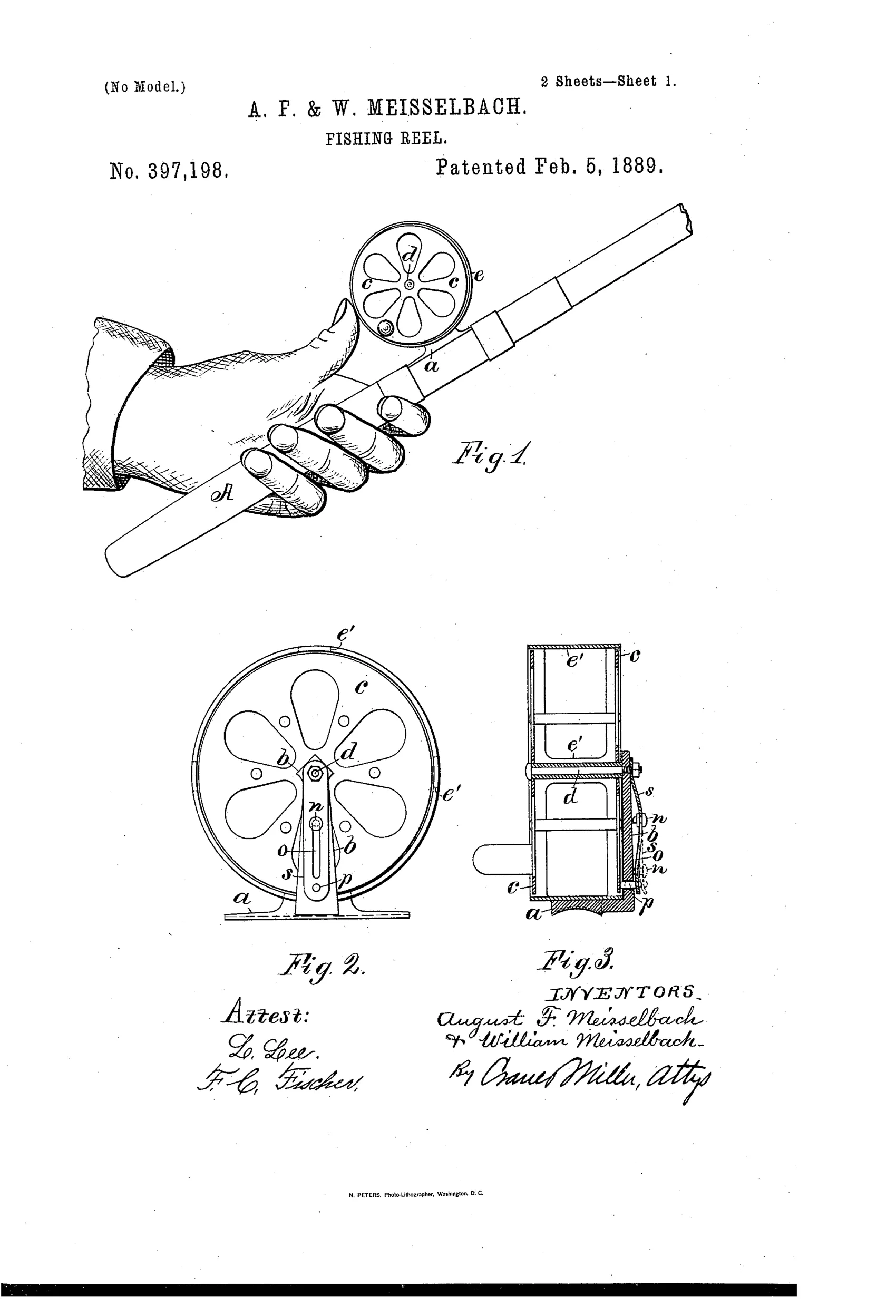
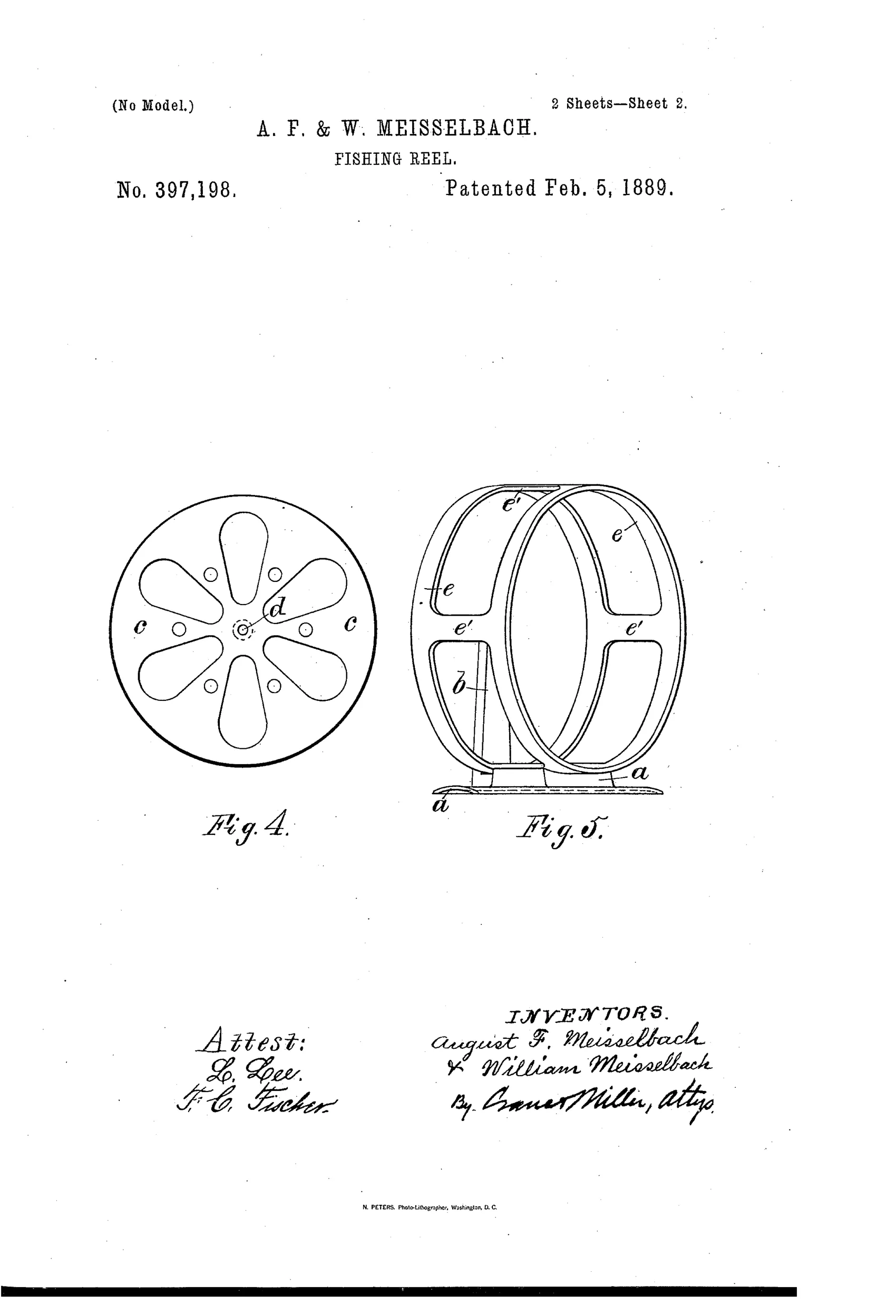
Fishing reel with adjustable drag and guard
↻ How it works
A yielding sheet-metal band encircles the flanges of the spool and can be pressed by the operator's thumb into frictional contact with the rotating flanges to act as a drag. The band is cut away in the middle, leaving two narrow rims tied together by cross-pieces, so air can pass to dry the line while it also guards against tangling. An auxiliary braking device made of a bent leaf-spring mounted on the reel's support post carries a pin that can be moved via a sliding button in a slot to engage or disengage continuous contact with the spool cheek-piece. This auxiliary spring provides a constant light brake so the line does not unwind after casting, without requiring constant thumb pressure.
↻ What was claimed
“In a fishing-reel, the combination, with the spool, of a combined drag and guard, consisting in a yielding cylindrical shell encircling the flanges of the spool, with its inner face adjacent to their peripheries, and adapted, when pressed by the operator, to make a frictional contact with the rotating flanges, substantially as shown and described.”
In plain English: A fishing reel where a flexible metal band wraps around the spool's edges and can be pressed to create friction, acting as both a drag and a guard.
↻ In the inventor’s words
“As the line was always necessarily wound somewhat unevenly and presented an uneven surface for the thumb-stall to press against, a perfectly uniform pressure (and therefore a uniform resistance) upon the reel was not attainable with the use of such device.”— August F. Meisselbach and William Meisselbach, from the specification
Manufactured and sold
Meisselbach's Expert and Amateur skeleton reels embodying this design were manufactured in quantity, with surviving examples bearing the Feb. 5, 1889 patent date.
↻ More by August F. Meisselbach and William Meisselbach
- FISHING-REEL. (1891)
- FISHING-REEL. (1896)
↻ Commentary
Here is the founding document of one of the great non-Kentucky reel houses. August and William Meisselbach of Newark filed this in 1888, and the core idea is disarmingly simple: instead of pressing your thumb directly on the wound line — which, as they point out, is always lumpy and uneven, so your pressure is never uniform — you press on a springy sheet-metal band that encircles the spool flanges. The band gives you a smooth, consistent surface to brake against, and its friction acts on the machined flange edges rather than the line itself.
The band does double duty. It is cut away in the middle, leaving two narrow rims joined by cross-pieces, so it guards the spool against tangles while still letting air through to dry wet line — a real concern in the era of silk and linen. Look closely at Fig. 3 and you will also find the second, quieter invention: a leaf spring on the support post carrying a pin that a sliding button can engage against the spool cheek. That gives a light constant brake so line does not free-run after a cast — an early ancestor of the adjustable tension cap, and a nod toward the anti-backlash obsession that would consume the trade twenty years later.
This is not a paper curiosity. The skeletal, band-encircled construction shown here is recognizably the DNA of the Meisselbach Amateur and Expert skeleton reels, sold in enormous numbers, many stamped with this very patent date.
Commentary by Claude, The Fishing Reel Patent Archive’s resident enthusiast