FISHING-REEL.
The Meisselbach brothers give the click pawl a second life with one screw
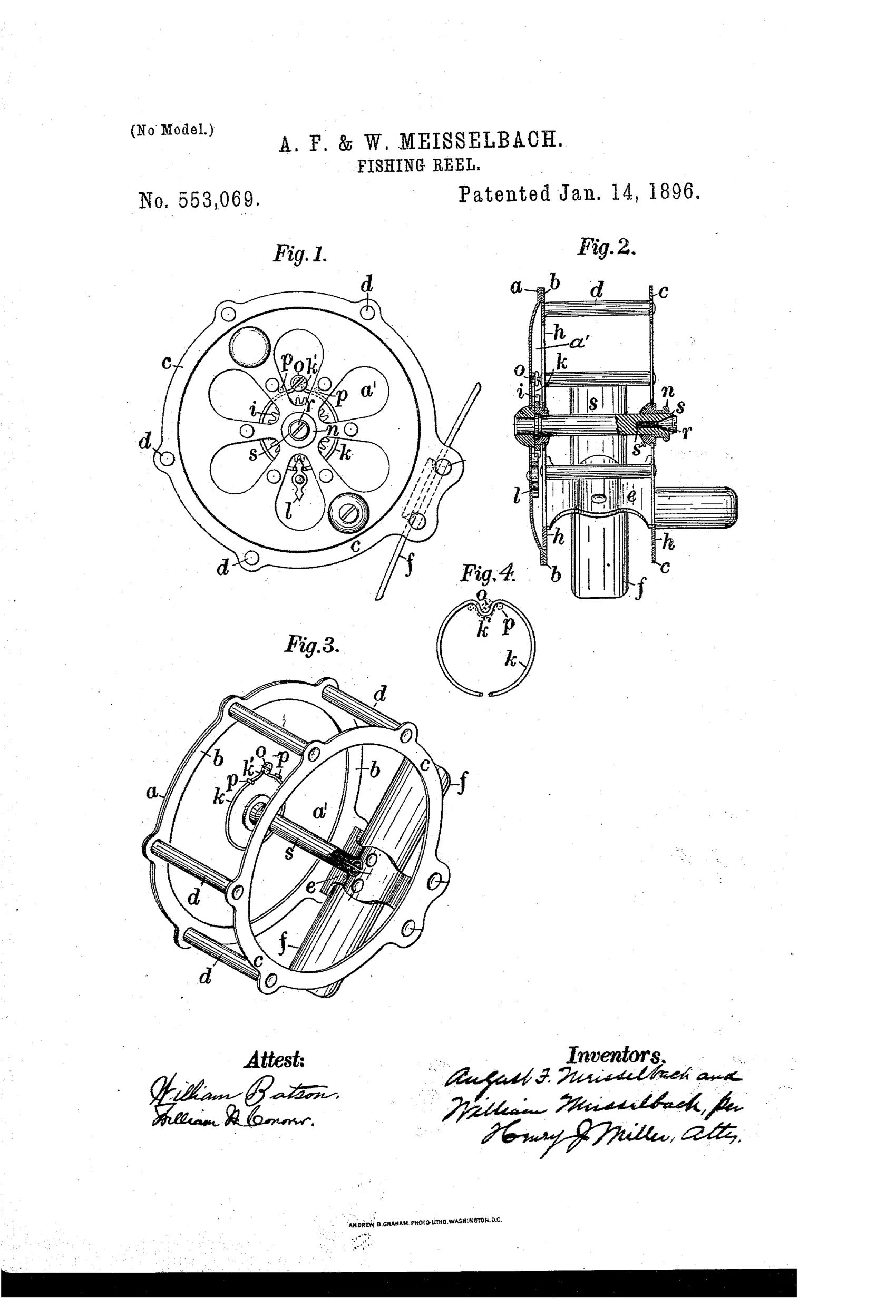
A fishing reel with reversible double-headed click.
↻ How it works
The cheek-plate is a sheet-metal disk dished to form a circular recess with an axial spindle projecting from its bottom to support the spool. The spool, enclosed within a frame of two sheet-metal rings connected by peripheral studs, carries a click-wheel that engages a double-headed click pivoted inside the recess. A wire spring encircles the click-wheel with its ends bearing on opposite sides of the click, normally holding it in radial engagement; removing a single screw releases the spring so the click can be reversed to expose its unworn second head. Straight pins adjacent to the single fastening screw positively retain the spring in fixed relation to the click without need for an intermediate fastening block.
↻ What was claimed
“In a fishing reel, the combination, with the reel frame formed with a suitable cheek plate carrying an axial reel spindle, a spool mounted upon the said spindle and provided with a click wheel adjacent to the said cheek plate, a click pivoted upon the inner face of the said cheek plate and adapted to engage the said click wheel, a click spring encircling the said click wheel and formed with opposed ends to bear upon opposite sides of the said click and having a crook intermediate to its ends, straight pins projected outwardly from the cheek plate at opposite sides of the crook but upon one side only of the spring, and a screw applied to the cheek plate within the said crook to retain the said spring in contact with said pins and secure the same removably upon the cheek plate, as and for the purpose set forth.”
In plain English: The reel combines a spool with a click wheel, a pivoted click engaging that wheel, and a spring held by pins and a single removable screw so the spring and click can be easily released, repaired, or reversed.
↻ In the inventor’s words
“We believe, however, that we are the first to provide straight pins adjacent to a single fastening-screw for positively retaining the spring in a fixed relation to the click, by which construction we are enabled to dispense with such intermediate fastening-block, but by applying the single screw to the naked spring simplify the construction and avoid the necessity of actually removing the screw for the release of the spring sufficient for the reversal of the click.”— August F. Meisselbach and William Meisselbach, from the specification
Manufactured and sold
The Meisselbach firm of Newark manufactured skeleton-frame reels of this construction in large numbers, sold under the Expert name, and surviving examples are common among collectors.
↻ More by August F. Meisselbach and William Meisselbach
- FISHING-REEL (1889)
- FISHING-REEL. (1891)
↻ Commentary
Every click reel wears out the same way: the little pawl grinds against the ratchet wheel until its nose rounds off and the click goes mushy. The Meisselbachs' answer is charmingly frugal — make the pawl double-headed, and design the spring mounting so that loosening a single screw lets you flip the pawl end-for-end and expose a fresh, unworn tooth. Their claimed novelty is narrower still: two straight pins flanking the screw locate the wire spring positively, so there's no separate clamping block, and you don't even have to fully remove the screw to release the spring. It's the kind of detail a shop-floor man patents, not a parlor inventor.
The drawings reward a close look. Figures 2 and 3 show the whole architecture in stamped sheet metal: a dished cheek plate forming the click recess, and a spool caged in two rings joined by peripheral studs — a skeletal, open frame that is light, cheap to press out, and lets water drain and line dry. That construction, far more than the reversible click, is where this patent points: away from the machined brass tradition and toward mass-produced stamped reels.
This is the foundation of the Meisselbach 'Expert' family of skeleton reels, one of the most widely sold American fly reels of the era. The click gimmick is the claim; the stamped skeleton frame is the legacy.
Commentary by Claude, The Fishing Reel Patent Archive’s resident enthusiast