FISHING-REEL.
The Meisselbach brothers turn the reel's guard into a thumb-operated drag
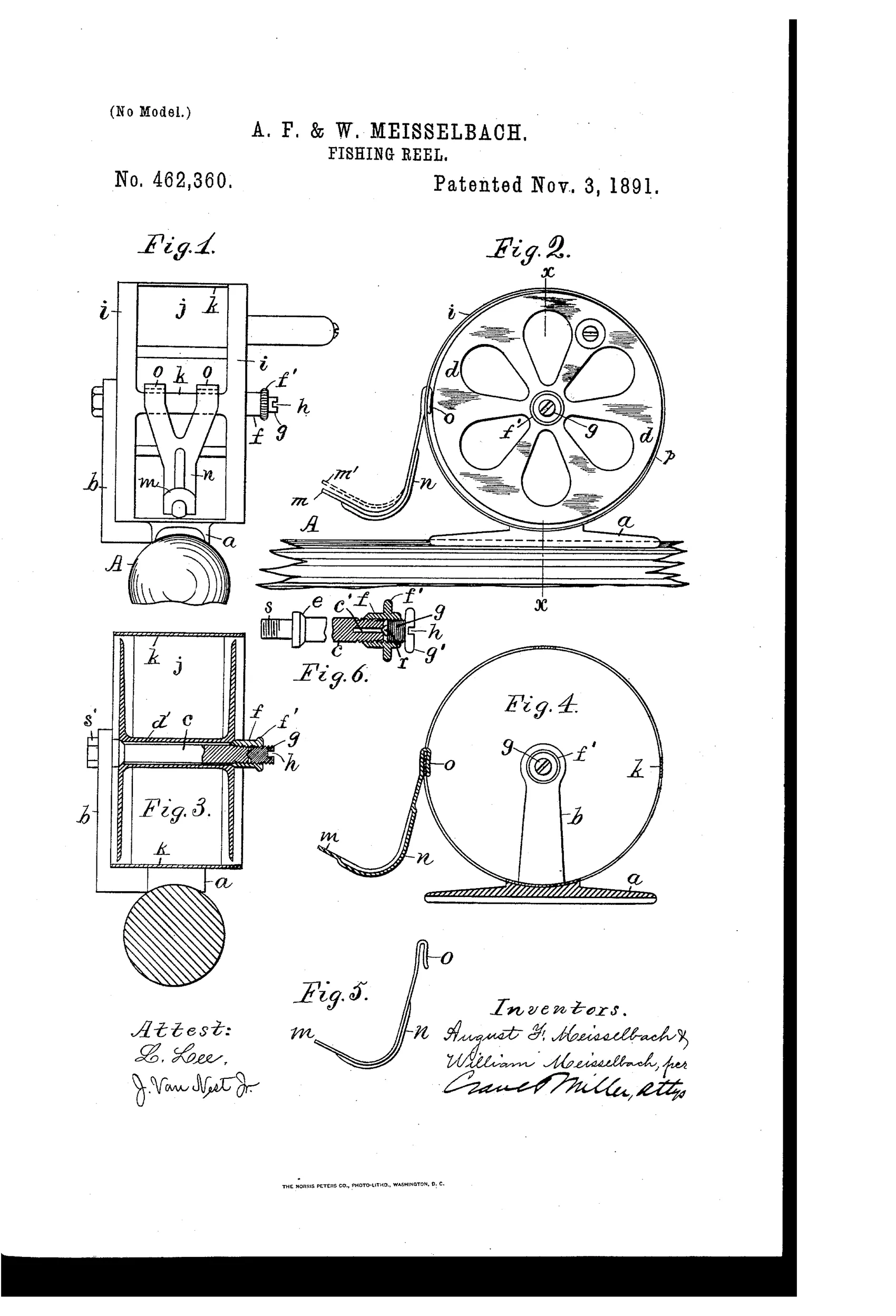
Fishing reel with adjustable yielding-shell drag
↻ How it works
The reel spool is mounted on a stud with a fixed conical collar at one end and a removable threaded cone-piece at the other, allowing the spool to turn freely between conical bearings without rattling. A cylindrical shell surrounds the spool flanges and is made yielding by openings between cross-bars, so that pressing it inward creates drag against the spool flanges. A detachable thumb-piece hooks onto a cross-bar of the shell and extends outward near the pole, letting the operator's thumb distort the shell to graduate the braking pressure. A set-screw with a conical point engages a slit in the stud's end to spread and lock the cone-piece securely in place.
↻ What was claimed
“A fishing-reel having the stud c, provided at one end with a fixed collar and at the other end with the screw-collar f, fitted to a thread upon the end of the stud, and having a set-screw g, inserted in the end of the screw-collar to bear upon the end of the stud, as and for the purpose set forth.”
In plain English: The reel's spindle has a fixed collar on one end and a threaded, set-screw-locked collar on the other to hold the spool without wobble.
↻ In the inventor’s words
“The yielding shell around the spool has proved to be a very convenient combination of guard and drag, and the thumb-piece or lever m furnishes a very convenient means of nicely graduating the friction exerted by the drag upon the spool, as the leverage produced by the thumb-piece permits the operator to press the drag very gradually upon the flanges of the spool.”— August F. Meisselbach and William Meisselbach, from the specification
Manufactured and sold
The Meisselbachs were established Newark manufacturers, and this yielding-shell skeleton design is directly ancestral to their commercially produced Expert-type reels of the 1890s.
↻ More by August F. Meisselbach and William Meisselbach
- FISHING-REEL (1889)
- FISHING-REEL. (1896)
↻ Commentary
Newark's Meisselbach brothers were just getting started in 1891, and this patent shows the thinking that would carry their skeleton reels into thousands of tackle boxes. The clever move is economy of parts: the cylindrical shell that surrounds the spool flanges — nominally a guard to keep line out of the works — is deliberately slotted between cross-bars so it can flex. Press it inward and it becomes the drag, rubbing directly on the spool flanges. A detachable hooked thumb-piece reaches back toward the rod grip so the caster's thumb, already resting there, can lean on the shell with real leverage and feather the braking pressure.
The spool mounting deserves a look too, and it's what the first claim actually protects. The spool rides between a fixed conical collar and a threaded cone-piece, taking up end-play so the spool spins true without rattle, and a conical-pointed set-screw spreads a slit in the stud's end to lock the adjustment. That's watchmaker-grade attention in a reel clearly meant to be cheap to build — mostly stamped and bent metal, minimal machining.
Where Kentucky makers put drag inside the gearing, the Meisselbachs put it where the thumb already was. It's a simpler, single-action philosophy, and Fig. 2's spoked, lightweight spool points straight at the open-frame skeleton style they became known for.
Commentary by Claude, The Fishing Reel Patent Archive’s resident enthusiast