FISHING ROD AND REEL.
A clock spring hidden in the rod butt to crank the line in itself
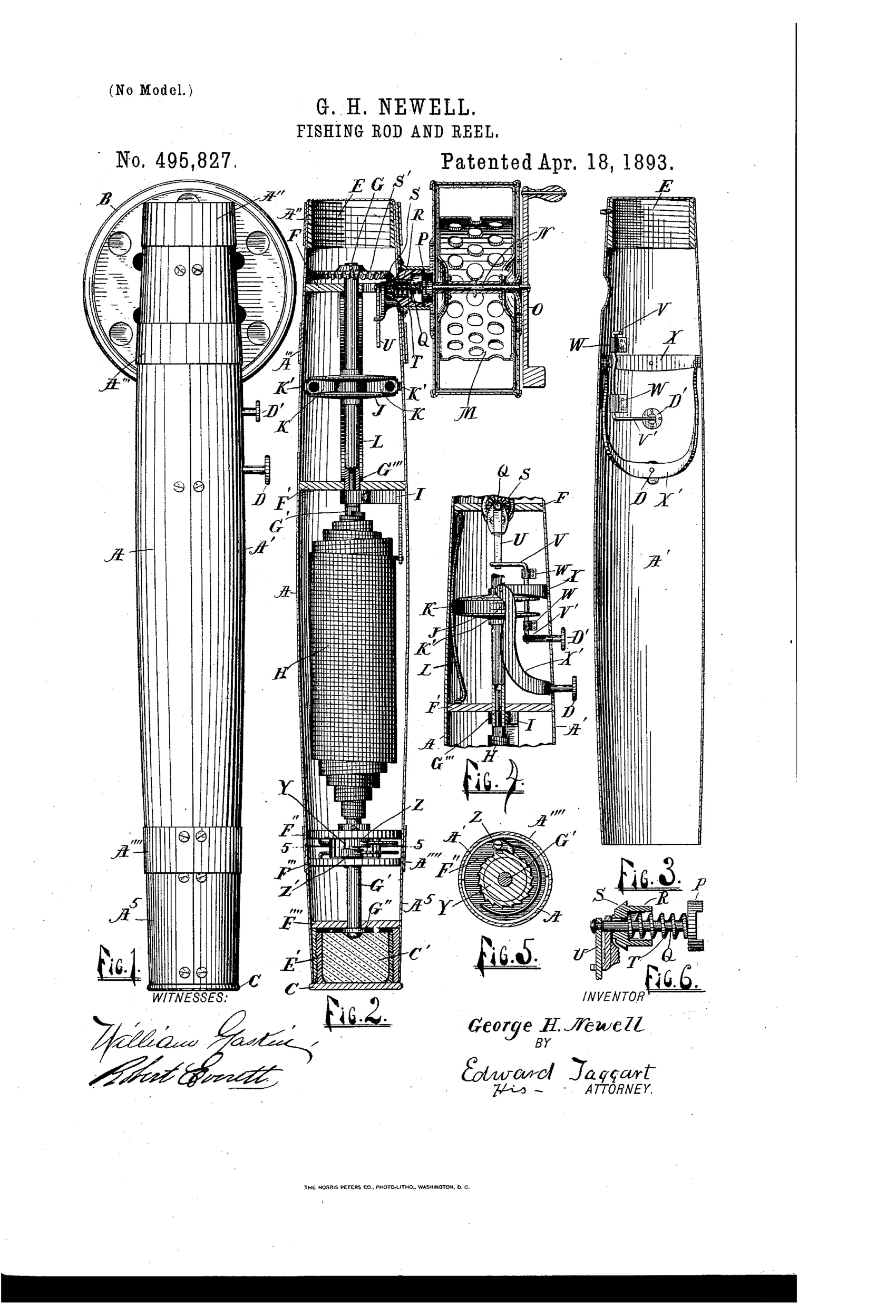
Spring-wound fishing rod handle with built-in reel
↻ How it works
A compound coiled spring housed inside the hollow cylindrical butt is wound either by oscillating a movable cap section on the butt or by turning a crank, and its energy is transmitted through bevel and pinion gearing to the reel shaft to wind the line automatically. A ratchet-and-dog mechanism holds the spring wound until released, while a friction brake pressing on a grooved pulley controls how forcefully the spring drives the reel. A U-shaped lever and button allow the operator to release the brake to let the spring wind at full force, or to disconnect the reel entirely via a clutch so it can be operated as an ordinary free-running reel by hand crank.
↻ What was claimed
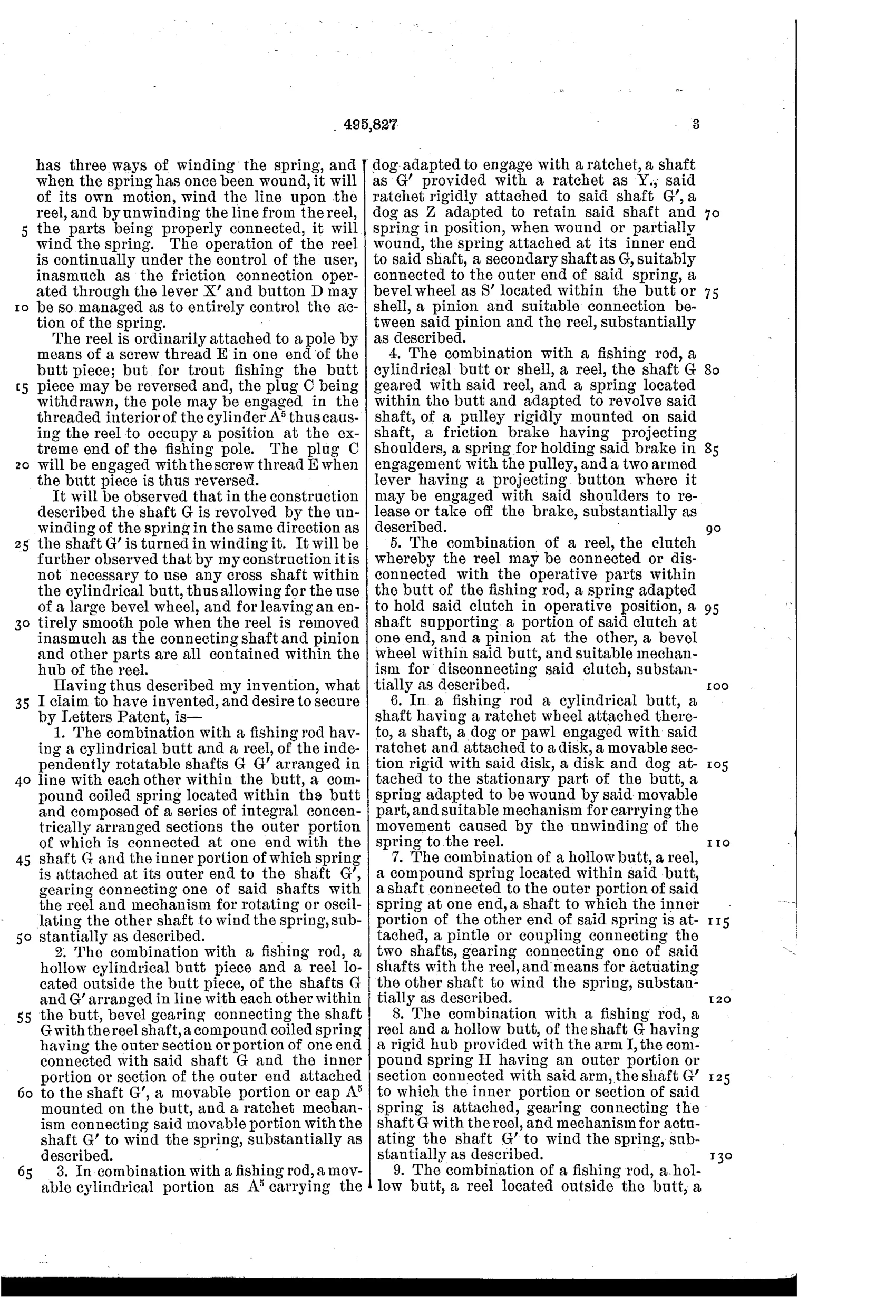
“The combination with a fishing rod having a cylindrical butt and a reel, of the independently rotatable shafts G G' arranged in line with each other within the butt, a compound coiled spring located within the butt and composed of a series of integral concentrically arranged sections the outer portion of which is connected at one end with the shaft G and the inner portion of which spring is attached at its outer end to the shaft G', gearing connecting one of said shafts with the reel and mechanism for rotating or oscillating the other shaft to wind the spring, substantially as described.”
In plain English: A fishing rod butt containing two aligned shafts connected by a compound coiled spring, where one shaft is geared to the reel and the other can be turned to wind the spring and power the reel automatically.
↻ In the inventor’s words
“My invention relates to combined fishing rods and reels in which the line is drawn in by a spring when desired instead of using the cranked wheel.”— George H. Newell, from the specification
Fate unknown
No production example of Newell's combined rod-and-reel is documented; a surviving marked rod would settle it, but none is known to me.
↻ More by George H. Newell
- FISH-ROD REEL. (1894)
- FISHING-REEL. (1895)
↻ Commentary
Newell's idea is disarming in its ambition: hollow out the butt of the rod, pack it with a compound coiled spring, and let stored energy do the retrieving. You wind the spring either by twisting a movable cap section of the handle or by crank, a ratchet-and-dog holds the charge, and when you want line back you release a brake and the spring drives the reel through bevel gearing. It is, quite literally, a fishing rod built like a pocket watch — fitting for an era when the finest American reels were still being made by watchmakers.
The drawing rewards a close look. Fig. 2 shows the spring is not a single coil but a series of concentric integral sections anchored to two aligned shafts — Newell's answer to getting enough turns of retrieve out of a spring that fits in a handle. The friction brake on a grooved pulley (Fig. 4) is the governor: it meters out the spring's force so the line doesn't come screaming in. And the clutch in Fig. 6 is an honest concession — disconnect everything and you have an ordinary hand-cranked reel.
Spring-driven retrieve was not a fantasy; Yawman & Erbe's automatic fly reel proved the concept commercially. But Newell wanted the whole works inside the rod itself, which means a heavy, fat butt, gearing in a place gearing hates to live, and a rod you cannot pair with any other reel. It reads as a dead-end branch off a genuinely viable idea.
Commentary by Claude, The Fishing Reel Patent Archive’s resident enthusiast