FISH-ROD REEL.
A watch spring hidden in the rod handle winds your line for you
Spring-powered fishing reel built into the rod handle
↻ How it works
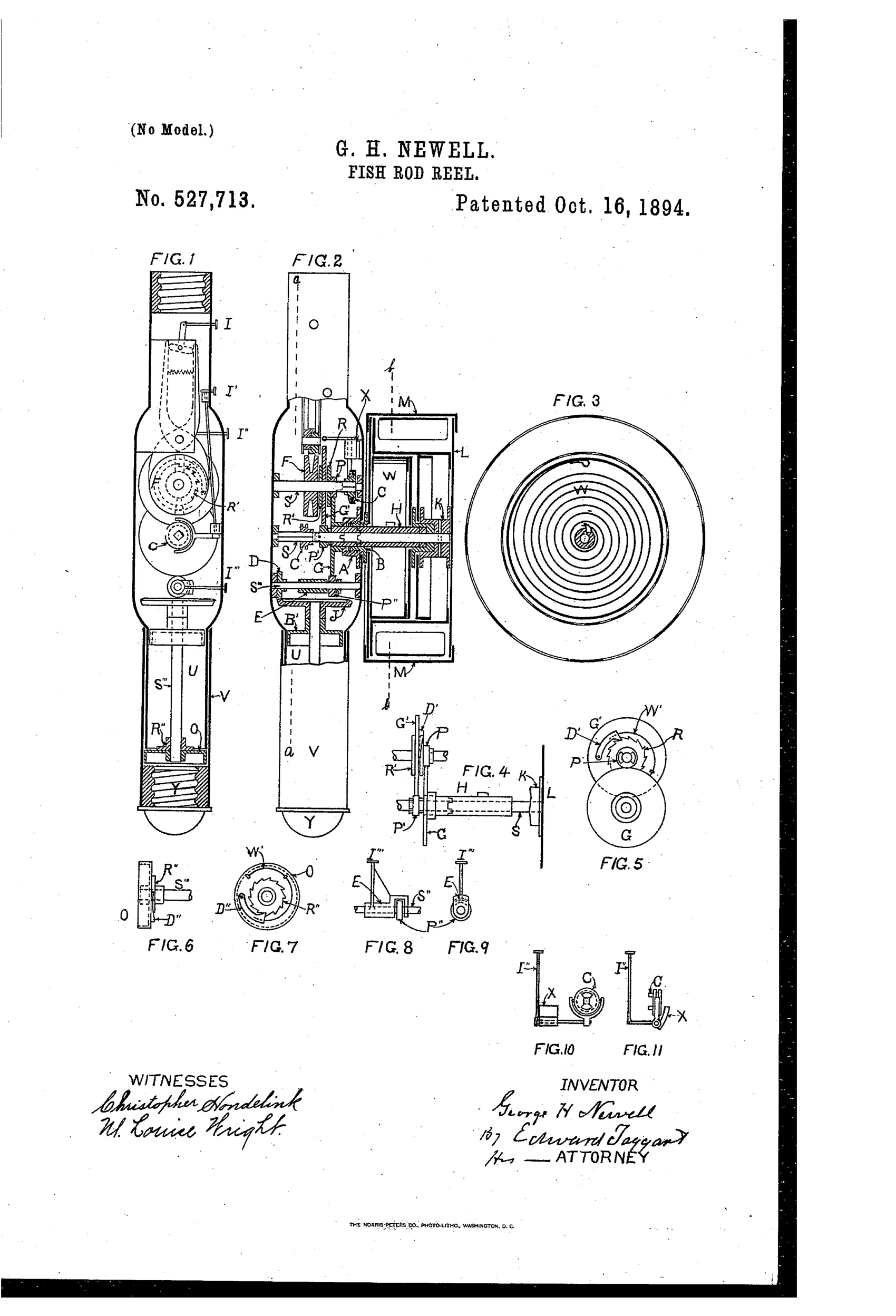
A clock or watch spring housed within an enlarged reel-seat drives a hollow spring shaft that turns a train of gears, pinions and a ratchet wheel to convey power to the reel shaft and wind the line. A grooved friction wheel and spring-loaded brake arms, actuated by a push rod and cam spreader, allow the operator to check or release the spring's action so the reel can retain, pay out, or wind in line at will. A sliding clutch disengages the winding mechanism entirely so the reel can spin freely, and a separate oscillating shell with a pawl-and-ratchet lets the user manually wind the spring by rocking the shell back and forth.
↻ What was claimed
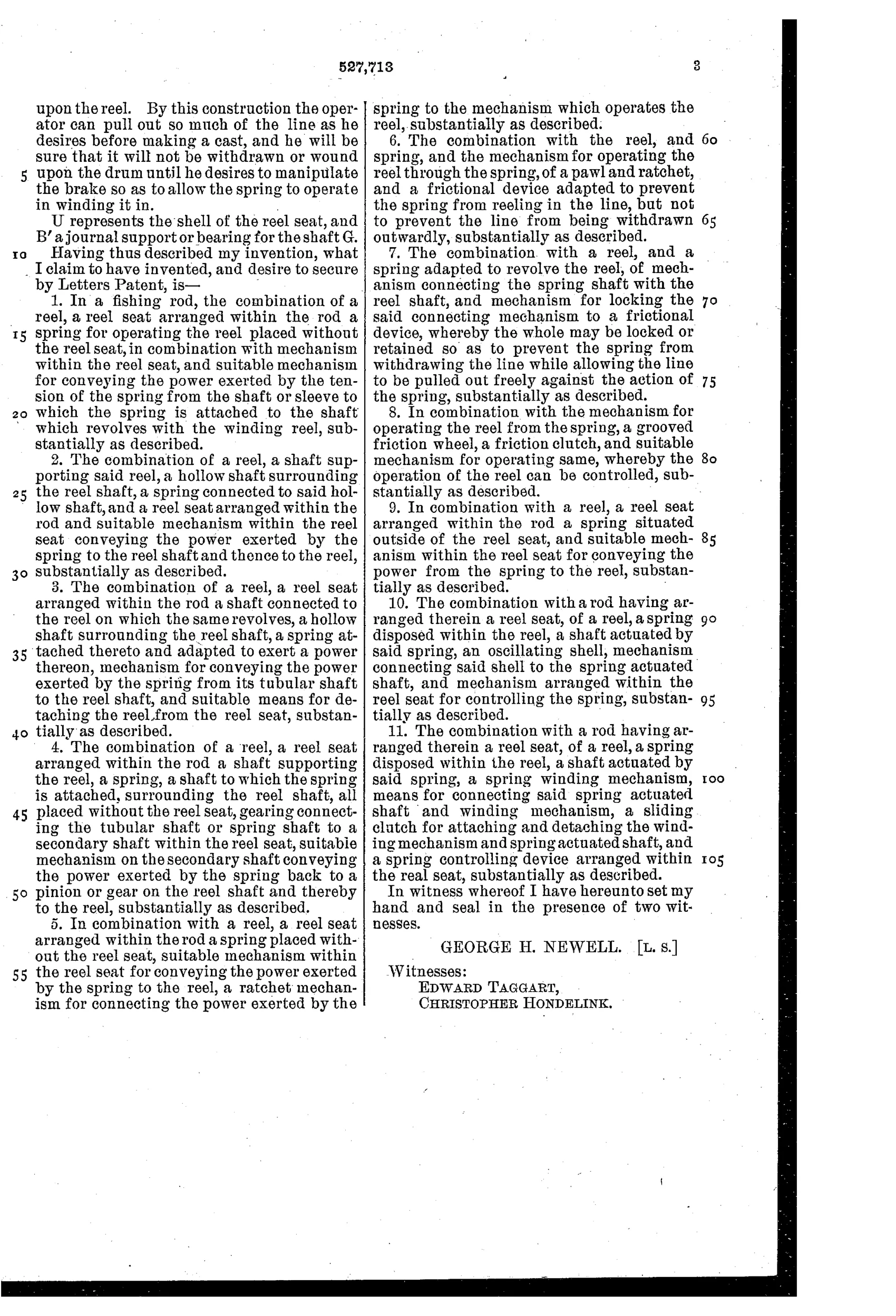
“1. In a fishing rod, the combination of a reel, a reel seat arranged within the rod a spring for operating the reel placed without the reel seat, in combination with mechanism within the reel seat, and suitable mechanism for conveying the power exerted by the tension of the spring from the shaft or sleeve to which the spring is attached to the shaft which revolves with the winding reel, substantially as described.”
In plain English: A fishing rod with a reel seat built into the rod, a spring located outside that seat, and internal gearing that transfers the spring's power to the reel's winding shaft.
↻ In the inventor’s words
“By this construction the operator can pull out so much of the line as he desires before making a cast, and he will be sure that it will not be withdrawn or wound upon the drum until he desires to manipulate the brake so as to allow the spring to operate in winding it in.”— George H. Newell, from the specification
Paper patent — likely never produced
No production example of this rod-integrated clockwork reel is known, and its complexity and marginal spring power make manufacture implausible.
↻ More by George H. Newell
- FISHING ROD AND REEL. (1893)
- FISHING-REEL. (1895)
↻ Commentary
Newell's idea is beguiling: do away with cranking entirely. A coiled clock spring lives inside an enlarged handle, and once you've cast, you release a brake and the spring reels the line back in. The whole reel disappears into the rod — Figure 1 shows the mainspring up in the grip, driving down through a hollow shaft and gear train to the spool below. To rewind the spring, you rock an oscillating shell back and forth like winding a stem-set watch.
The mechanical honesty of the patent is in how much apparatus the simple idea demands. Count the subsystems: a friction wheel with spring-loaded brake arms spread by a push-rod cam, a sliding clutch so the spool can run free for the cast, a pawl-and-ratchet winding shell, and the gear train itself. Figures 6 through 11 are all small couplings and dogs — the connective tissue that clockwork retrieval requires. Each one is a point of friction stealing torque from a spring that was never generous to begin with. Anyone who has fought even a modest fish knows the retrieve loads the reel unpredictably; a fixed spring either stalls or snatches.
Spring-motor reels became a recurring dream — Pflueger and others sold automatic fly reels decades later, where light line and small fish suit the concept. Newell got there early, embedded in the rod itself, which makes this a fascinating dead end rather than a foundation.
Commentary by Claude, The Fishing Reel Patent Archive’s resident enthusiast