FISHING-REEL
Herman Martin adds a line-out gauge to his spring-driven automatic reel
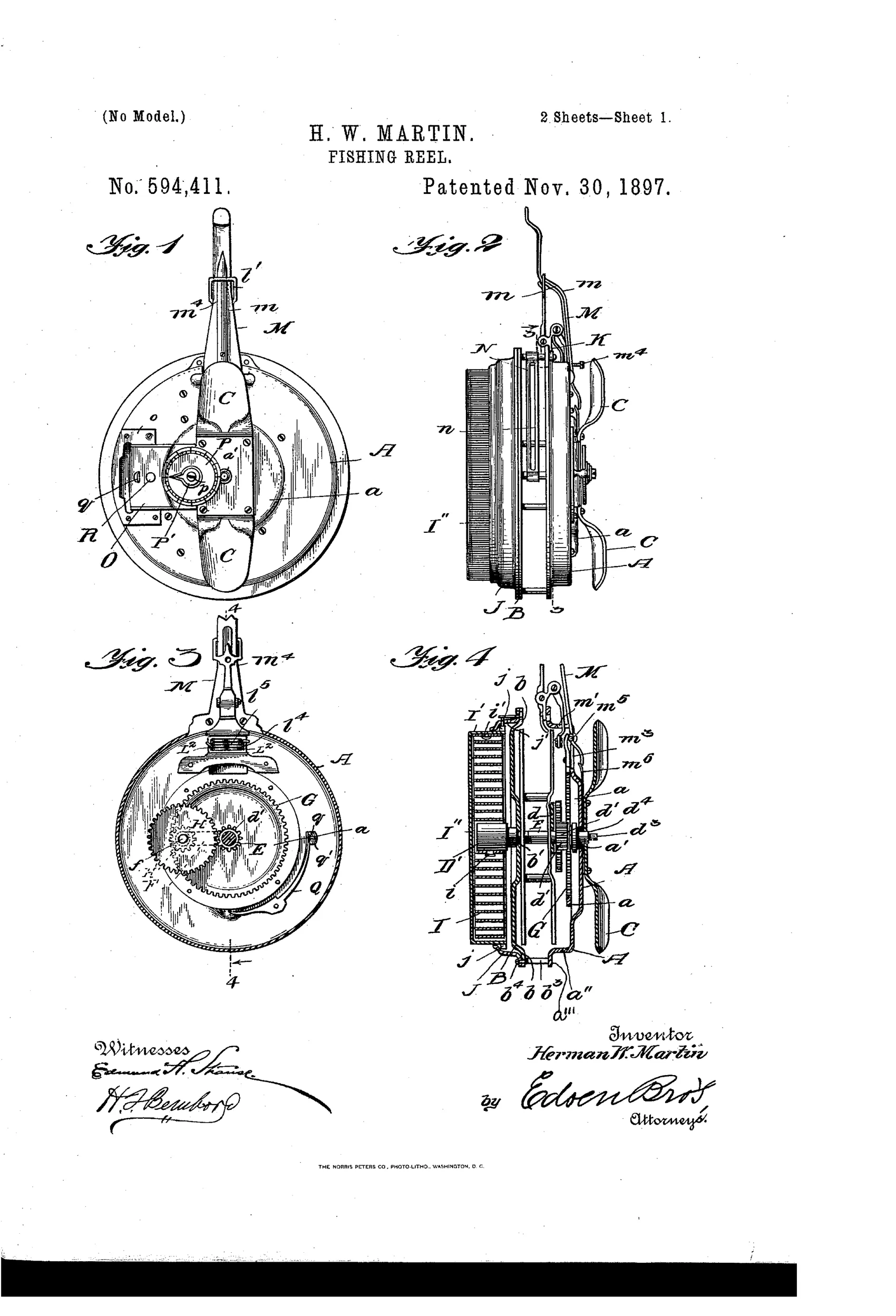
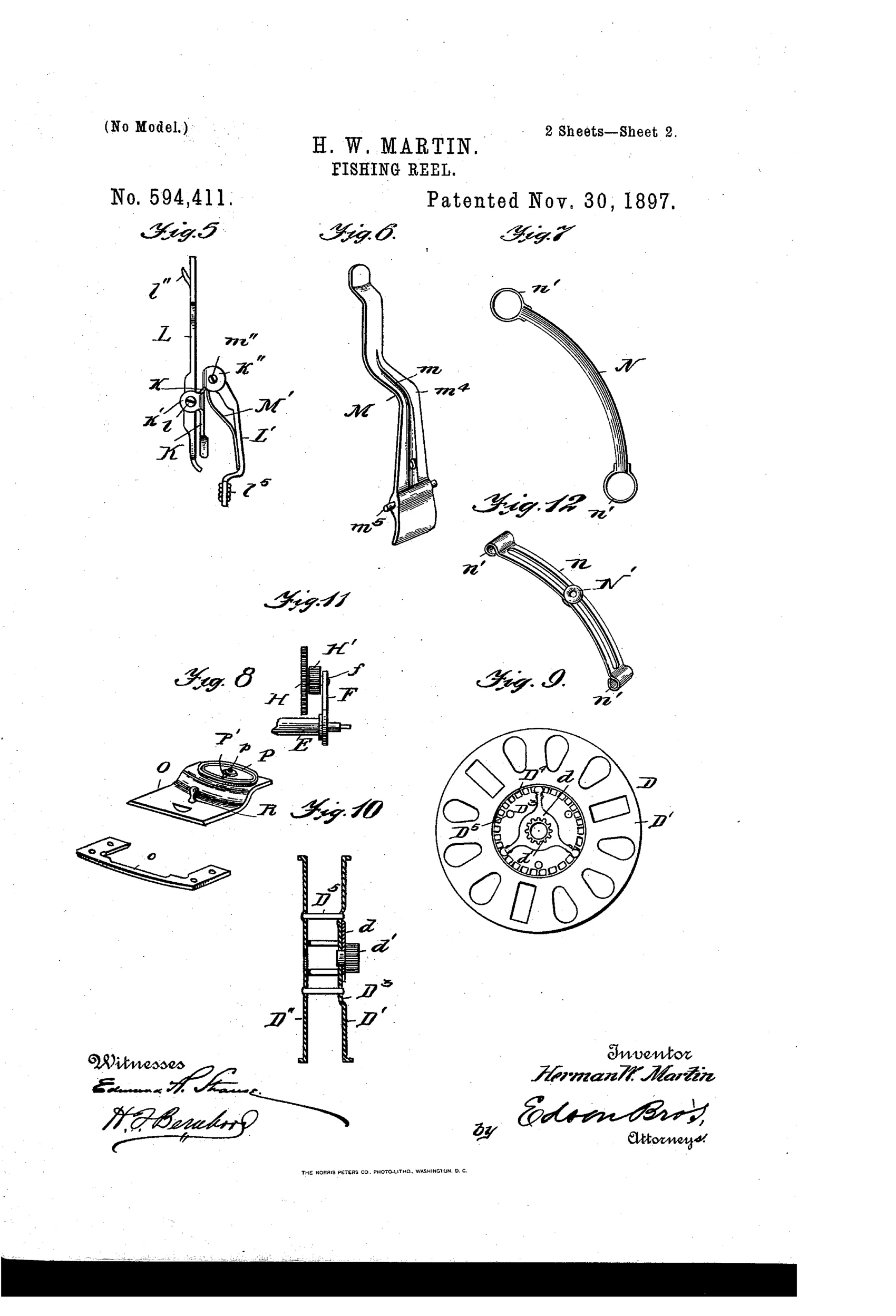
Spring-driven multiplying fishing reel with line indicator
↻ How it works
A revolving line-spool is mounted loosely on a shaft driven by a coiled mainspring housed in a drum, with a crank-arm, compound gear and fixed internal rack forming a multiplying gear train between the arbor and the spool. A dual-jaw brake, controlled by a single spring-loaded lever, clamps opposite faces of the spool head to stop or release rotation. A slidable, spring-pressed carrier-plate on the outside head carries a rotary indicator disk that frictionally engages the protruding end of the revolving shaft to show how much line has been paid out, and a loosely supported segmental line-guide floats between the reel heads to wind the line evenly onto the spool.
↻ What was claimed
“In a fishing-reel, the combination with a reel-housing, and a mainspring, of a revolving line-spool shaft or arbor journaled in said housing and operatively connected with said mainspring, a line-spool mounted loosely on said revolving arbor or shaft, multiplying-gearing and clutch mechanism intermediate between the revolving shaft or arbor and the line-spool loosely mounted thereon and a line-indicator mechanism arranged laterally on the reel-housing and in operative relation to said revolving line-spool to be driven thereby, substantially as and for the purposes described.”
In plain English: The reel combines a spring-driven shaft, a line-spool loosely mounted on that shaft, gearing and a clutch connecting the two, and a line-length indicator mounted on the reel housing that is driven by the rotating shaft.
↻ In the inventor’s words
“It frequently occurs that the angler desires to know the length of the line that is paid out from the reel; but so far as I aware fishing-reels have not heretofore been equipped with means to indicate the length of line that has been uncoiled from the reel, so that the angler has been compelled to guess merely as to the amount of line he has in service.”— Herman W. Martin, from the specification
Manufactured and sold
Martin's automatic reels were manufactured for decades by the Martin Automatic Fish Reel Company, though whether the line-indicator feature itself reached production is less clear.
↻ Patented the same day
- FISHING-REEL. — Herman W. Martin
↻ More by Herman W. Martin
- FISHING-REEL. (1892)
- FISHING-REEL. (1895)
- FISHING-REEL. (1897)
↻ Commentary
Herman W. Martin of Ilion, New York is the man behind the American automatic reel — the spring-motor design that rewinds line at the touch of a lever — and this 1897 patent is him refining the idea and bolting on something nobody else had tried: an odometer for your line. His own complaint in the specification is disarmingly practical: the angler 'has been compelled to guess merely as to the amount of line he has in service.' His fix is a small rotary indicator disk on a spring-pressed carrier plate, friction-driven off the protruding end of the spool shaft, so it turns with the spool and reads out how much line has been paid off.
The rest of the patent shows how much machinery an automatic reel actually hides. Figs. 3 and 4 reveal a coiled mainspring in a drum, a compound gear and internal rack multiplying the arbor's motion, and — the detail worth lingering on — a dual-jaw brake that clamps opposite faces of the spool head from one lever, a genuinely sound way to stop a spring-loaded spool without twisting it. There is even a floating segmental line-guide to lay line evenly, a modest level-wind years before the casting-reel crowd made that their obsession.
The indicator itself was a dead end — anglers never demanded one — but the reel around it is the real Martin lineage, and that lineage was anything but paper.
Commentary by Claude, The Fishing Reel Patent Archive’s resident enthusiast